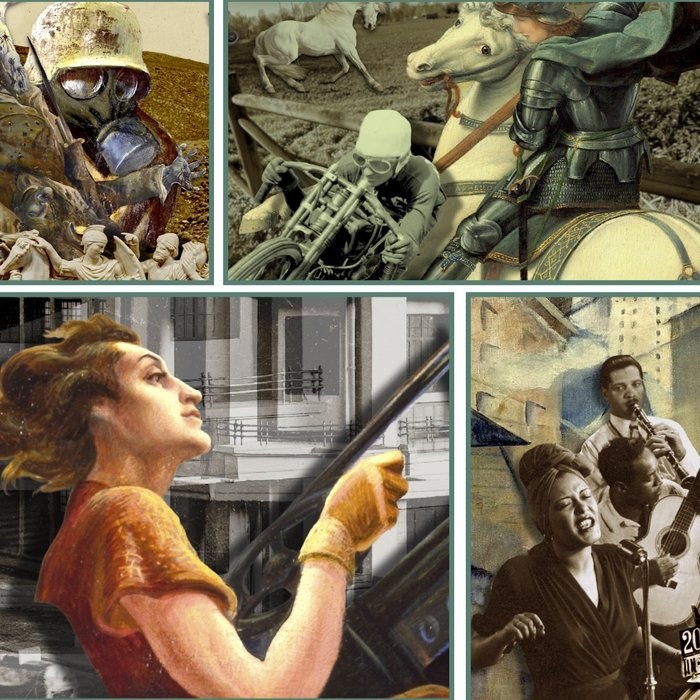
FotoGrafia
Twenty Collages Where Painting and Photography Trade Places
20 collages in this catalogcollage in questo catalogo
Painting lends photography its compositional soul — balance, and the disciplined use of light and shadow. Photography, in turn, gives painting back a new kind of freedom: a blurred background borrowed from a Leonardo-esque landscape, a face lit like a Caravaggio portrait. Released from the burden of pure imitation, painting is free to explore abstraction; in the digital age the boundary blurs further still, as photo editing turns a photograph into a virtual painting and digital brushes borrow filters built to mimic the camera. Each collage below plays with that same exchange, layering figures, artists and centuries onto a single frame. Each piece is available as a high-resolution, 300dpi, royalty-free download for €39, ready for print at any size.
Download Catalog PDF →Scarica il Catalogo PDF → View All Collections →Vedi Tutte le Collezioni →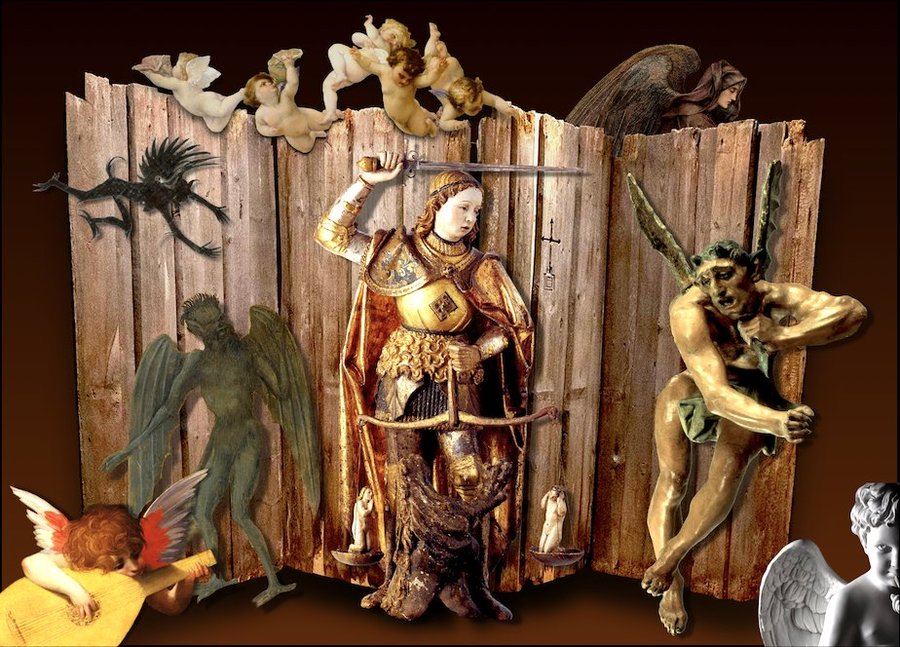
Angels & Demons
Two sacred worlds meet across five centuries. Duccio di Buoninsegna’s 1310 contribution comes from the years he spent on the Maestà, the altarpiece that made Siena, not Florence, the other capital of early Italian painting. Rosso Fiorentino, working two centuries later, brought Florentine Mannerism’s nervous, elongated grace to religious subjects the earlier Sienese master would barely recognize. Ignaz Günther’s 1755 sculpture belongs to the last great flowering of German Rococo church art, when Bavarian workshops carved saints and archangels with a theatrical lightness that bordered on the secular.
A 1515 St Michael the Archangel adds a third register again — armor and wings rendered with Northern Renaissance precision. Four different centuries of imagining what stands between the human and the divine.
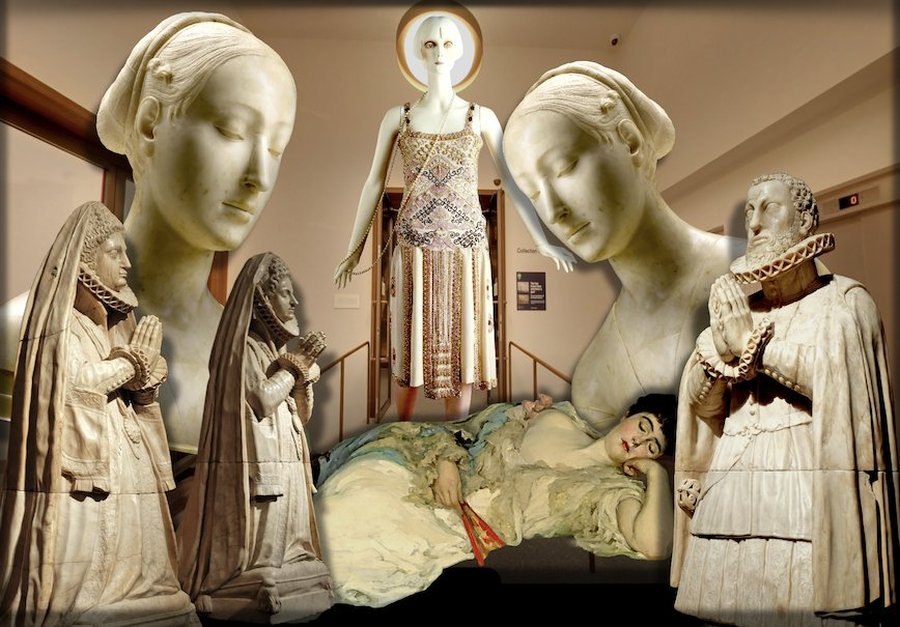
Beatification Imminent
Francesco Laurana’s 1470 contribution comes from the Renaissance sculptor’s mature Neapolitan and Provençal period, when his serene, simplified portrait busts of noblewomen quietly invented a new kind of idealized likeness. Rupert Bunny, the Australian painter who spent most of his career in Paris, offers a 1904 work from his Symbolist-inflected years there, steeped in the same fin-de-siècle taste for beauty edged with mystery.
Jean Patou’s 1924 contribution is a different kind of portraiture altogether — the French couturier’s own designs, from the decade he spent dressing the era’s most photographed women. Placed together, sculpture, painting and fashion all reach for the same kind of consecration: a subject elevated just out of reach.
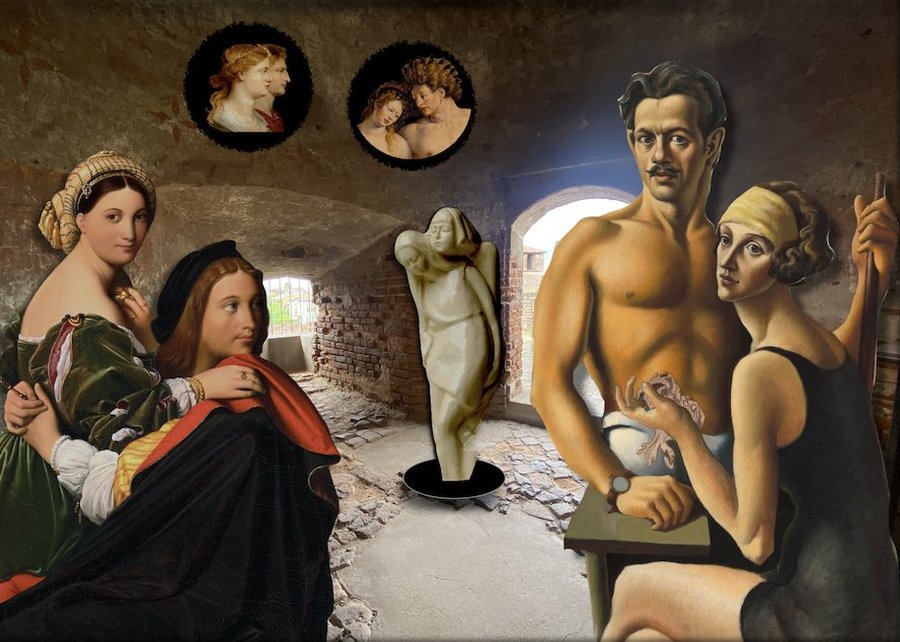
Clandestine Couples
A collage of secrets across three centuries. Rubens’ 1614 work comes from the years just after his return to Antwerp from Italy, already the most sought-after painter in the Spanish Netherlands. Jan Gossaert’s 1516 contribution belongs to the generation before him, one of the first Netherlandish painters to bring Italian Renaissance ideas north. Ingres, two centuries later in 1814, was in Rome himself, developing the cool, linear precision that would define his long career.
Barbara Hepworth’s 1922 piece is a rare early work — she was barely out of her teens, still years from the abstract carving that made her name. Thomas Hart Benton’s 1924 contribution catches the American Regionalist before his mural fame, still finding his subject. Five artists, none of them yet fully who they would become.
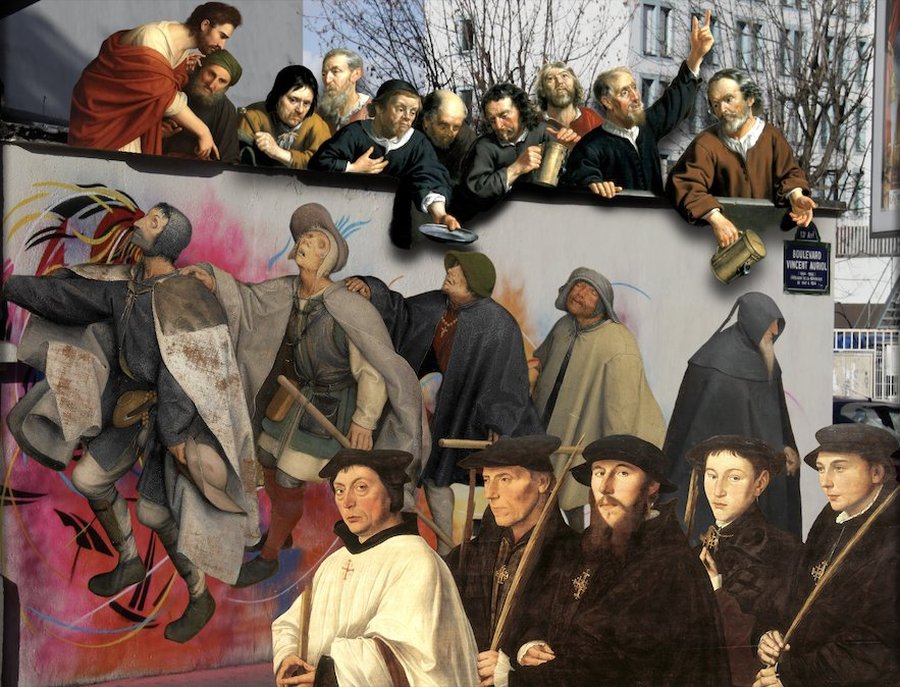
Class Conflicts
Pieter Bruegel the Elder’s 1568 work comes from the final year of his life, the period of his darkest, most socially pointed peasant scenes. Jan van Scorel’s 1541 contribution belongs to his late Utrecht period, when the well-traveled Dutch painter — one of the first to bring the Italian High Renaissance home with him — had settled into a prosperous, established position of his own.
Jan van Bijlert’s 1630 piece, painted a generation later, carries the candlelit drama the Utrecht Caravaggisti learned from Rome. Gaspare Landi’s 1812 contribution, arriving two centuries on, applies a Neoclassical restraint to the same old tensions between rank and labor — proof the subject never really went out of fashion.
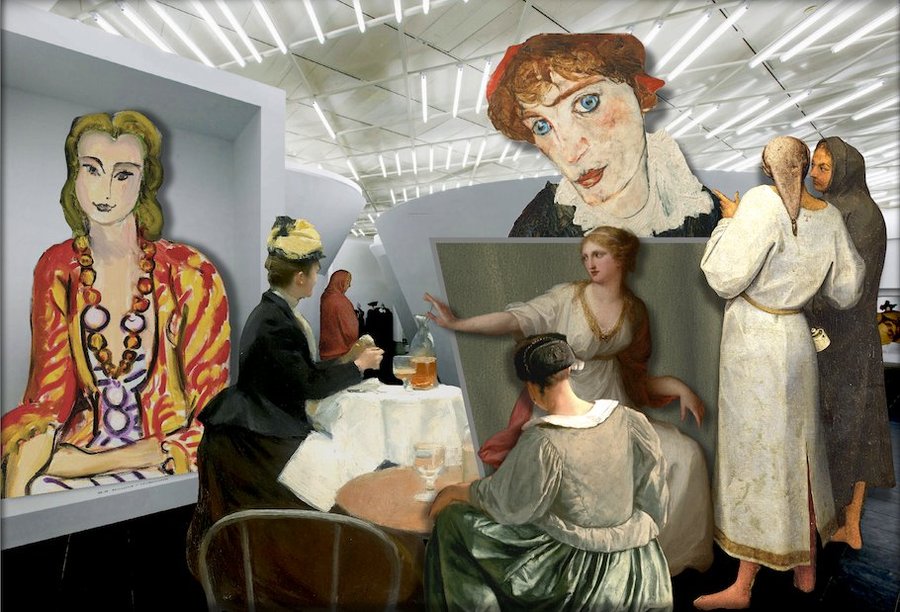
Conciliabulum
A gathering — the word means a private, half-secret meeting — assembled from seven very different rooms. Giotto’s 1310 contribution comes from the years around his Scrovegni Chapel frescoes, the work that effectively invented dramatic narrative painting. Jan Steen’s 1663 and Bruegel’s 1566 pieces bring the noisy, crowded interiors of Netherlandish genre painting, three generations apart. Angelica Kauffman’s 1783 work belongs to her celebrated London and Rome period, one of the few women admitted as a founding member of the Royal Academy.
Ramon Casas’ 1890 contribution catches the Catalan painter in his early Paris years, absorbing everything the city offered. Egon Schiele’s 1912 piece returns to the charged year just after his brief imprisonment, when his figures grew starkest. Matisse’s 1942 work, the latest here by three decades, comes from his own late reckoning, painting through wartime illness. Seven conversations, none of them entirely comfortable.
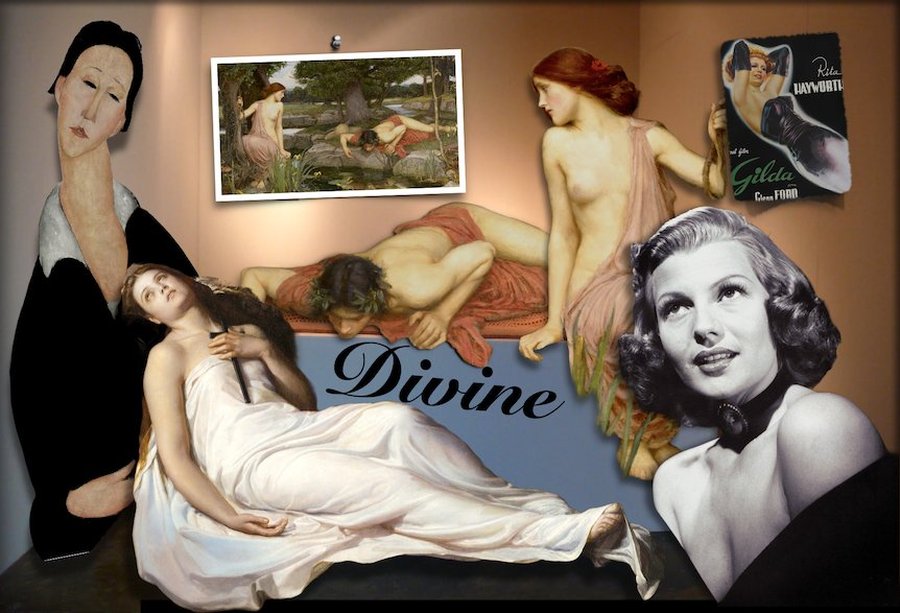
Divine Disorder
Amedeo Modigliani’s 1919 contribution comes from the final year of his life, the period of his most confident, elongated portraits, painted in Paris as tuberculosis quietly closed in. John William Waterhouse’s 1903 work belongs to his mature mythological period, when Pre-Raphaelite subject matter met a looser, more atmospheric late-Victorian technique.
John Florea’s 1947 photograph comes from the American photojournalist’s postwar Hollywood years, after his wartime work for LIFE and the Army Signal Corps — a very different kind of disorder, glamour’s own. Together with Luis Monroy’s 1893 contribution, the four pieces suggest that divinity, however each century pictured it, was never quite as orderly as its iconography claimed.
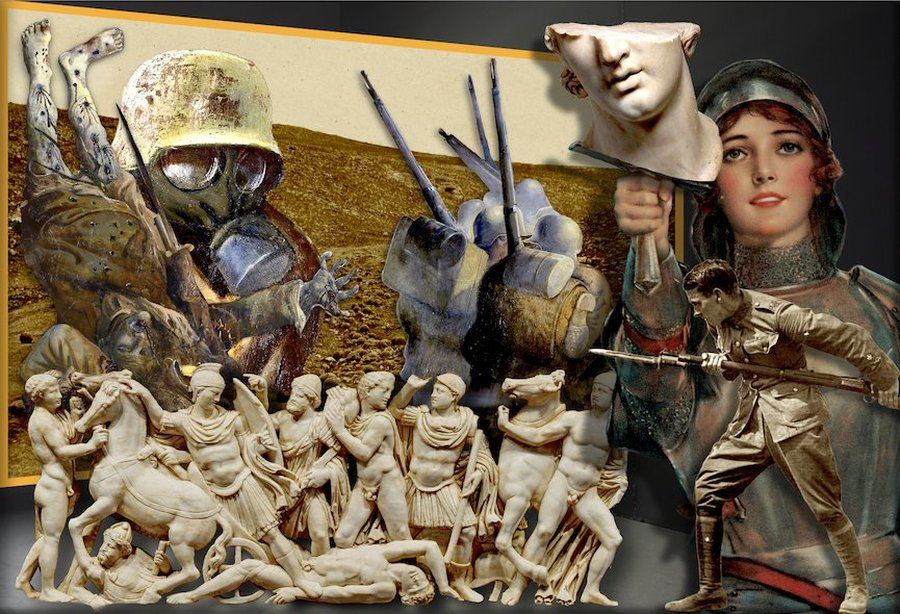
Forgotten Victims
Three works by Otto Dix anchor this collage — 1929 and twice in 1932, the years just before the Nazi regime would brand him a producer of ‘degenerate art’ and dismiss him from his teaching post. This was Dix at his most unsparing: a painter of the Weimar Republic’s war-wounded, its cabarets, and its quietly ignored casualties, part of the Neue Sachlichkeit movement’s refusal to look away.
A 1918 contribution attributed to C. Haskell, from the closing year of the First World War itself, sits alongside Dix’s retrospective reckoning with that same conflict’s aftermath — one artist working in the moment, the other returning to it more than a decade later, neither willing to let the victims stay forgotten.
Illusory Progress
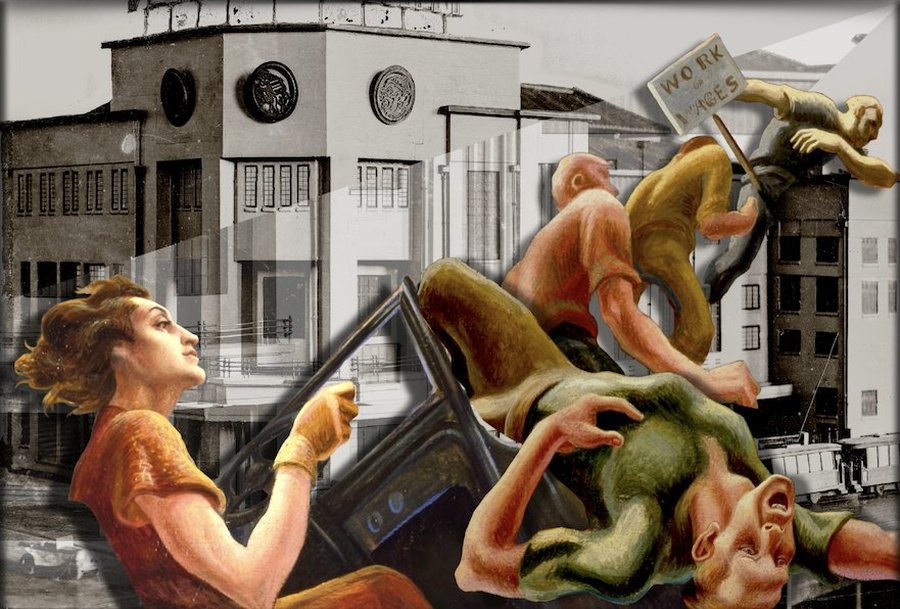
A single artist carries this collage: Thomas Hart Benton, the American Regionalist, in 1932 — the year before his Indiana murals and just after America Today, the cycle that made his sweeping, muscular vision of industry and labor famous nationwide. Benton painted progress as motion itself: pistons, crowds, machinery, all rendered with the same rolling, almost musical rhythm he brought to every subject.
Coming at the exact midpoint of the Depression, the 1932 date is not incidental — Benton’s confident industrial imagery was already, even then, starting to look like it was outrunning the reality most Americans were living through.
In Blackbeard's House
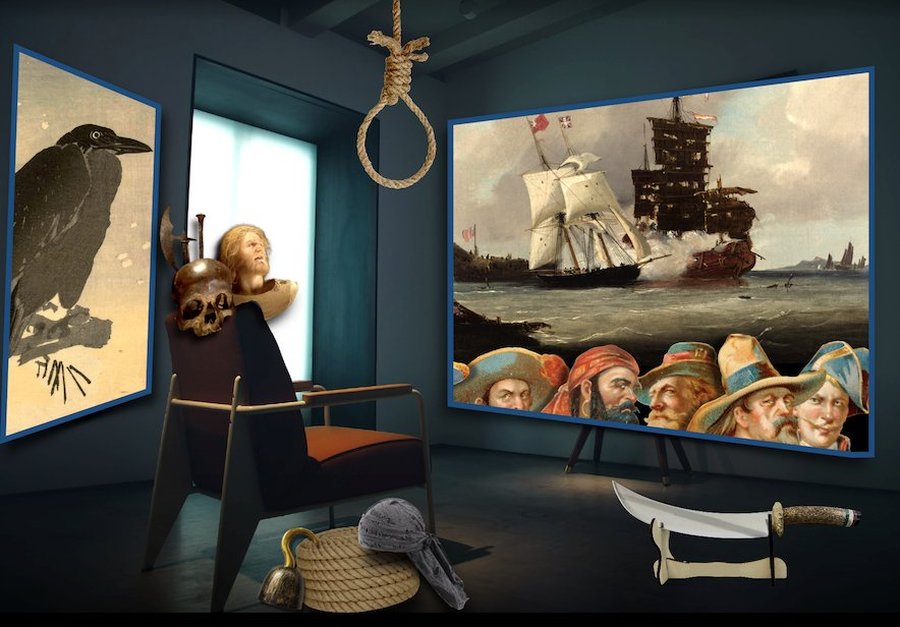
This collage draws on a different kind of source altogether: a 19th-century naval illustration of HM Sloop Ariel engaging a pirate Chinese junk, the kind of maritime print that once circulated widely to record Britain’s Far East anti-piracy campaigns. Rather than a single named painter, the image belongs to the broader tradition of 19th-century marine documentary art — part reportage, part adventure illustration.
Piracy in the South China Sea was a real and persistent problem for 19th-century naval powers, and scenes like this one served both as record and as spectacle, feeding a public appetite for tales of empire and danger at sea.
Incommunicability
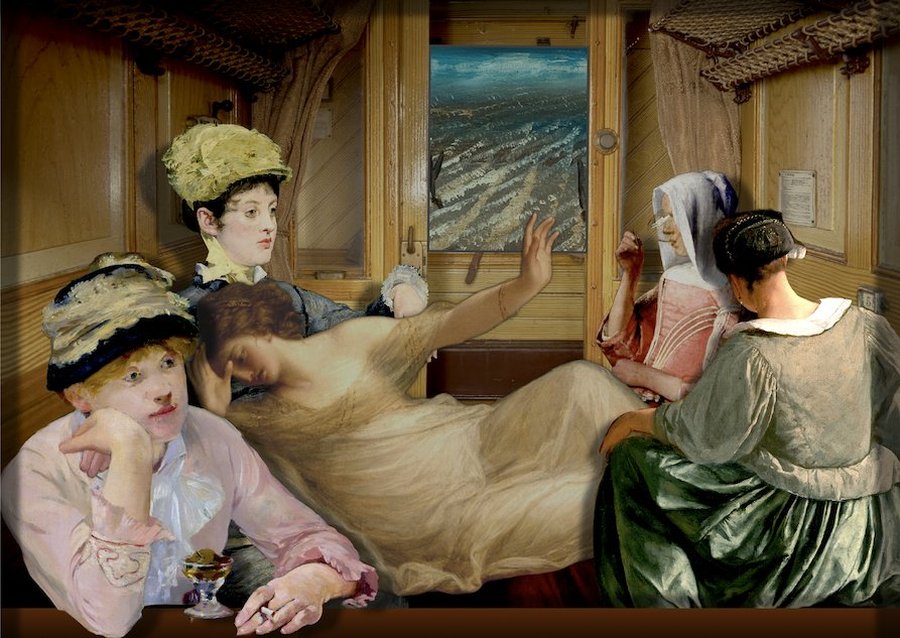
Édouard Manet contributes twice — 1877 and 1879, from the last years of his career, when Paris café society and its performers (Nana, the barmaid at the Folies-Bergère) became his central subject, painted with a directness that unsettled Salon audiences. Johannes Vermeer’s 1658 work belongs to his early mature period in Delft, the years just before the luminous, quiet interiors that made him famous centuries later.
Jan Steen’s 1663 and Angelica Kauffman’s 1774 pieces bracket the other two chronologically and temperamentally — Steen’s crowded, disorderly households against Kauffman’s cool Neoclassical restraint. Four painters, three centuries, all circling the same difficulty: how much a face can actually say.
Jazz Time
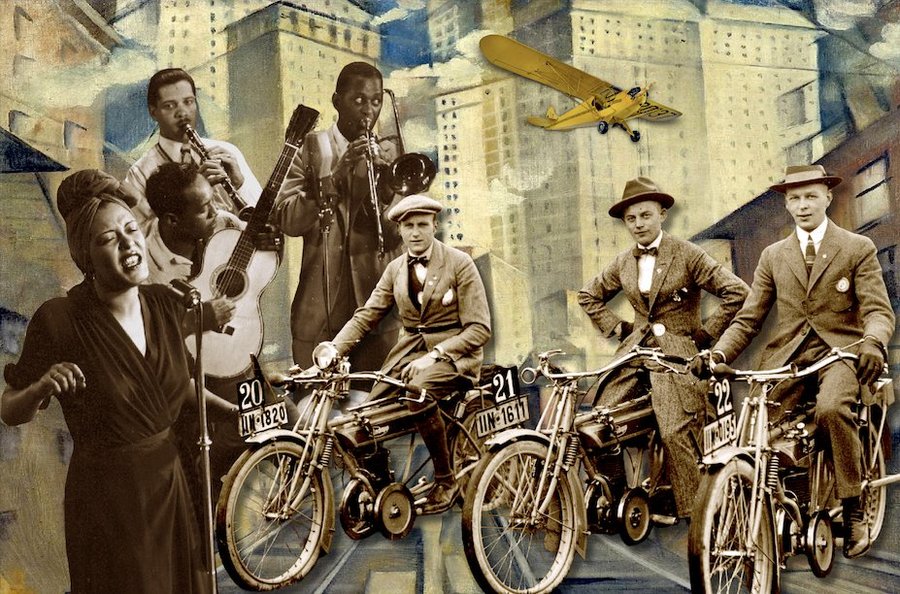
The collage draws on a 1920 work by C.R.W. Nevinson — Christopher Richard Wynne Nevinson, the British painter whose jagged, Futurist-influenced style made him one of the defining visual chroniclers of the First World War. By 1920, with the war behind him, Nevinson turned his same nervous, angular energy toward the modern city itself: nightlife, motion, and the syncopated new rhythms just beginning to arrive from America.
Jazz had barely reached London and Paris by 1920, but the appetite for speed, noise and modernity that Nevinson had sharpened in wartime found an easy new subject in the dance halls and cabarets of the decade just beginning.
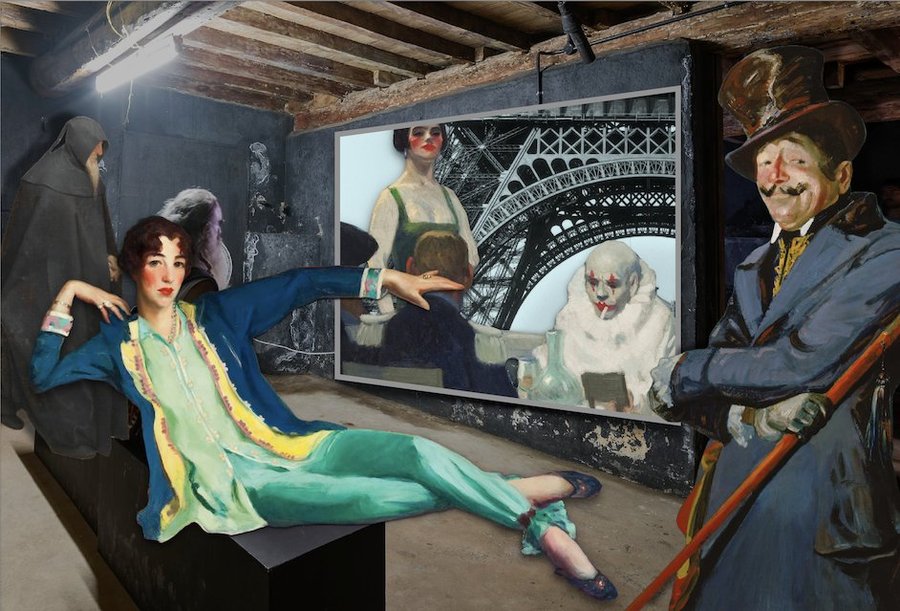
Mémoire de Paris
An American view of a European capital, filtered through three Ashcan School painters. Robert Henri’s 1916 contribution comes from the leader of ‘The Eight,’ the group that pushed American painting toward the raw, unglamorous life of the modern city — including, in works like this one, the Paris he knew from his own student years abroad. George Luks, one of Henri’s closest circle, contributes a 1919 piece from the same urban-realist tradition.
Edward Hopper’s 1914 work catches the future painter of American solitude a full sixteen years before Early Sunday Morning, still absorbing the lessons of his own Paris trips earlier that decade. Bruegel’s 1568 piece, the odd one out by three and a half centuries, is a reminder that remembering a city is only the latest chapter in a much older tradition of painting crowded, ordinary life.
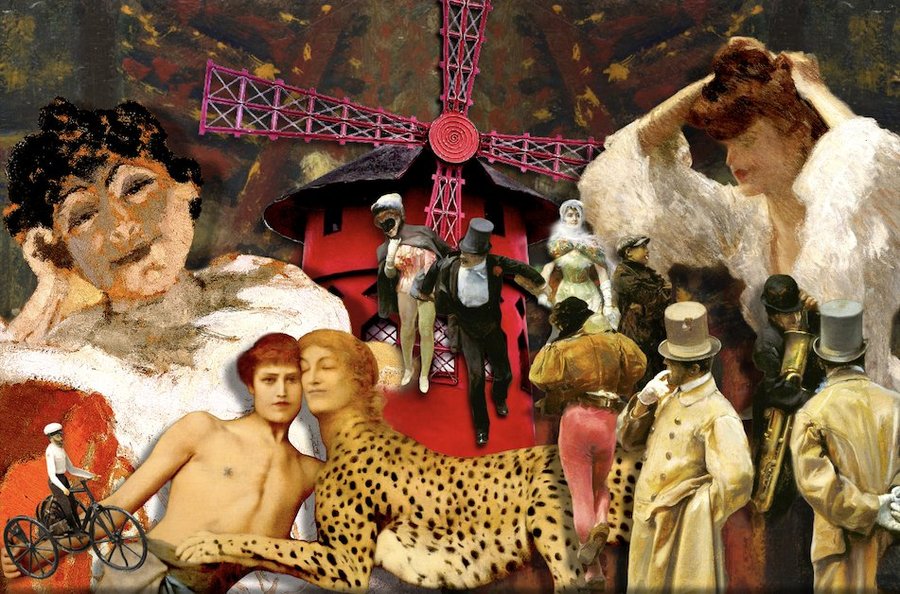
Moulin Rouge Years
Édouard Vuillard’s 1900 contribution comes from his mature Nabi period, when the intimate, patterned interiors that made his name had reached full confidence. Fernand Khnopff’s 1896 work belongs to the Belgian Symbolist’s most enigmatic years, painting mood and suggestion rather than incident. José García Ramos, the Sevillian costumbrista painter, offers a 1905 scene from his lifelong record of Andalusian daily life and festival.
A 1906 piece attributed to C. Innocenti rounds out the set. Together the four sketch the wide geography of belle époque nightlife — Paris, Brussels and Seville all keeping their own version of the same late hours.
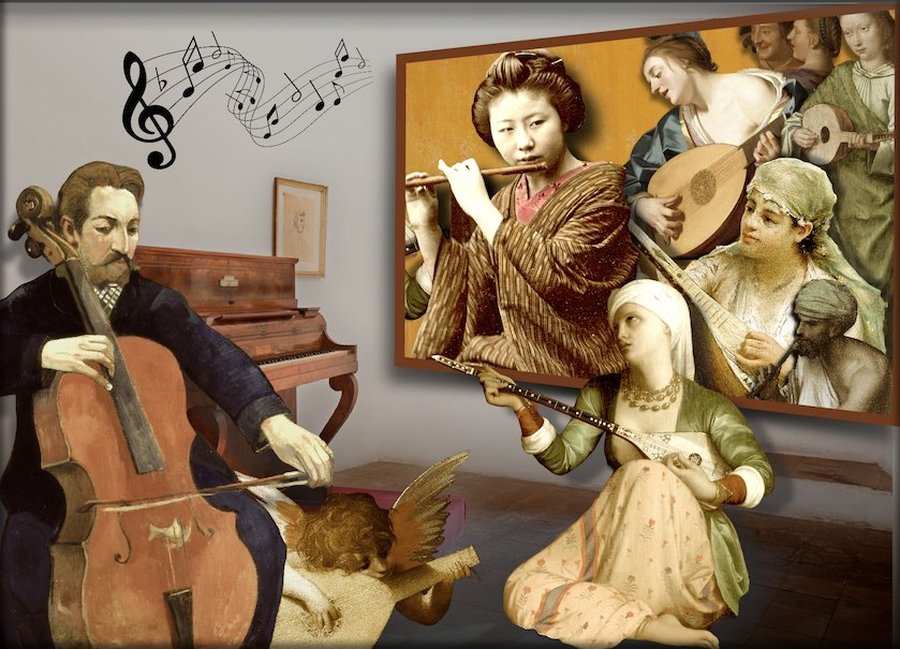
Musici
Gerard van Honthorst’s 1623 contribution is the natural heart of this collage: the Dutch Caravaggisti painter earned the nickname ‘Gherardo delle Notti’ — Gerard of the Night Scenes — for exactly this kind of candlelit musical gathering, a subject he all but made his own after studying Caravaggio’s followers in Rome. Rosso Fiorentino’s 1522 work brings an earlier, more theatrical Florentine Mannerism to the same idea of performance.
Ingres (1839), Gauguin (1894) and Fausto Zonaro — the Italian painter who became court artist to the Ottoman Sultan in Constantinople, contributing an Istanbul-period work from 1904 — each bring their own century’s idea of music-making. Photographs from Japan’s Kusakabe studio tradition, pioneers of the hand-colored photography that introduced Western audiences to Japanese musicians and performers, complete the ensemble.
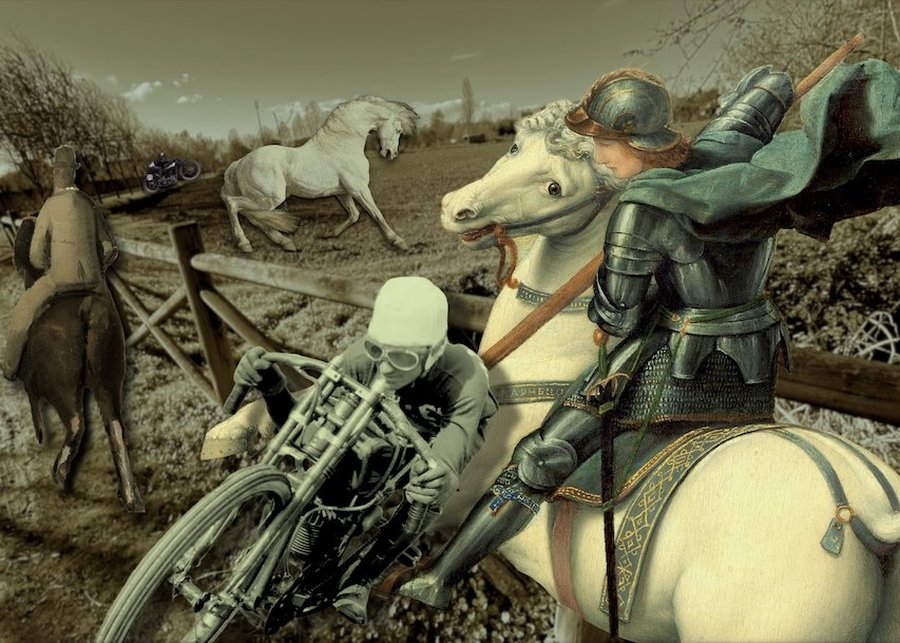
Natural and Artificial Horses
George Stubbs’ 1770 contribution comes from the English painter at the height of his powers — a decade after The Anatomy of the Horse made him, almost uniquely among 18th-century artists, as much a scientist as a painter of animals. Raphael’s 1506 work, over two and a half centuries earlier, belongs to his Florentine period, just before the Roman commissions that would define his short, brilliant career.
Virgilio Guidi’s 1926 piece brings a very different, more modern Italian sensibility to the same animal, painted in the years just before his own turn toward a quieter, more metaphysical style. Natural craft and artificial invention, in other words, have been circling the horse for a very long time.
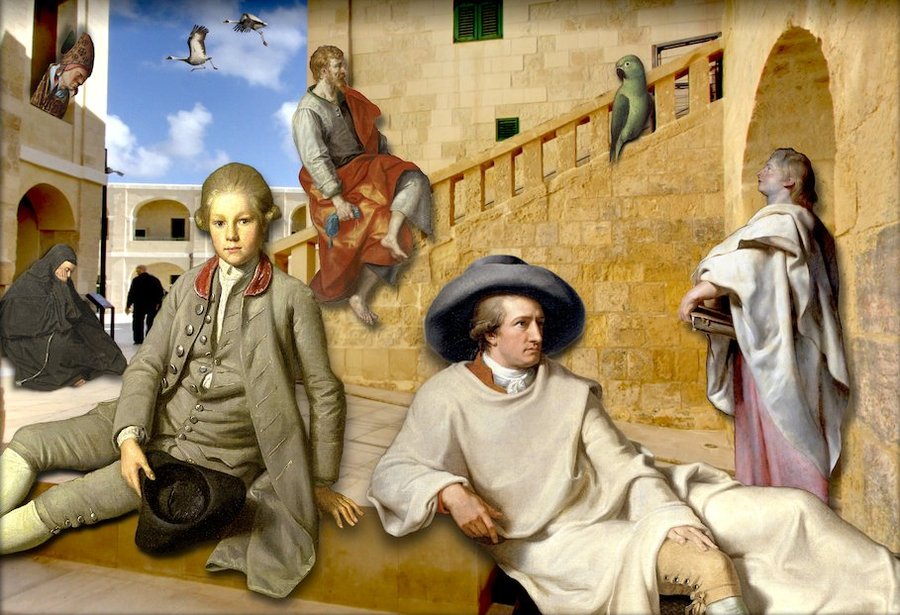
Overtourism Xp
A fittingly historical joke: this collage draws its central image from Johann Heinrich Wilhelm Tischbein’s 1787 Goethe in the Roman Campagna, arguably the single most famous painting to come out of the 18th-century Grand Tour — the very tradition that invented mass European travel-as-self-improvement. Nathaniel Dance-Holland’s 1769 contribution comes from his own years in Rome, where the English painter made a comfortable living turning young aristocrats on their own Grand Tours into souvenir portraits.
Rubens’ 1614 work, arriving a century and a half earlier, is a reminder that artists were already traveling to Italy to be transformed by it long before ‘tourism’ had a name. Three artists, three centuries, one very old complaint about crowded ruins.
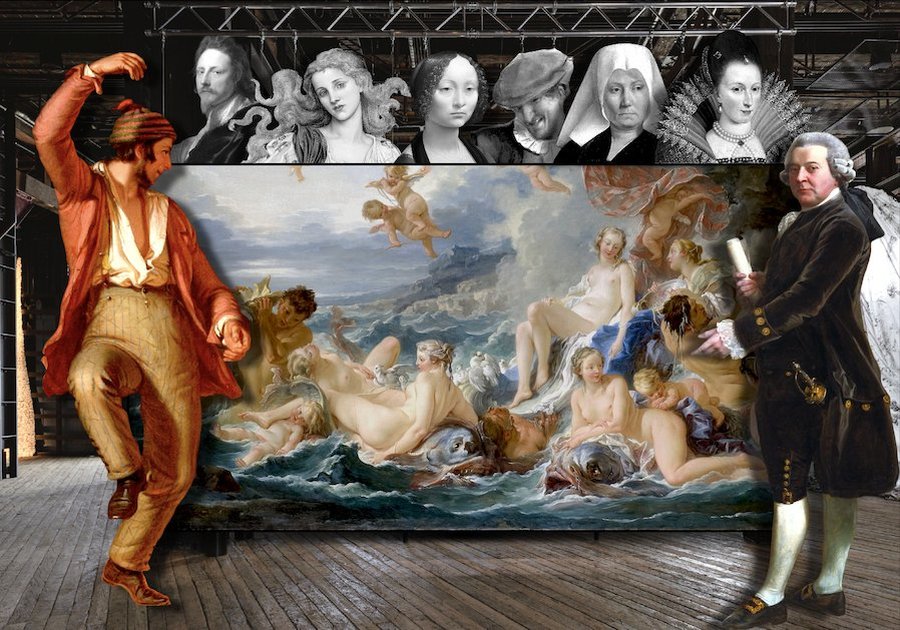
Painting Competition
Nine artists across four centuries, gathered under a title that could describe any of them. Leonardo’s contribution comes from his formative years in Florence, still associated with Verrocchio’s workshop before he struck out fully on his own. Quentin Massys (1520) and Antwerp-school contemporaries John De Critz (1606) and Van Dyck (1628) trace the Netherlandish and Flemish line forward a full century.
Jan Steen’s 1663 genre scene, Boucher’s 1740 Rococo elegance, and John Singleton Copley’s 1783 work — painted after the American portraitist relocated to London — carry the story through the 18th century. William Sidney Mount (1845) and Evelyn De Morgan (1894) close it out. If there really were a competition across four centuries of painting, it would be hard to judge — which may be exactly the point.
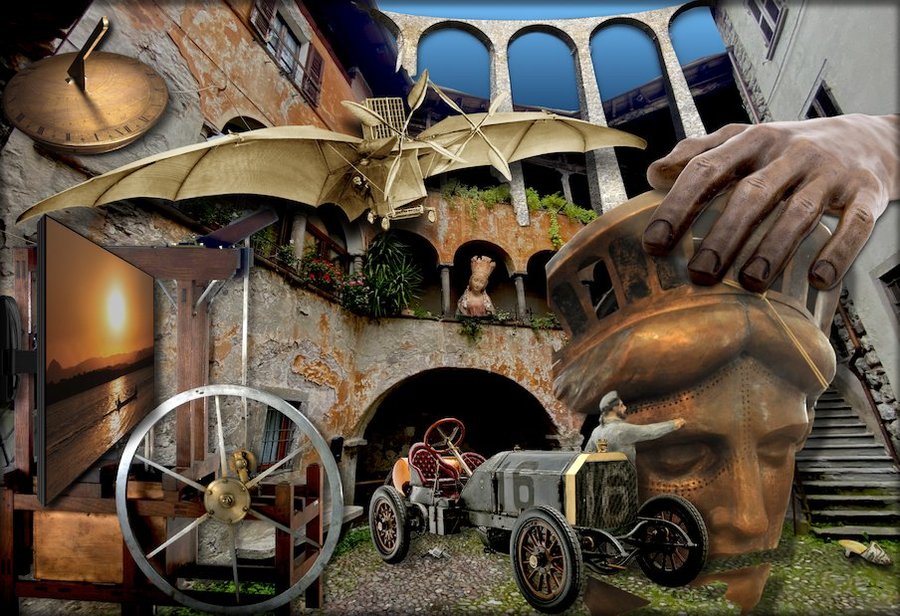
Progress & Freedom
A Gothic bust from Bohemia, dated around 1390, belongs to the same sculptural tradition as the famous triforium portrait busts of Prague Cathedral — anonymous, exquisitely carved likenesses from one of medieval Central Europe’s most sophisticated workshops. Five centuries later, Frédéric Auguste Bartholdi’s 1878 contribution catches the French sculptor mid-project: the head of his Statue of Liberty, exhibited on its own at the Paris Exposition Universelle that year, eight years before the completed statue would be unveiled in New York harbor.
Between an anonymous medieval face and the most recognizable monument to freedom ever built, the collage spans everything progress has meant — from individual likeness to a promise made to an entire nation of newcomers.
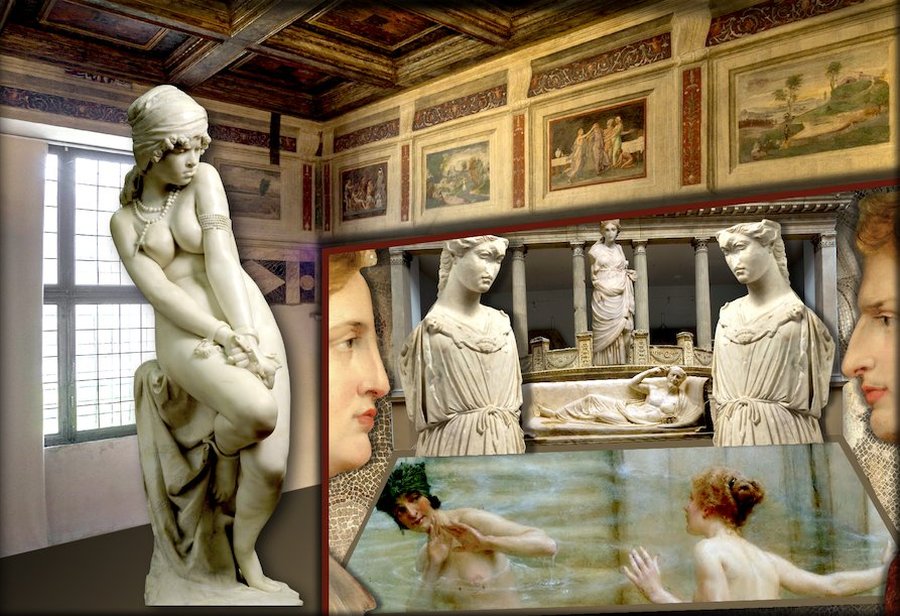
Roman Leisure
Lawrence Alma-Tadema barely needs introduction here — the Dutch-British painter built his entire late career, this 1909 work included, on luxuriously detailed reconstructions of ancient Roman daily life: marble terraces, flowers, and figures at rest, researched with an archaeologist’s rigor and painted with a photographer’s polish.
Giacomo Ginotti’s 1877 sculpture, three decades earlier, approaches the same world of classical ease from a different medium and a more overtly Italian academic tradition. Together they represent the 19th century’s enduring fascination with Rome not as ruin, but as a society that had, once, gotten leisure right.
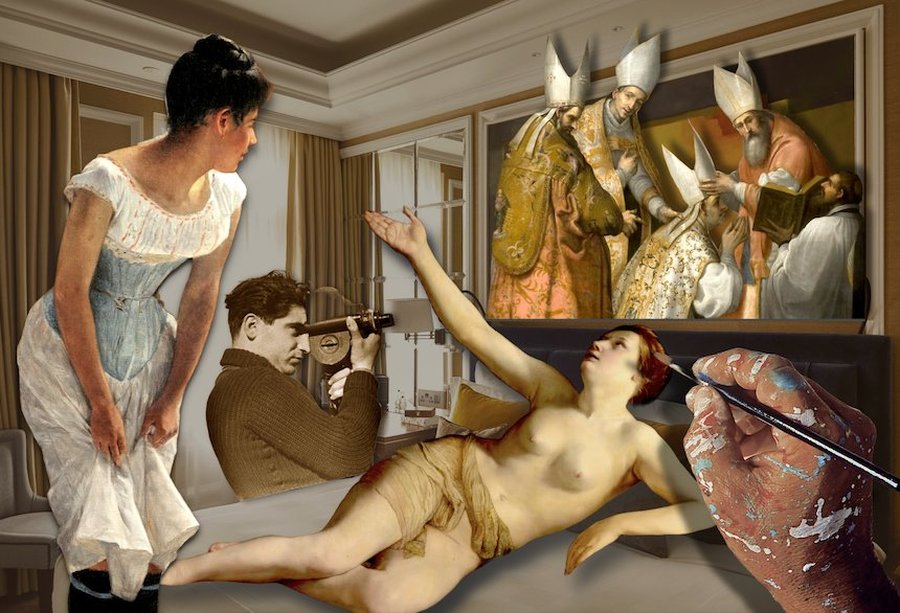
Softcore Film Set
Robert Capa’s 1937 photograph comes from the legendary war photographer’s Spanish Civil War years — the period, a year after his famous Falling Soldier, that made his reputation as the defining combat photojournalist of his generation. Orazio Gentileschi’s 1622 contribution belongs to the Italian Caravaggisti painter’s mature period, not long before he left for the English court of Charles I.
Vicente Carducho’s 1632 work, from the Italian-born painter’s long Spanish court career, and José Ferraz de Almeida Júnior’s 1898 piece, from the Brazilian painter’s final years, complete a collage that moves — like the title suggests — between document and staged illusion, never quite settling on which is which.
FotoGrafia is part of Blu Artworks' wider body of work — 577 original SIAE-registered collages in total. Explore the FotoGrafia fa parte del lavoro più ampio di Blu Artworks — 577 collage originali registrati SIAE in totale. Esplora la Full GalleryGalleria Completa.