Expressionism
Fifteen Collages from the Age of Die Brücke and Der Blaue Reiter
15 collages in this catalogcollage in questo catalogo
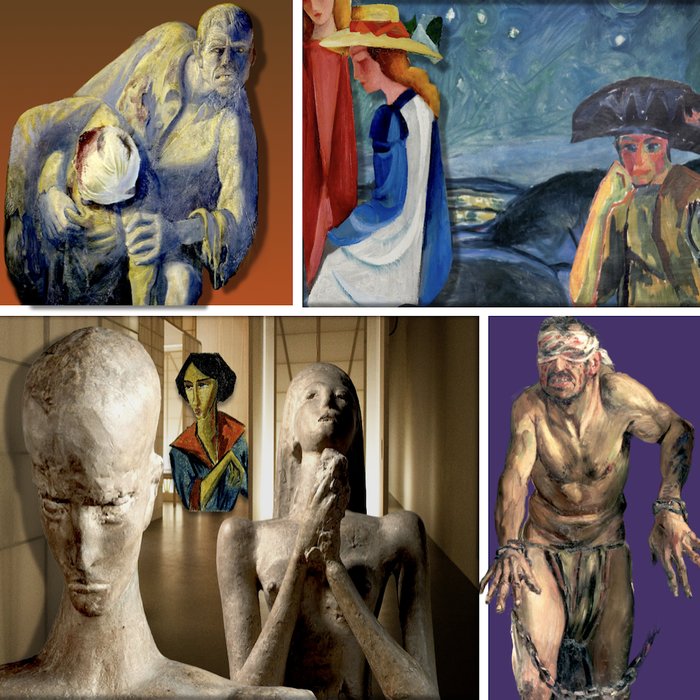
Expressionism developed in European art at the end of the 19th century. The period of ‘Classical Expressionism’ began in 1905 with the founding of the group Die Brücke, and ended around 1920. Although it was partly a reaction to both academic art and Impressionism, the movement is best understood as a form of ‘new Humanism,’ seeking to communicate man's spiritual life — a reflection of the deep intellectual restlessness of the early twentieth century and the destruction of traditional relationships of trust between man and the world. Each piece below is available as a high-resolution, 300dpi, royalty-free download for €39, ready for print at any size.
Download Catalog PDF →Scarica il Catalogo PDF → View All Collections →Vedi Tutte le Collezioni →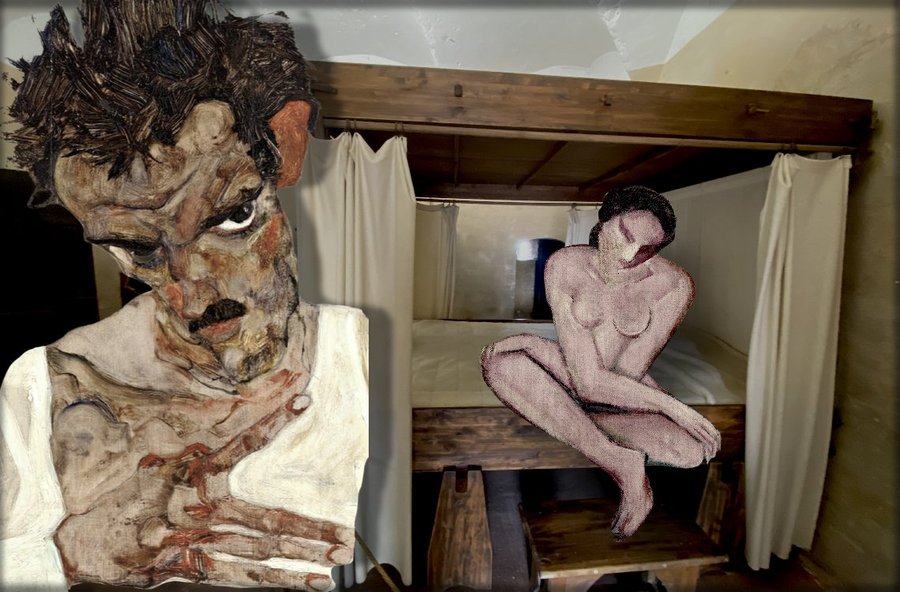
Amore Tossico
A quiet, unsettled study in attachment, built from two very different registers of German-language Expressionism. Franz Marc, the co-founder of Der Blaue Reiter, spent the years around 1912 developing his famous symbolic use of color in animal subjects, applying that same emotional palette to the human figure. Egon Schiele's 1912 contribution belongs to the period just after his brief imprisonment for ‘immorality’ — the year his line grew even more angular and his psychological unease more visible on the surface of the paint.
Together, the two 1912 works suggest love as something closer to a symptom than a comfort — a recurring theme across the Expressionist generation that came of age in the years just before the First World War.
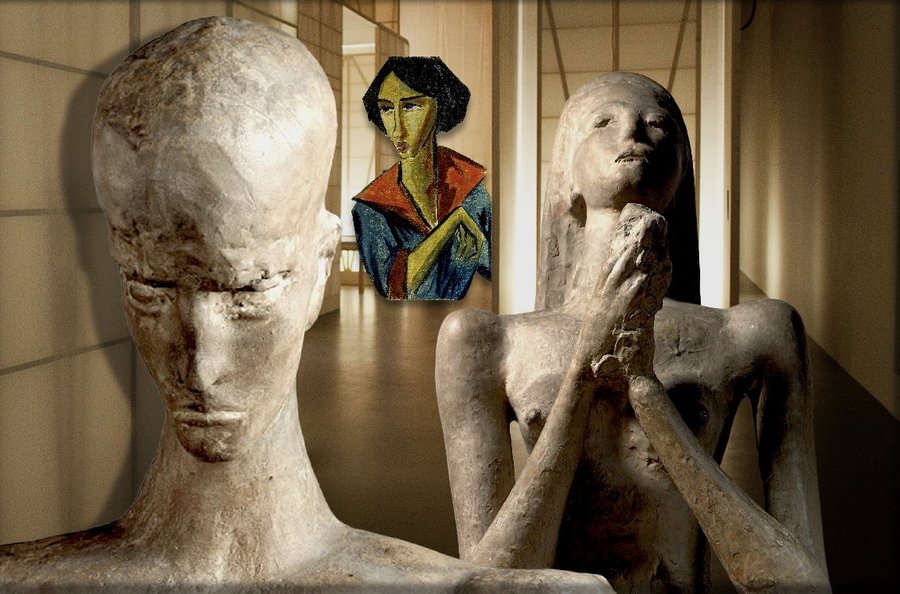
ArcheoLogica
Three details from the same hand: Wilhelm Lehmbruck, the German sculptor whose elongated, melancholic figures became one of Expressionism's most distinctive contributions to three-dimensional form. Works from across his mature period — 1915, 1918, and 1919, the last the year of his death — are layered here like strata, an excavation of a single artistic language across its final, most intense years.
Lehmbruck's figures, stretched and inward-looking, were among the works the Nazi regime later condemned as ‘degenerate art,’ a fate shared by several of the artists gathered across this catalog.
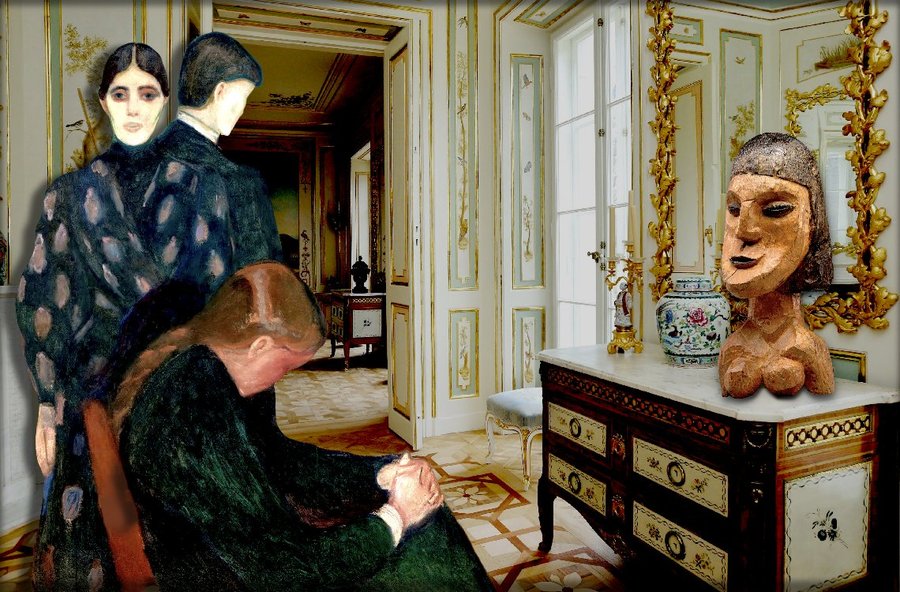
Aristocratici
Edvard Munch's 1893 contribution places this collage in the very year of The Scream — the peak of the Norwegian painter's first mature, symbol-laden style, obsessed with anxiety, isolation, and the thin social varnish over both. Ernst Ludwig Kirchner, founder of Die Brücke, supplies a 1913 counterpoint from his Berlin street-scene period, when his nervous, splintered brushwork turned fashionable city crowds into something closer to threat than glamour.
Placed side by side, two different generations of Expressionism arrive at the same suspicion: that polish and privilege conceal more than they reveal.
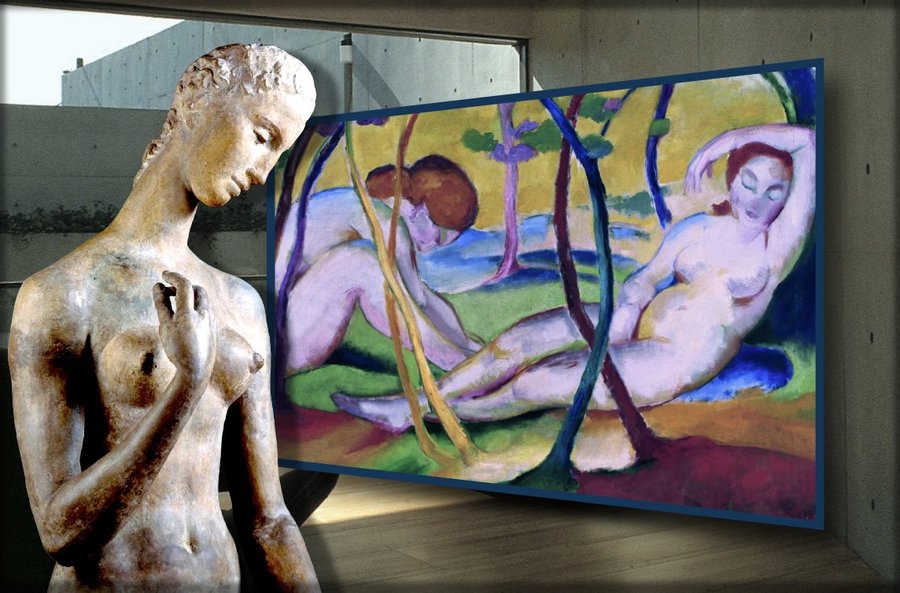
Art Atelier
A study of the studio itself, drawn from two artists working in 1911, the year Der Blaue Reiter was founded in Munich. Franz Marc's contribution comes from the same year he began developing his theory of color symbolism — blue for the masculine and spiritual, yellow for the feminine and joyful — that would define his mature animal paintings. Wilhelm Lehmbruck, meanwhile, was in Paris in 1911, absorbing Rodin and Maillol before returning to Germany to forge his own elongated sculptural language.
Two very different artistic educations, captured in the same pivotal year of the movement's formation.
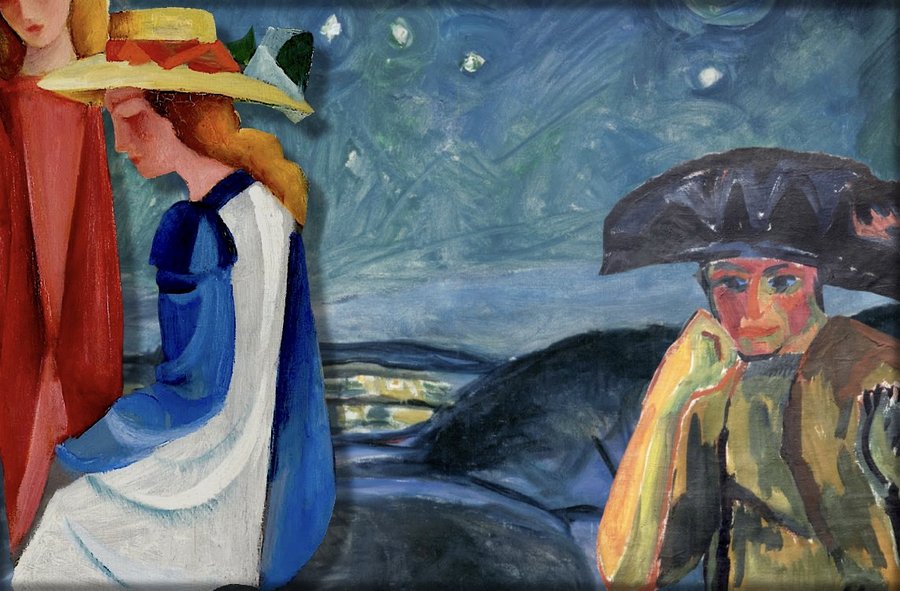
Attesa
Waiting rendered across three careers and three decades: August Macke's 1913 contribution comes from the final full year before his death on the Western Front in September 1914, a period when his color-saturated scenes of leisure and everyday life reached their fullest confidence. Edvard Munch's 1922 work belongs to his later, more settled period at Ekely, still returning obsessively to themes of anxiety and anticipation. Karl Schmidt-Rottluff, a founding member of Die Brücke, contributes a 1912 piece from the group's most radical Berlin years.
The three together span the movement's arc — from its confident youth to the losses that would reshape it.
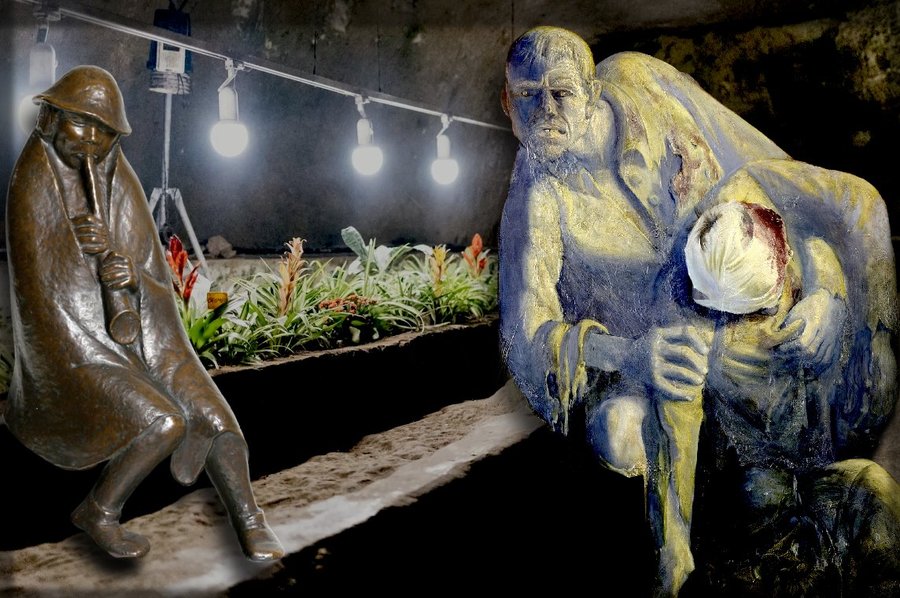
Bunker
Ernst Barlach, the German sculptor, playwright, and pacifist whose war memorials were later destroyed by the Nazi regime as ‘degenerate,’ contributes a 1936 work from the last years before his death in 1938, made under increasing state persecution. Otto Dix's 1930 painting belongs to his Weimar-era Neue Sachlichkeit period, when unsparing, almost forensic portraits of Germany's war-scarred society made him one of the regime's later targets as well.
Both artists spent their final years watched and condemned by the same authorities that would soon confiscate their work — a history this collage's title quietly gestures toward.
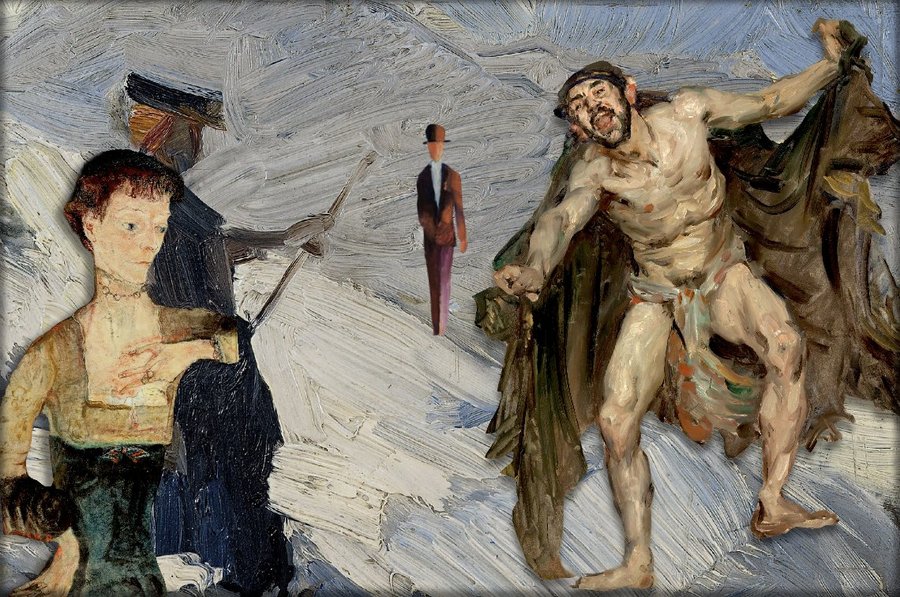
Esibizionista
Four artists, four decades of provocation. Oskar Kokoschka's 1910 contribution comes from his scandalous Vienna debut years, when his raw, psychologically probing portraits horrified polite society. Franz Marc (1906) and August Macke (1914) bracket the Blaue Reiter's brief, luminous existence, while Lovis Corinth's 1904 work belongs to his pre-stroke Berlin period, still working in a robust, painterly Impressionism before a 1911 stroke pushed his late style toward something rawer and more expressionistic.
Taken together, the four represent Expressionism's range of temperaments — from calculated shock to unguarded exposure.
Estate
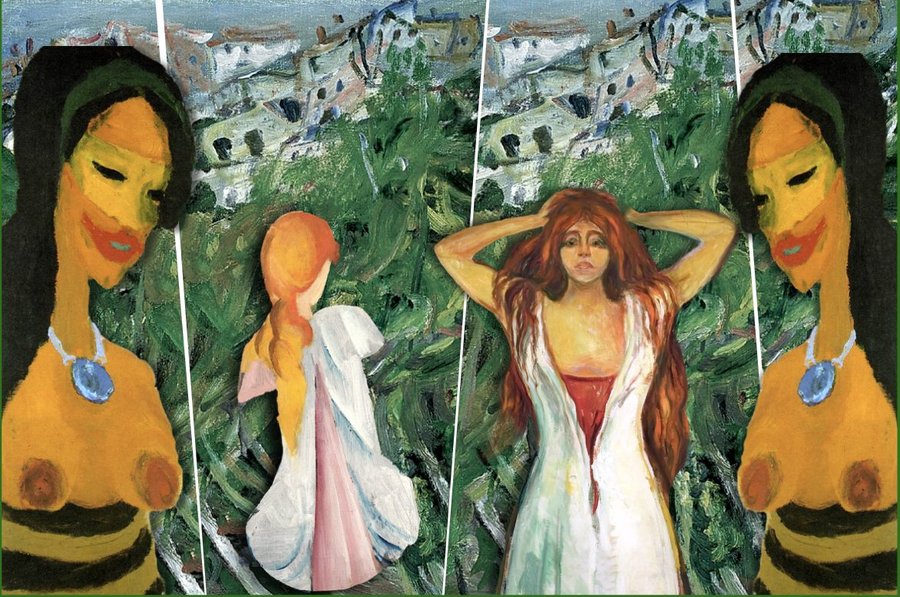
Summer refracted through four very different palettes. Emil Nolde's 1917 contribution comes from his most vividly colored period, painted on his native Schleswig-Holstein coast. Chaïm Soutine, the Lithuanian-born painter of the School of Paris, contributes a 1920 work from his intensely gestural early Paris years. August Macke's 1912 piece belongs to his sunniest, most joyfully colored period, cut short two years later by the war, while Edvard Munch's 1925 work comes from his later, more reflective Ekely period.
Four painters, four different relationships to warmth and light — from Nolde's saturated intensity to Munch's cooler distance.
Inverno
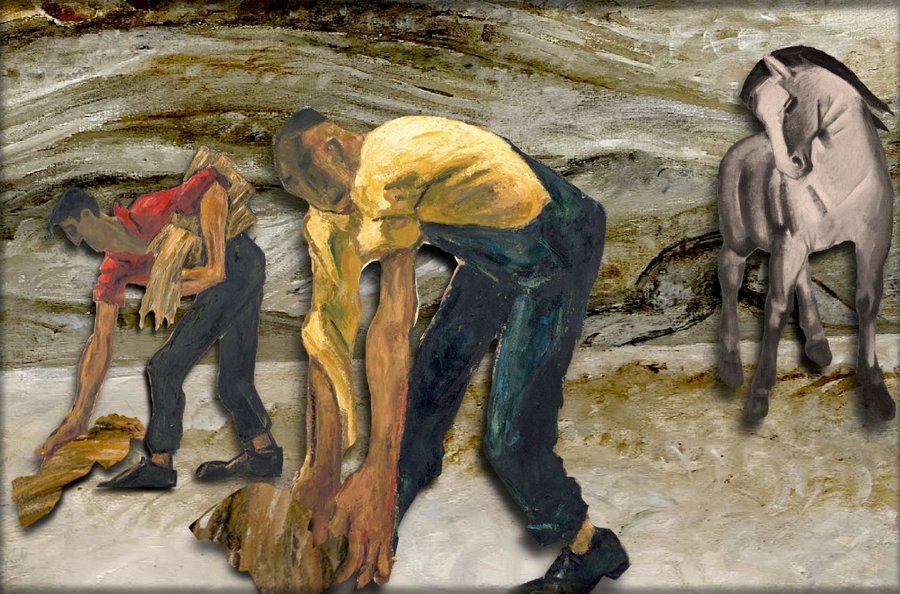
An unlikely trio spanning three countries. Clyfford Still, who would go on to become one of the founding figures of American Abstract Expressionism, contributes an early 1936 work from his figurative, Depression-era period, years before the radical color-field abstraction that made his name. Lasar Segall, the Lithuanian-born painter who settled in Brazil, offers a 1939 piece from his mature São Paulo years, steeped in the same Expressionist inheritance he carried from Dresden. Franz Marc's 1911 contribution returns to the Blaue Reiter's founding moment.
Together they trace how Expressionism's language traveled — from Munich to Brazil to the American West — long after its German origins.
No Smoking
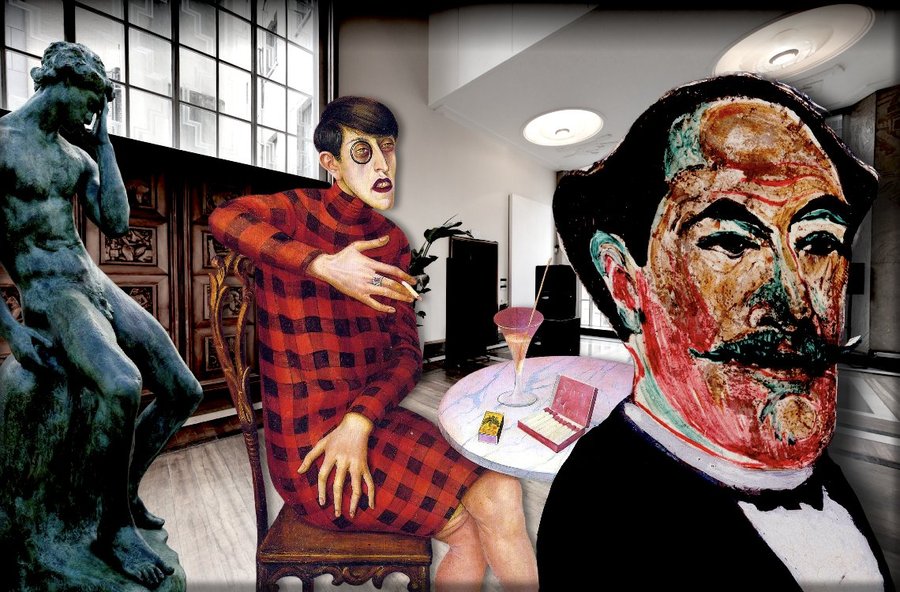
Émile-Antoine Bourdelle, Rodin's former assistant and one of the key sculptors bridging Symbolism and early modernism, contributes an 1889 work from his formative years. Otto Dix's 1926 piece belongs to the height of his Neue Sachlichkeit period, when his unsentimental portraits of Weimar Berlin's demimonde — smoke, cabaret, and all — made him one of the era's sharpest social observers. Franz Marc's 1911 contribution again returns to the Blaue Reiter's earliest year.
A collage that quietly juxtaposes sculptural restraint against Dix's smoke-filled, morally unvarnished Berlin.
Provocatoriamente
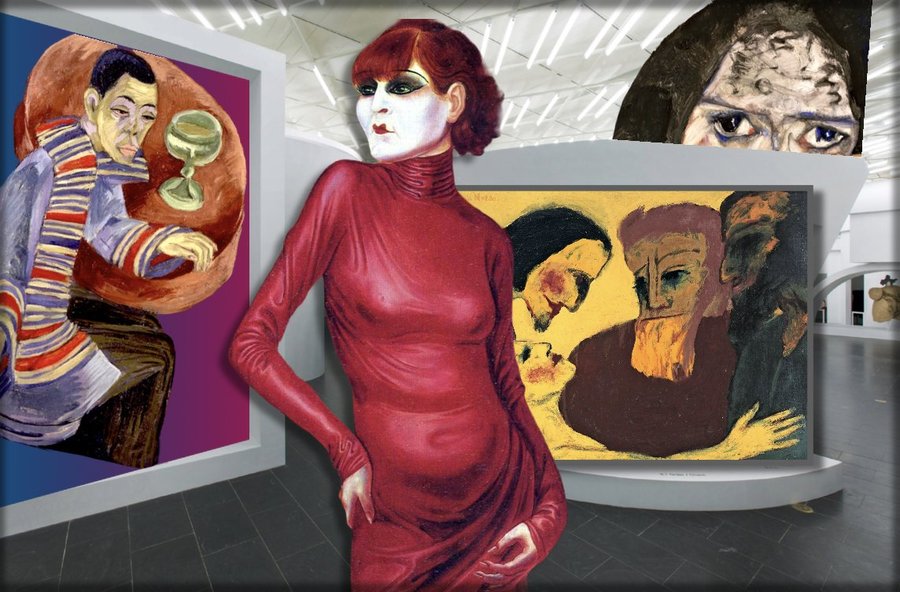
Four artists built around confrontation. Ernst Ludwig Kirchner's 1913 contribution comes from his most radical Berlin street-scene period. Otto Dix (1925) and Emil Nolde (1926) both represent artists whose unsparing honesty — toward war, society, and the body — later drew official condemnation. Egon Schiele's 1912 work returns to the same charged year as Amore Tossico, just after his brief imprisonment, when his figures grew rawest.
Provocation, for this generation, was rarely a pose — it was closer to an ethical position, a refusal to soften what they saw.
Ribellione
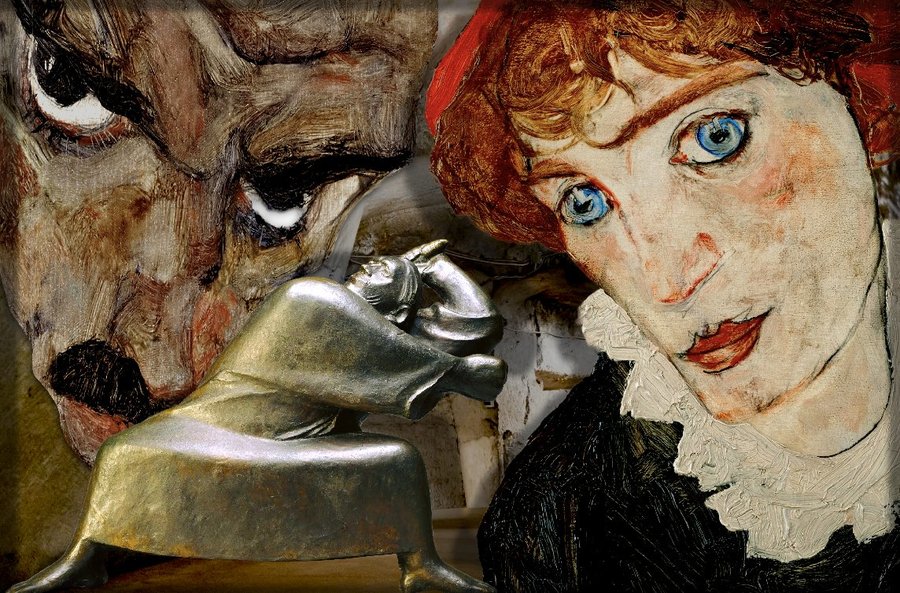
Two 1912 works by Egon Schiele frame a 1910 sculpture by Ernst Barlach. Schiele's contributions come from the intense early period before his imprisonment that same year on morality charges, when his line was already pushing toward the extremes that would define his short career. Barlach's 1910 piece belongs to his early maturity as a sculptor, developing the simplified, emotionally direct figures for which he became known — and later persecuted.
Rebellion here takes two distinct forms: Schiele's raw, confrontational figuration and Barlach's quieter, more enduring defiance.
Separazione
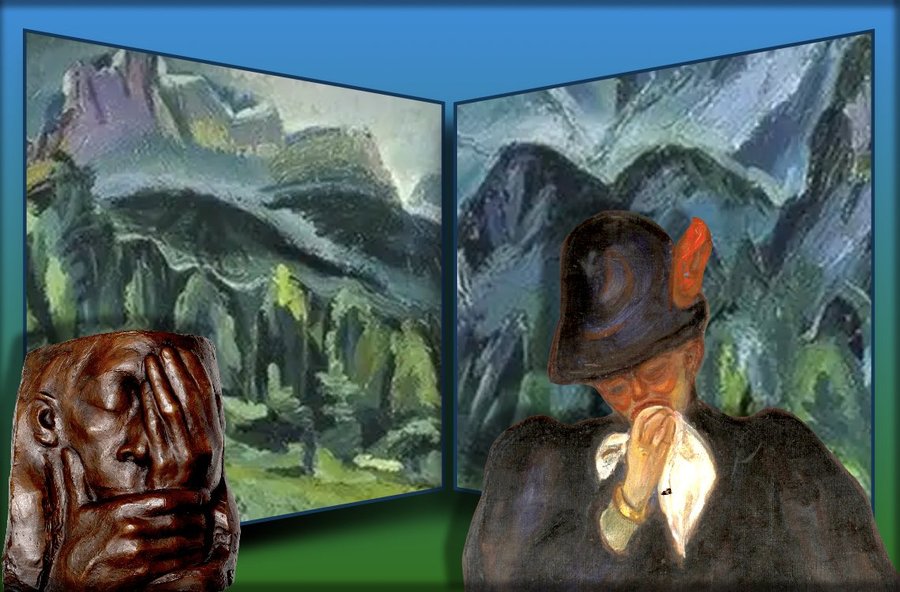
Käthe Kollwitz, the German printmaker and sculptor whose work was consumed by grief after losing her son Peter in the First World War, contributes a 1938 piece from her late period, still working through loss two decades on. Oskar Kokoschka's 1913 work comes from the year after his tumultuous, short-lived affair with Alma Mahler began to unravel — a relationship that haunted his art for years. Edvard Munch's 1899 contribution belongs to his most intensely symbolic period, not long after The Scream.
Three artists, three private griefs, gathered under a single word: separation.
Sguardo Indiscreto
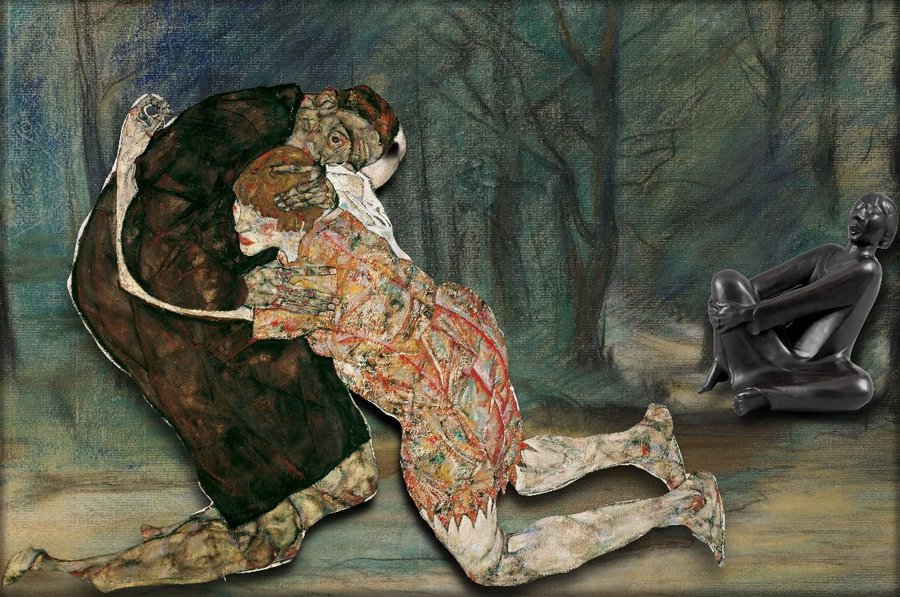
Egon Schiele's 1915 contribution comes from the year of his marriage to Edith Harms, a period when his work briefly softened without losing its psychological intensity. Lovis Corinth's 1890 piece predates his stroke by two decades, from his early, still fully Impressionist period. Ernst Barlach's 1928 work belongs to his mature late style, made a decade before the Nazi regime began seizing his sculptures from German museums.
An indiscreet gaze, indeed — three artists at three very different moments of looking too closely, at themselves and at others.
Wanted
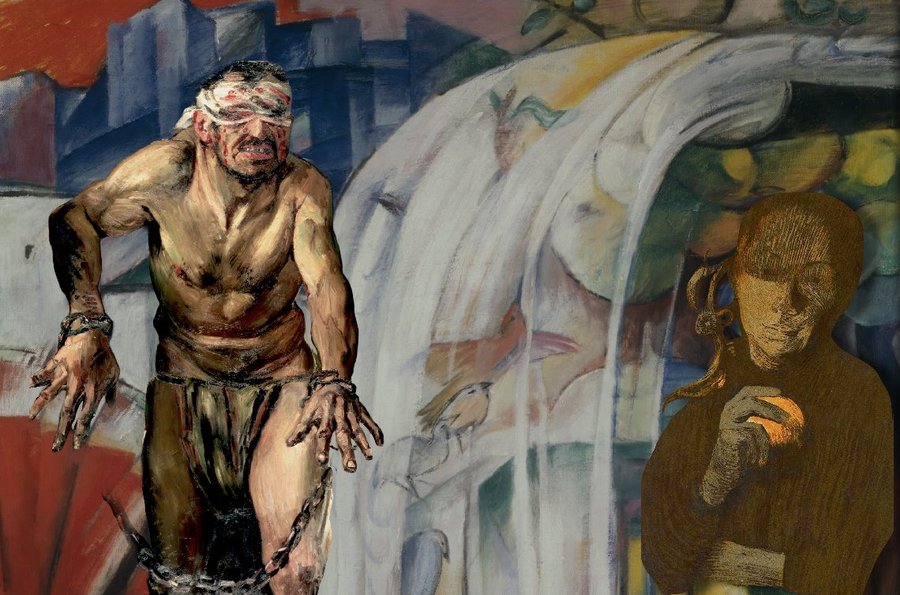
Lovis Corinth's 1912 contribution comes from the year after his stroke, the beginning of the looser, more urgent late style that critics increasingly read as expressionistic. Franz Marc's 1913 piece belongs to the year before his death, when his animal paintings grew darker and more apocalyptic, seemingly anticipating the war to come. Käthe Kollwitz's 1901 work is an early piece, years before the losses of the First World War would come to define her mature output.
Three artists, each in their own way marked men and women even before history came looking for them.
Expressionism is part of Blu Artworks' wider body of work — 577 original SIAE-registered collages in total. Explore the Expressionism fa parte del lavoro più ampio di Blu Artworks — 577 collage originali registrati SIAE in totale. Esplora la Full GalleryGalleria Completa.