AutoRitratti d'Artista
Painters facing the mirror, five centuries apartPittori davanti allo specchio, a cinque secoli di distanza
10 collages in this catalogcollage in questo catalogo
Painting oneself has never been mere vanity. For an artist, the self-portrait is a unique territory where painter, model and artwork coincide — a genre that crosses the centuries, evolving from a practical necessity into a genuine psychological inquiry. This catalog brings together real self-portraits — by names ranging from Jan van Eyck and Rubens to Frida Kahlo, Egon Schiele and Lee Krasner — regrouped into new imagined scenes: a rehearsal room, a hasty studio setup, a surprise visit backstage. Each piece below is available as a high-resolution, 300dpi, royalty-free download for €39, ready for print at any size.Dipingere se stessi non è mai stato un mero esercizio di vanità. Per un artista, l'autoritratto rappresenta un territorio unico dove il pittore, il modello e l'opera coincidono — un genere che attraversa i secoli, evolvendosi da una necessità pratica a una vera e propria indagine psicologica. Questo catalogo riunisce autoritratti reali — di nomi che vanno da Jan van Eyck e Rubens a Frida Kahlo, Egon Schiele e Lee Krasner — riorganizzati in nuove scene immaginate: una sala prove, un allestimento improvvisato, una visita a sorpresa dietro le quinte. Ogni opera qui sotto è disponibile in download ad alta risoluzione, 300dpi, royalty-free, a €39, pronta per la stampa in qualsiasi formato.
Download Catalog PDF →Scarica il Catalogo PDF → View All Collections →Vedi Tutte le Collezioni →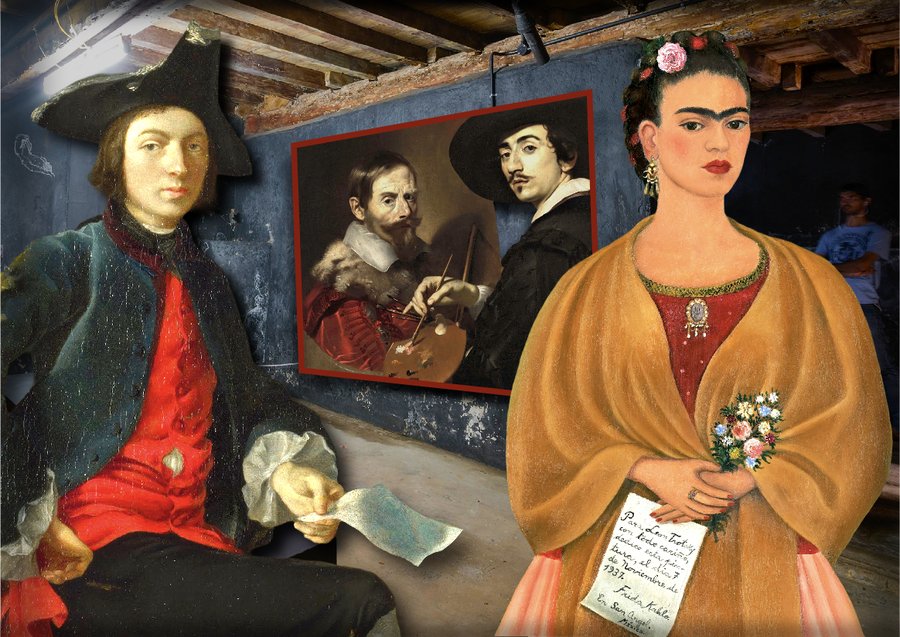
A Futura Memoria
Thomas Gainsborough, England's great portraitist of silk and shadow, painted himself in the late 1740s while still establishing his practice in Suffolk, decades before the fashionable London career that made him Reynolds's great rival. Nicolas Régnier, a Flemish-born Caravaggist who spent his career between Rome and Venice, favoured self-portraits dense with allegory and instruments, closer in spirit to a personal manifesto than a likeness. Between them, Frida Kahlo's 1937 self-image belongs to one of her most prolific years, painted in the aftermath of Trotsky's arrival in Mexico and steeped in the same fusion of personal pain and Mexican folk iconography that defines her entire body of work.
Thomas Gainsborough, grande ritrattista inglese della seta e dell'ombra, si dipinse alla fine degli anni 1740 mentre ancora si affermava nel Suffolk, decenni prima della carriera londinese che lo rese il grande rivale di Reynolds. Nicolas Régnier, caravaggesco di origine fiamminga attivo tra Roma e Venezia, prediligeva autoritratti densi di allegorie e strumenti, più vicini a un manifesto personale che a una semplice somiglianza. Tra loro, l'autoritratto di Frida Kahlo del 1937 appartiene a uno dei suoi anni più prolifici, dipinto all'indomani dell'arrivo di Trotsky in Messico e permeato da quella stessa fusione di dolore personale e iconografia popolare messicana che definisce l'intera sua opera.
Allestimento Provvisorio
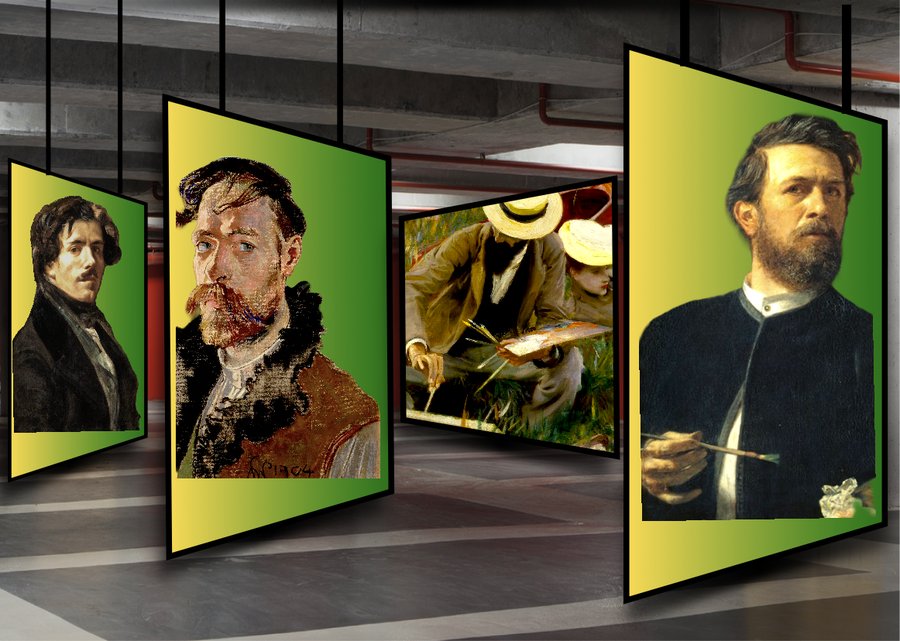
Eugène Delacroix painted his best-known self-portrait around 1837, by then the established leader of French Romanticism a decade after Liberty Leading the People, his gaze already that of a man aware of his own historical weight. Arnold Böcklin's 1872 Self-Portrait with Death Playing the Fiddle — a skeleton fiddling over the painter's shoulder as he works — remains one of Symbolism's most unsettling images of mortality intruding on the studio. Stanisław Wyspiański, playwright and painter at the heart of Poland's Young Poland movement, and John Singer Sargent, mid-career and already the portraitist of choice for transatlantic high society by 1889, complete this hastily assembled, temporary gathering.
Eugène Delacroix dipinse il suo autoritratto più noto intorno al 1837, ormai leader affermato del Romanticismo francese a un decennio da La Libertà che guida il popolo, con uno sguardo già consapevole del proprio peso storico. L'Autoritratto con la Morte che suona il violino (1872) di Arnold Böcklin — uno scheletro che suona alle spalle del pittore intento a lavorare — resta una delle immagini più inquietanti del Simbolismo sull'irruzione della morte nello studio. Stanisław Wyspiański, drammaturgo e pittore al centro del movimento polacco della Giovane Polonia, e John Singer Sargent, già ritrattista di riferimento dell'alta società transatlantica nel 1889, completano questo allestimento raccogliticcio e provvisorio.
Amore e Odio
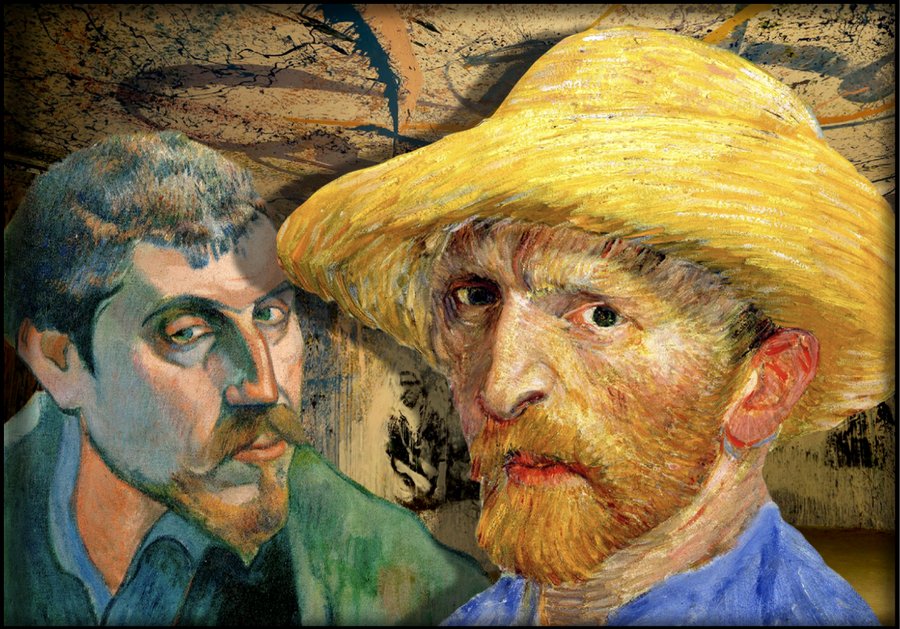
Few self-portraits carry as much shared history as these two: Paul Gauguin's 1888 self-image and Vincent van Gogh's from the very same year were painted during the nine volatile weeks the two spent together in the Yellow House in Arles — a friendship that swung between mutual admiration and mounting tension, and ended with van Gogh's breakdown and the infamous razor incident that cost him part of an ear. No title fits the pair better than this one: two artists who genuinely shaped each other's work, and genuinely could not live under the same roof.
Pochi autoritratti portano con sé una storia condivisa come questi due: l'autoritratto di Paul Gauguin del 1888 e quello di Vincent van Gogh, dello stesso anno, furono dipinti durante le nove settimane turbolente che i due trascorsero insieme nella Casa Gialla di Arles — un'amicizia oscillante tra ammirazione reciproca e tensione crescente, conclusa con il crollo nervoso di van Gogh e il celebre episodio del rasoio che gli costò parte di un orecchio. Nessun titolo si addice a questa coppia meglio di questo: due artisti che si influenzarono profondamente a vicenda, e che davvero non riuscirono a convivere sotto lo stesso tetto.
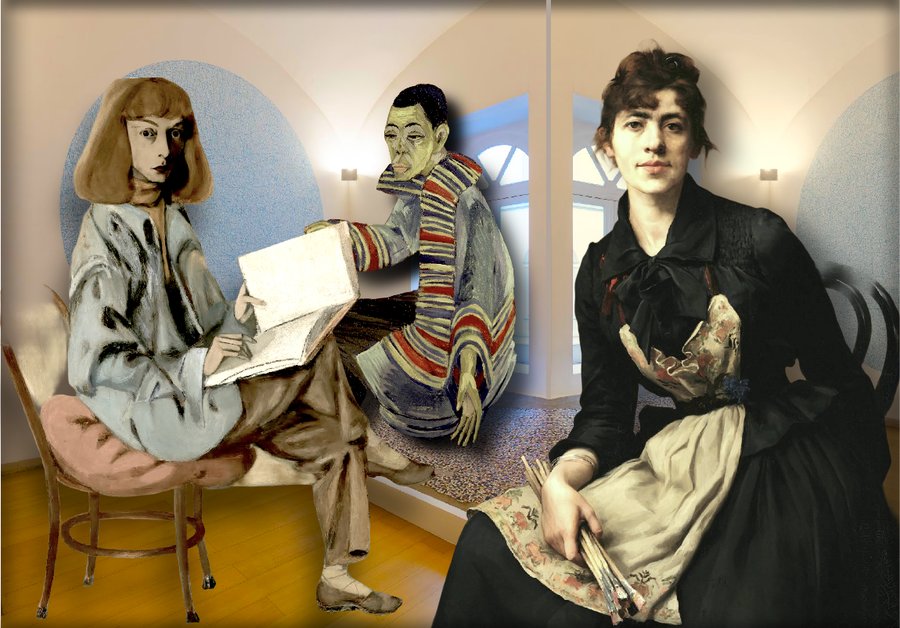
Briefing
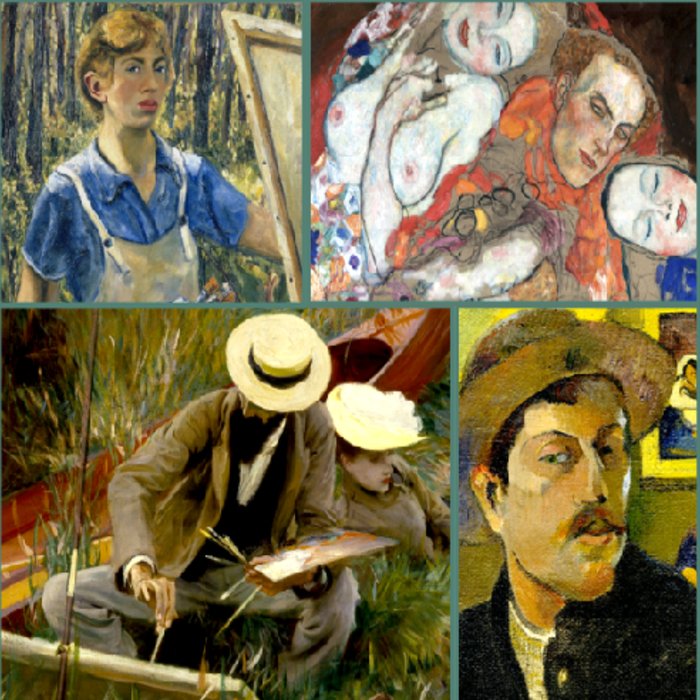
Elaine de Kooning, painting herself in 1946 at the very start of a career that would run alongside — and long be overshadowed by — her husband Willem's, brought an Abstract Expressionist's loose, gestural confidence even to a straightforward likeness. Ernst Ludwig Kirchner's 1914-15 self-portraits, made as Die Brücke's founding tensions were pulling the group apart and as war loomed over Germany, are some of Expressionism's rawest psychological documents. Anna Bilińska-Bohdanowicz, one of the first Polish women to win international recognition, painted her celebrated apron-clad self-portrait in 1887 — brush in hand, utterly unglamorous, utterly professional.
Elaine de Kooning, che si ritrasse nel 1946 agli esordi di una carriera che sarebbe corsa parallela — e per lungo tempo in ombra rispetto — a quella del marito Willem, portò la disinvoltura gestuale dell'Espressionismo Astratto perfino in un ritratto diretto. Gli autoritratti di Ernst Ludwig Kirchner del 1914-15, realizzati mentre le tensioni fondative di Die Brücke disgregavano il gruppo e la guerra incombeva sulla Germania, restano tra i documenti psicologici più crudi dell'Espressionismo. Anna Bilińska-Bohdanowicz, tra le prime pittrici polacche a ottenere riconoscimento internazionale, dipinse il suo celebre autoritratto con grembiule nel 1887 — pennello in mano, per nulla patinato, del tutto professionale.
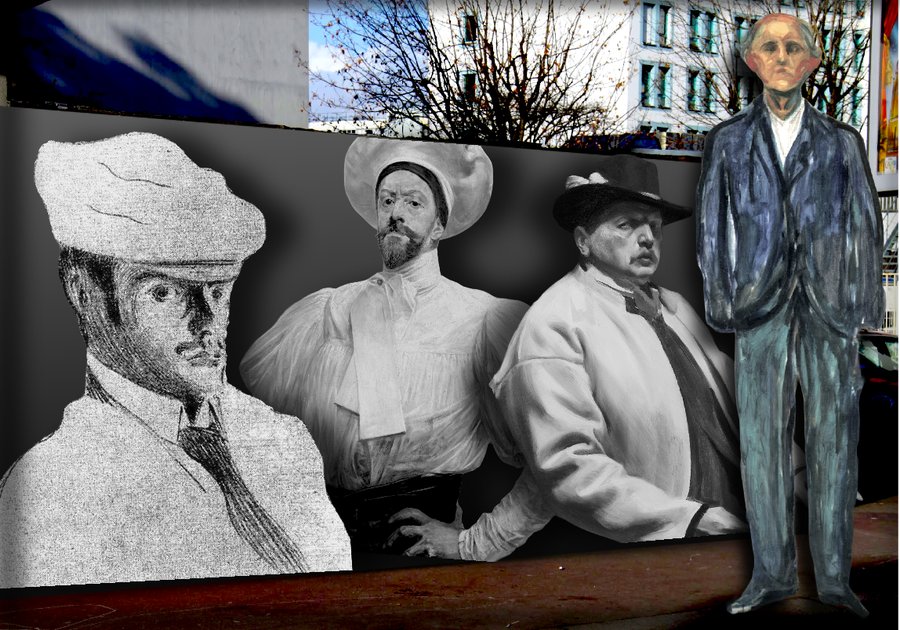
City Mural
Paul Klee's late-1890s self-portraits predate the Bauhaus years by decades, made while the young Swiss-German artist was still finding his way between caricature and a more searching introspection. Jacek Malczewski, Poland's leading Symbolist, painted himself repeatedly and rarely alone — his 1914 self-image, like most of his self-portraits, stages an encounter with an allegorical companion. Anders Zorn, by 1907 Sweden's most sought-after society portraitist, and Edvard Munch, whose 1940 self-portrait Between the Clock and the Bed shows an artist confronting old age and mortality with the same unflinching honesty he once brought to The Scream, complete this unlikely mural of faces from four different corners of Northern Europe.
Gli autoritratti di Paul Klee di fine anni 1890 precedono di decenni gli anni del Bauhaus, realizzati mentre il giovane artista svizzero-tedesco cercava ancora la propria strada tra caricatura e un'introspezione più profonda. Jacek Malczewski, massimo esponente del Simbolismo polacco, si ritrasse ripetutamente e raramente da solo — il suo autoritratto del 1914, come la maggior parte dei suoi autoritratti, mette in scena un incontro con una figura allegorica. Anders Zorn, già nel 1907 il ritrattista dell'alta società svedese più richiesto, ed Edvard Munch, il cui autoritratto del 1940 Tra l'orologio e il letto mostra un artista che affronta vecchiaia e mortalità con la stessa onestà spietata che un tempo riservò a L'urlo, completano questo improbabile murale di volti provenienti da quattro angoli diversi del Nord Europa.
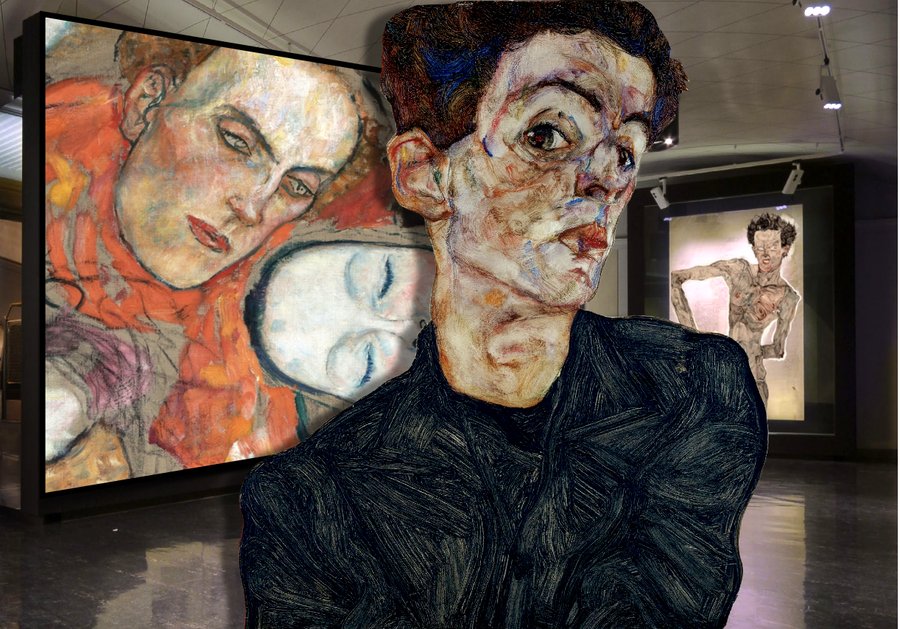
Espressionismo Austriaco
Gustav Klimt famously avoided painting himself — he once said he was not an interesting subject — which makes any self-image attributed to 1918, the final year of his life, a rare exception to a lifelong rule. His younger colleague and Vienna Secession successor Egon Schiele held no such reservations: his 1912 and 1910 self-portraits, angular, raw and unflinching, made him one of art history's most relentless self-examiners before his death at just 28. Placed side by side, the two sum up Viennese Expressionism's split personality — one master who hid, one who could not stop looking.
Gustav Klimt evitò notoriamente di dipingere se stesso — disse un tempo di non essere un soggetto interessante — il che rende qualunque sua immagine attribuita al 1918, ultimo anno della sua vita, una rara eccezione a una regola di tutta una carriera. Il più giovane collega ed erede della Secessione Viennese, Egon Schiele, non ebbe invece alcuna remora: i suoi autoritratti del 1912 e del 1910, spigolosi, crudi e senza compromessi, ne fecero uno degli osservatori di sé più implacabili della storia dell'arte, prima della morte a soli 28 anni. Accostati, i due riassumono la doppia anima dell'Espressionismo viennese — un maestro che si nascondeva, uno che non riusciva a smettere di guardarsi.
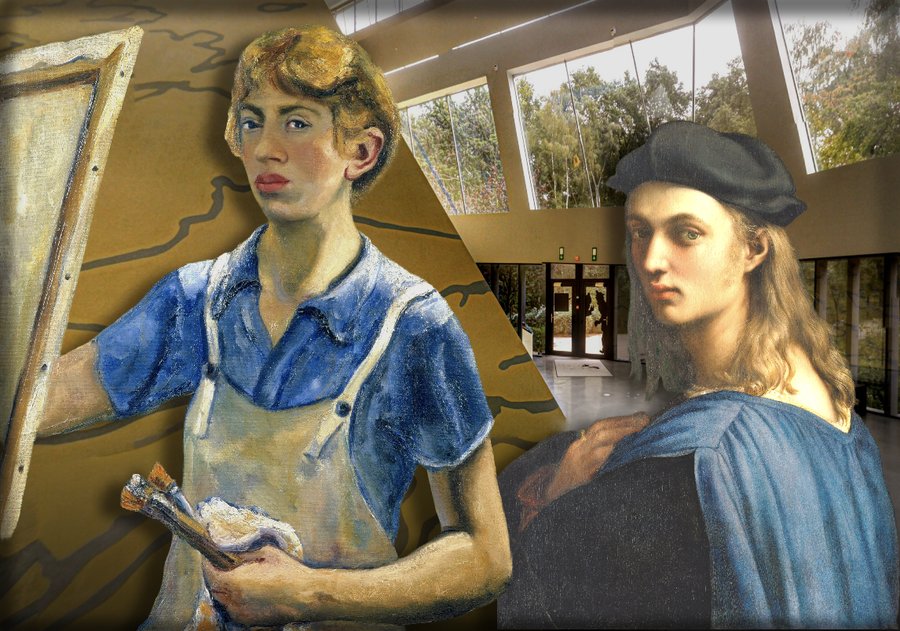
Il Maestro e l'Allieva
Raphael inserted his own likeness into more than one composition around 1515, most famously among the philosophers of The School of Athens, the young painter looking directly out at the viewer from a crowd of antiquity's greatest minds — a quiet claim to belong among them. Four centuries later, Lee Krasner painted her own self-portrait in 1928 as a student exercise, propping a mirror in a tree to catch the light, years before her marriage to Jackson Pollock and her own late recognition as a major Abstract Expressionist in her own right. Mastery and apprenticeship, this collage suggests, look remarkably similar across four hundred years.
Raffaello inserì il proprio volto in più di una composizione intorno al 1515, più celebre tra tutte tra i filosofi della Scuola di Atene, dove il giovane pittore guarda direttamente lo spettatore da una folla delle menti più grandi dell'antichità — una silenziosa rivendicazione di appartenenza. Quattro secoli dopo, Lee Krasner dipinse il proprio autoritratto nel 1928 come esercizio da studentessa, appoggiando uno specchio su un albero per catturare la luce, anni prima del matrimonio con Jackson Pollock e del riconoscimento tardivo come protagonista a pieno titolo dell'Espressionismo Astratto. Maestria e apprendistato, suggerisce questo collage, si somigliano sorprendentemente a quattro secoli di distanza.
Ritratti su Commissione
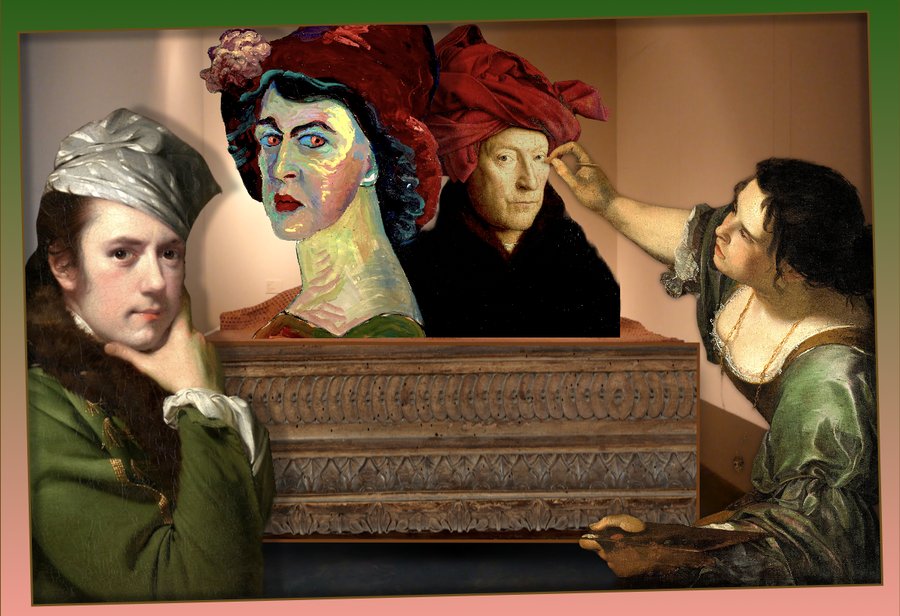
Jan van Eyck's Portrait of a Man in a Red Turban (1433) carries an inscription many scholars read as the painter's own signature boast — and its penetrating, direct gaze is widely believed to be the earliest surviving self-portrait in Western oil painting. Joseph Wright of Derby, celebrated for candlelit scenes of scientific experiment, and Marianne von Werefkin, the Russian-born Expressionist whose 1910 self-image is as psychologically searching as anything from her Blaue Reiter circle, bring the tradition into more modern territory. At the group's center, Artemisia Gentileschi's Self-Portrait as the Allegory of Painting (1638-39) remains one of art history's boldest gestures: a woman painter literally embodying the personification of Painting itself, brush in hand.
Il Ritratto d'uomo con turbante rosso (1433) di Jan van Eyck reca un'iscrizione che molti studiosi leggono come un'orgogliosa firma del pittore — e il suo sguardo penetrante e diretto è ritenuto da molti il più antico autoritratto sopravvissuto della pittura a olio occidentale. Joseph Wright of Derby, celebre per le sue scene di esperimenti scientifici a lume di candela, e Marianne von Werefkin, l'espressionista russa il cui autoritratto del 1910 è introspettivo quanto qualsiasi opera del suo circolo del Blaue Reiter, portano la tradizione in territorio più moderno. Al centro del gruppo, l'Autoritratto come allegoria della Pittura (1638-39) di Artemisia Gentileschi resta uno dei gesti più audaci della storia dell'arte: una pittrice che incarna letteralmente la personificazione della Pittura stessa, pennello in mano.
Sala Prove
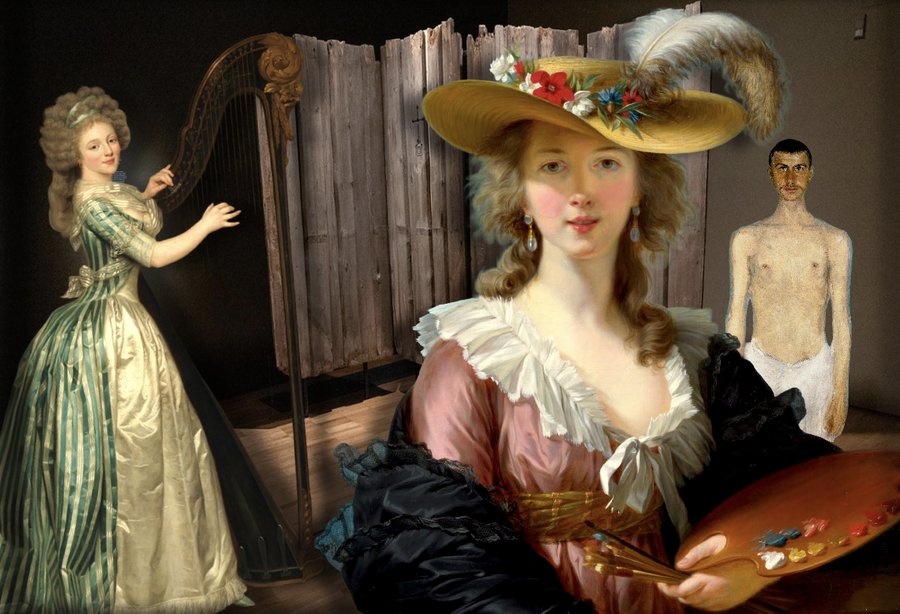
Rose Adélaïde Ducreux, daughter and pupil of the miniaturist Joseph Ducreux, painted herself with a harp in 1791 — an accomplished Neoclassical self-portrait that doubles as proof of a proper lady's education in the arts. Élisabeth Vigée Le Brun, portraitist to Marie Antoinette and one of the most successful painters of her generation regardless of gender, painted several confident self-portraits around 1782, radiating the professional poise that carried her through the Revolution and years of European exile. Richard Gerstl's 1902 self-portrait belongs to the early, still-tentative period of a short, turbulent career that would end in suicide at 25 — a rehearsal, in every sense, for the raw nudes still to come.
Rose Adélaïde Ducreux, figlia e allieva del miniaturista Joseph Ducreux, si ritrasse con un'arpa nel 1791 — un accomplished autoritratto neoclassico che è anche la prova della corretta educazione artistica di una signora. Élisabeth Vigée Le Brun, ritrattista di Maria Antonietta e tra le pittrici di maggior successo della sua generazione a prescindere dal genere, dipinse diversi autoritratti sicuri di sé intorno al 1782, irradiando quella disinvoltura professionale che l'avrebbe accompagnata attraverso la Rivoluzione e anni di esilio europeo. L'autoritratto di Richard Gerstl del 1902 appartiene al periodo ancora acerbo di una carriera breve e turbolenta, conclusa con il suicidio a 25 anni — una vera e propria prova generale, in ogni senso, dei nudi crudi che sarebbero arrivati.
Visita a Sorpresa
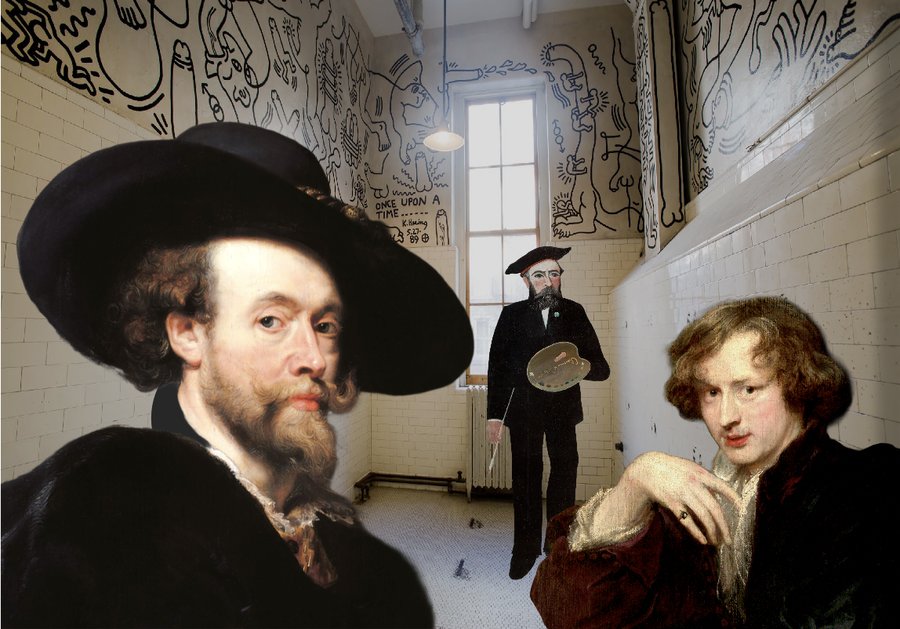
Peter Paul Rubens, by 1623 Europe's most sought-after and diplomatically connected painter, brought the same easy grandeur to his own likeness as to his royal patrons. Anthony van Dyck, his brilliant pupil, painted his own self-portrait around 1620-21 while still in his early twenties and still working in Rubens's Antwerp studio, on the verge of the independent career in Genoa and London that would make him a portraitist in his own right. Henri Rousseau's Myself: Portrait-Landscape (1890) — the self-taught customs officer standing improbably large over a Parisian riverbank, palette in hand — drops in on this company of Baroque masters like an uninvited but utterly unbothered guest.
Peter Paul Rubens, già nel 1623 il pittore più ricercato e diplomaticamente influente d'Europa, portò nella propria immagine la stessa disinvolta grandiosità riservata ai suoi committenti regali. Anthony van Dyck, il suo brillante allievo, dipinse il proprio autoritratto intorno al 1620-21 quando aveva poco più di vent'anni ed era ancora attivo nella bottega anversese di Rubens, alla vigilia della carriera indipendente tra Genova e Londra che ne avrebbe fatto un ritrattista a pieno titolo. Me stesso: ritratto-paesaggio (1890) di Henri Rousseau — il doganiere autodidatta che si erge, improbabilmente enorme, su un argine parigino, tavolozza alla mano — si intrufola in questa compagnia di maestri barocchi come un ospite non invitato ma per nulla intimorito.
AutoRitratti d'Artista is part of Blu Artworks' wider body of work — 577 original SIAE-registered collages in total. Explore the AutoRitratti d'Artista fa parte del lavoro più ampio di Blu Artworks — 577 collage originali registrati SIAE in totale. Esplora la Full GalleryGalleria Completa.