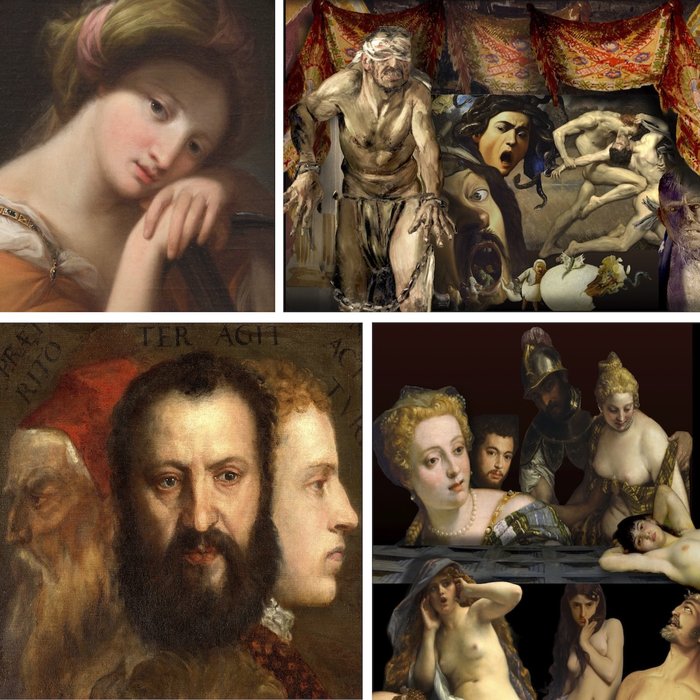
Vices vs Virtues
Seven Vices, Seven Virtues in Art
14 collages in this catalogcollage in questo catalogo
An attempt to represent human vices and virtues through details drawn from the history of art, composing new allegorical images across fourteen original collages — seven vices and seven virtues, the deep-seated inclinations that lead us astray and the ‘antibodies of the soul’ that help us act well. Each piece below is available as a high-resolution, 300dpi, royalty-free download for €39, ready for print at any size.
Download Catalog PDF →Scarica il Catalogo PDF → View All Collections →Vedi Tutte le Collezioni →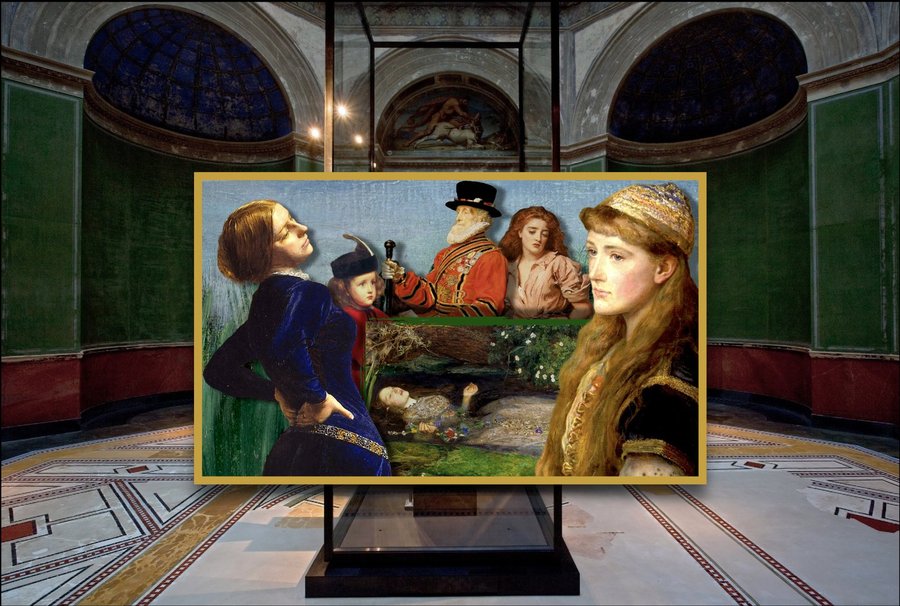
Accidia (Sloth)
Sloth is a profound state of indifference, apathy, and aversion to action, often described as a ‘sadness of the soul’ that leads to the neglect of one's duties and the good — akin to depression, abulia, and apathy, manifesting as an absence of desire and purpose. Thomas Aquinas defined it as the ‘sorrow for spiritual good.’
For the collage, we chose the style of the British artist John Everett Millais, characterized by a combination of realism, emotion, and technical refinement — a timeless master of 19th-century art.
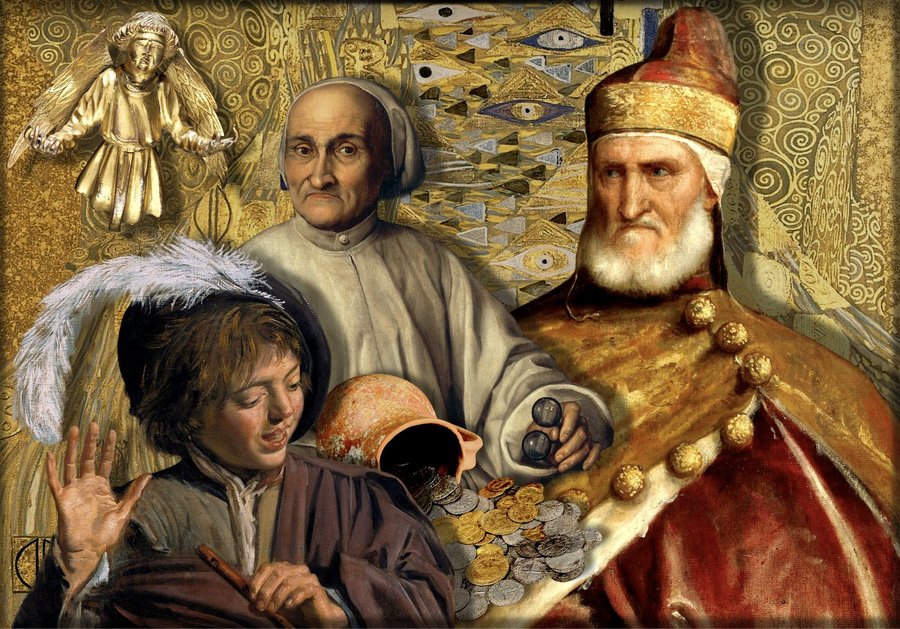
Avarizia (Avarice)
Avarice is an excessive attachment to money and material goods. Recognized as one of the seven deadly sins, it differs from greed in its focus on hoarding rather than accumulating. “The avaricious person is defined as a sinner not because they love some good of this world, but because their love for this good is immoderate… sin begins not with the possession of money, but with its ‘misuse’ — when money ceases to be a means and becomes an end.” (Renato Boccardo)
From left to right, the three portraits are owed to three masters: Frans Hals (1623), Fede Galizia (1592), and Titian (1546).
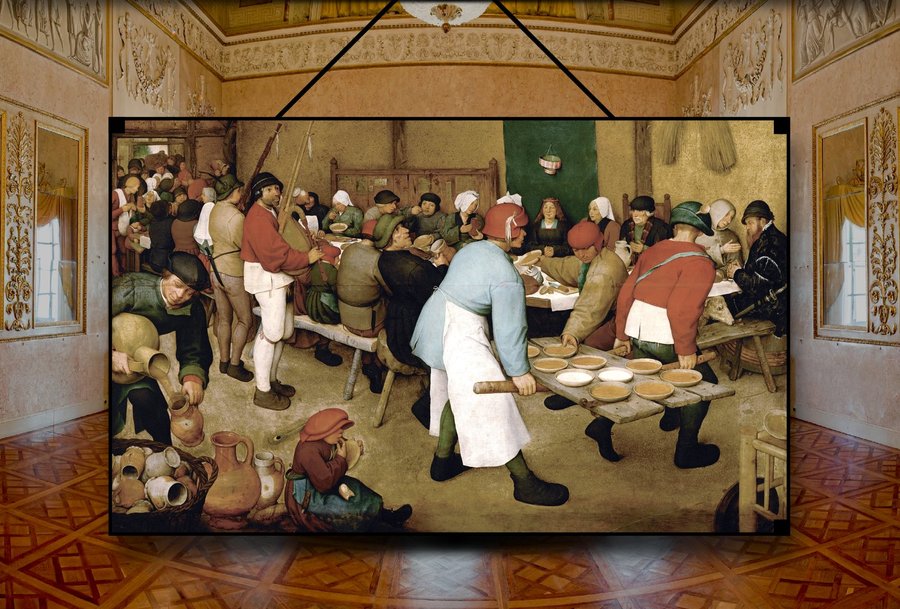
Gola (Gluttony)
Gluttony is considered a vice because it represents a degeneration of instinct and a lack of moderation, prioritizing bodily gratification over the care of the soul; it also carries a social dimension, historically viewed as an injustice amid widespread poverty.
The painting depicts The Peasant Wedding, a masterpiece by the Flemish painter Pieter Bruegel the Elder, created around 1568–1570 and housed at the Kunsthistorisches Museum in Vienna — rich with details of daily life from the era, including clothing and ceramic tableware.
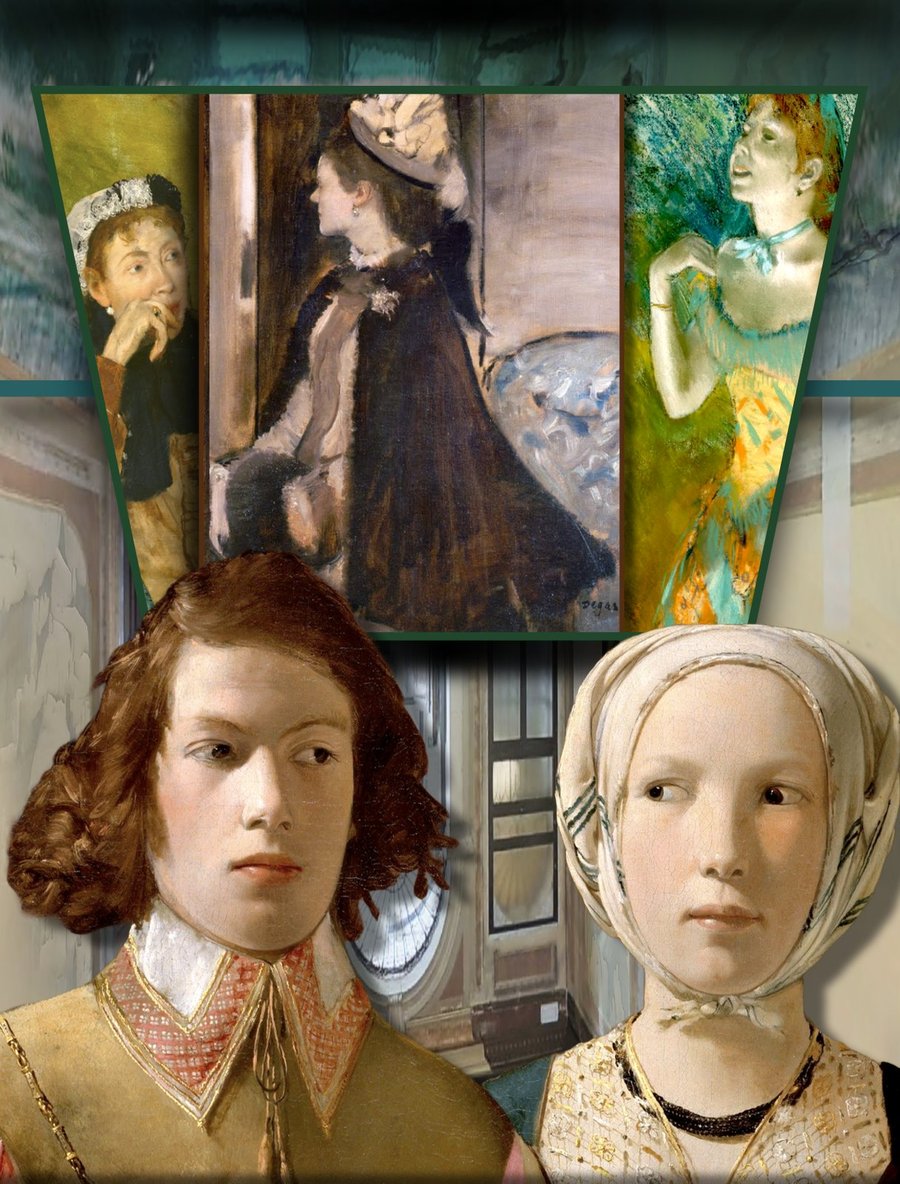
Invidia (Envy)
Considered by Saint Augustine to be the ‘diabolical sin par excellence,’ envy is the sadness felt over the good fortune of others — the vice that leads Cain to kill Abel, giving rise to hatred, slander, detraction, and joy in the misfortunes of others. In Dante's Purgatorio, the envious are punished by having their eyes sewn shut with iron wire, symbolizing their refusal to look upon their neighbors with love.
The couple in the collage is taken from a painting by the French artist Georges de La Tour (1630), depicting a naive young man being robbed by the girl beside him and her accomplices while an old fortune-teller distracts him. The figures above draw on Edgar Degas, whose almost analytical fascination with the female world captured women in the natural, spontaneous dynamism of everyday gestures.
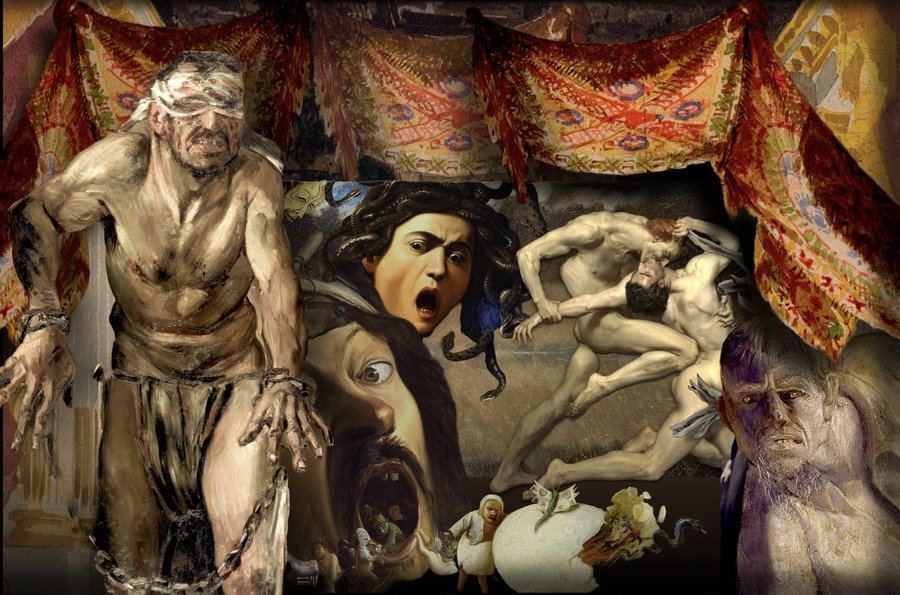
Ira (Wrath)
Wrath is one of the seven deadly sins, defined as an inordinate desire for revenge and a violent reaction that clouds reason — a deep vice that degrades natural aggressiveness into selfishness and destruction, leading to resentment, violence, and division. Christian tradition proposes overcoming it through meekness.
In the collage, the two wrathful figures are portrayed by two German artists: Lovis Corinth (1912), a representative of German Impressionism, and Otto Dix (1930), a leading figure of the artistic avant-garde that emerged in post-WWI Germany.
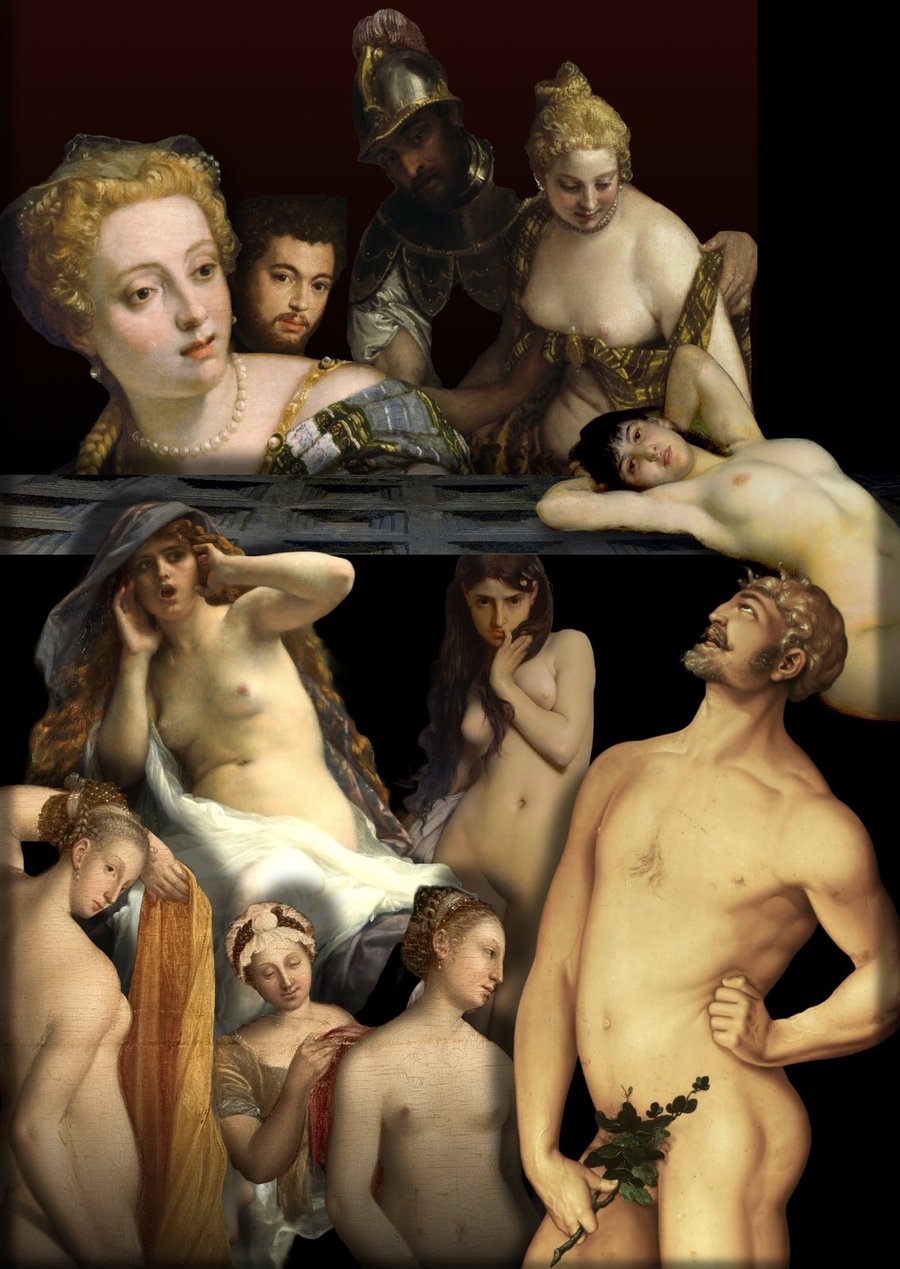
Lussuria (Lust)
Lust is a deadly sin characterized by an immoderate pursuit of physical pleasure and a reckless abandonment to passion, devoid of the control of reason or morality — often severing sexuality from genuine affection and reducing it to mere gratification.
Paolo Veronese, a leading figure of the great 16th-century Venetian art scene alongside Titian and Tintoretto, contributes one portrait. The German artist Hans Baldung (1484–1545), Dürer's finest pupil and a painter particularly drawn to the theme of demonic power arising from sexuality, contributes another — his allegories of erotic female nudes carrying messages linked to the concept of death.
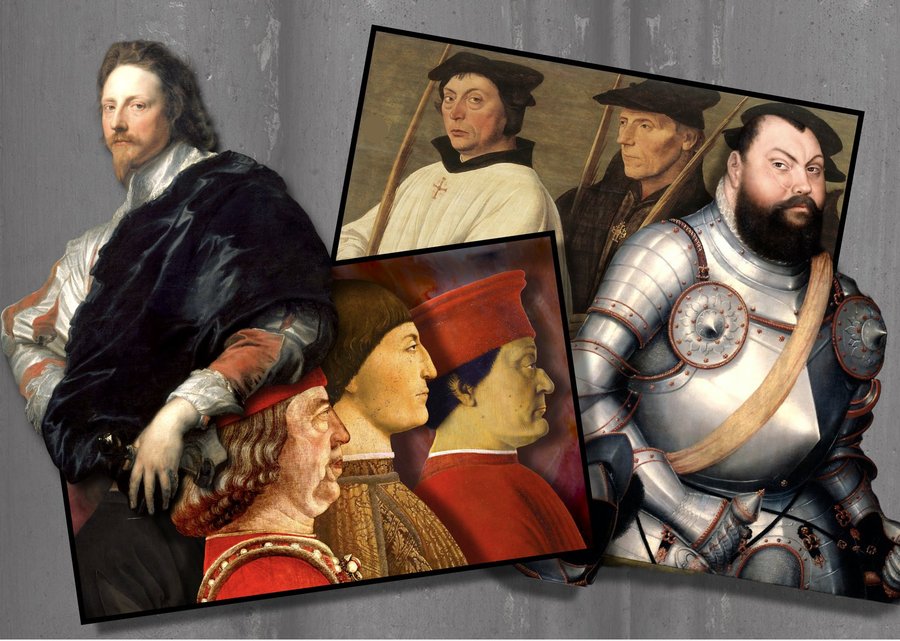
Superbia (Pride)
Pride is an exaggerated self-esteem, accompanied by an ostentatious sense of superiority and contempt for others — the Renaissance man, vigorous yet unstable, physically accustomed to military exercise and hunting, his sensitivity excessive and uncontrollable, ready to be overwhelmed by anger, tears, and violence: a man full of contrasts, rendered insensitive to the spectacle of suffering and death.
The collage brings together contributions from three great artists of the period: Jan van Scorel, Lucas Cranach the Younger, and Anthony van Dyck.
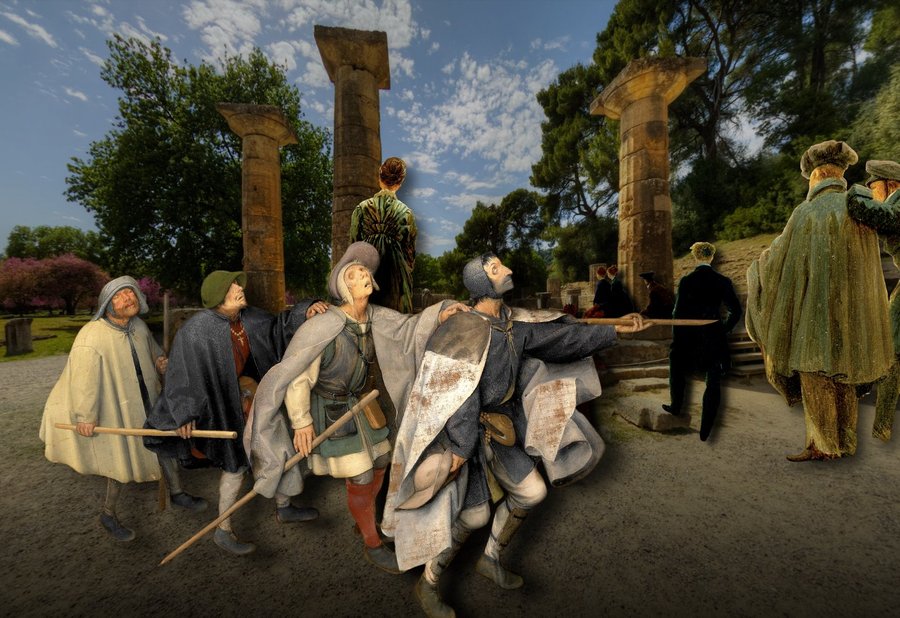
Carità (Charity)
“Charity opens men's hearts to the entire world and enables them to place the seal of love upon it through beneficence, almsgiving, and fraternal correction. If all men lived through charity, the world would be the paradise everyone has dreamed of.” (Alfred White)
The collage illustrates this often-overlooked virtue with two modified works: above, a group of people seen from behind, admiring archaeological wonders, taken from the works of Caspar David Friedrich; below, a group of blind beggars passes by unnoticed, from a painting by the Flemish artist Pieter Bruegel the Elder, dated 1568.
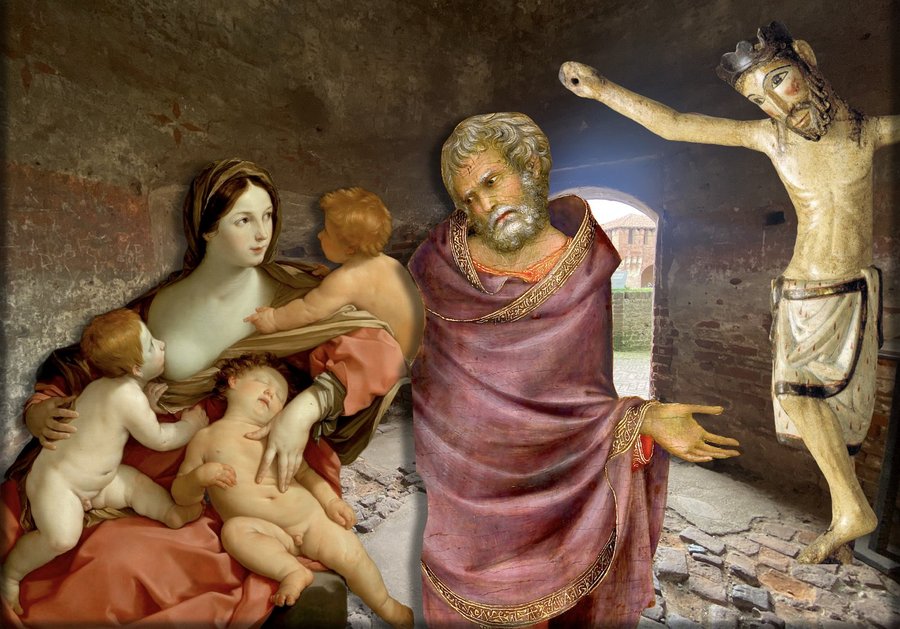
Fede (Faith)
Faith is one of the three theological virtues, along with hope and charity — understood by Christians as a divine gift that allows one to believe in God and in what He has revealed.
The invitation to have faith in Jesus Christ is represented by the bearded man in the portrait painted by Simone Martini in 1342, one of the leading artists of 14th-century Gothic art alongside Giotto. The gentle mother to whom the old man turns was painted by the Bolognese artist Guido Reni in 1630 — ‘the divine Guido,’ the most illustrious painter of the Bolognese school.
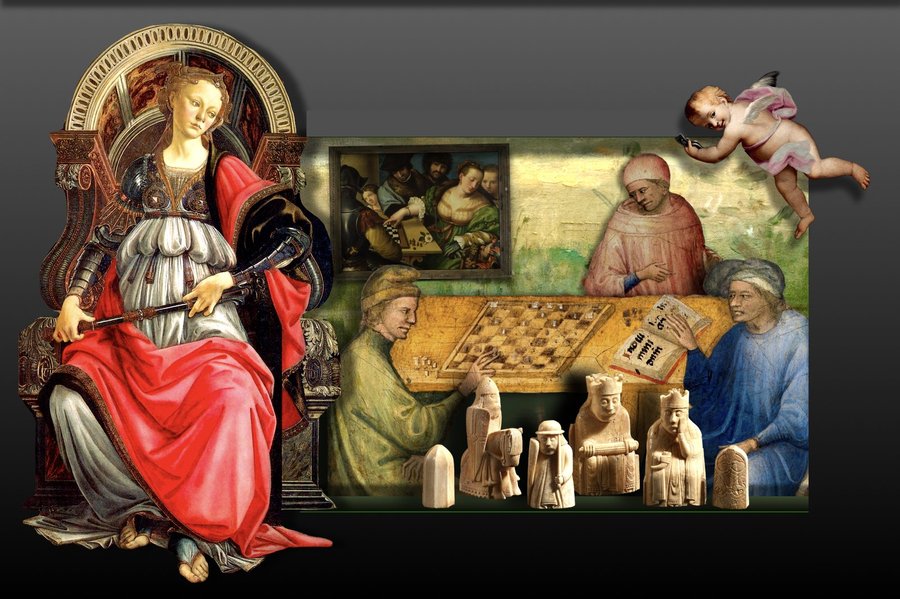
Fortezza (Fortitude)
The virtue of fortitude enables one to overcome fear, even the fear of death, and to face trials and persecution, granting the courage to renounce and sacrifice one's own life to defend a just cause. Pope Francis described it as the gift by which “the Lord always comes to sustain us in our weakness.”
Fortitude is depicted by Sandro Botticelli as a young woman in armor over a graceful gown, holding the scepter of command — a painting displayed at the Uffizi Gallery in Florence, dated 1470. We added the ancient game of chess, which requires great perseverance to play at a high level.
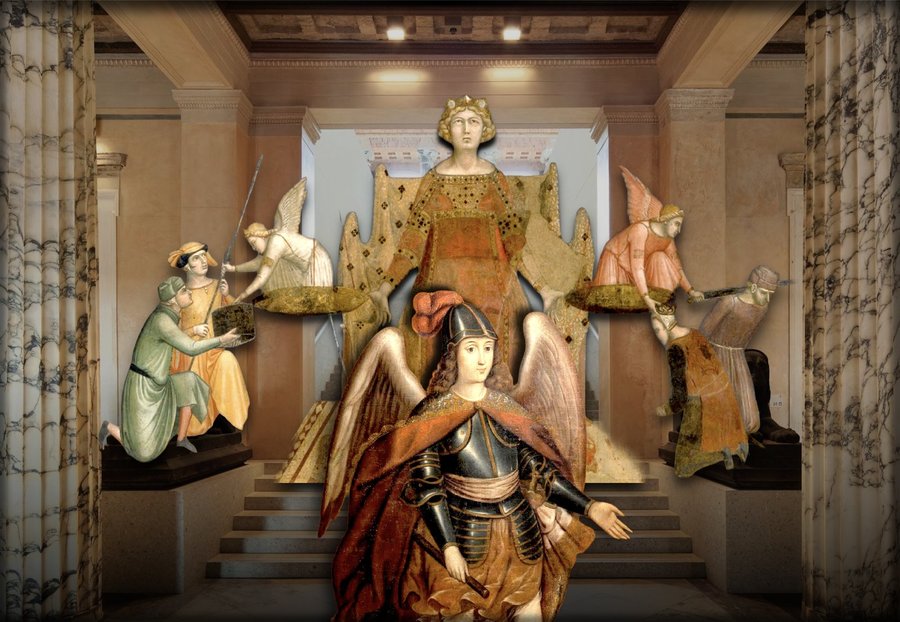
Giustizia (Justice)
Justice is the moral virtue that consists in the constant and firm will to give to God and neighbor what is due to them — often summarized by the Latin motto ‘unicuique suum,’ ‘to each their own.’
In the foreground is ‘The Embrace of Peace and Justice,’ painted by the Italian artist Marcantonio Franceschini in 1715; the old man attempting to separate them, his arms bound behind his back, is a detail from Giorgio Vasari's 1543 fresco ‘Allegory of Justice.’ “Justice without force is impotent; force without justice is tyrannical.” (Blaise Pascal, Pensées)
Prudenza (Prudence)
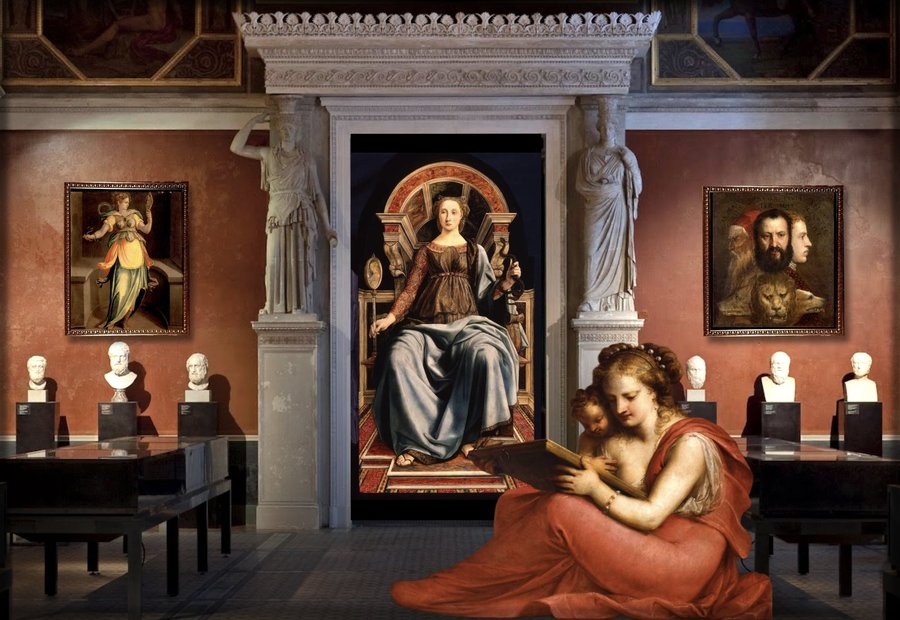
Prudence is the first of the four cardinal virtues, defined as ‘practical wisdom.’ It is not timidity, but a virtue that illuminates and guides justice, fortitude, and temperance — Dante points to prudence as one of the most important virtues necessary for achieving a moral life, an expression of good sense.
Four artistic contributions illustrate this collage: a painting by the Florentine Mannerist Giovanni Butteri (1588); the allegory of prudence painted in 1470 by the Tuscan brothers Piero and Antonio del Pollaiolo; a painting on the same theme by Titian (1570); and the portrait of the Venetian artist Pietro Liberi, dated 1661.
Speranza (Hope)
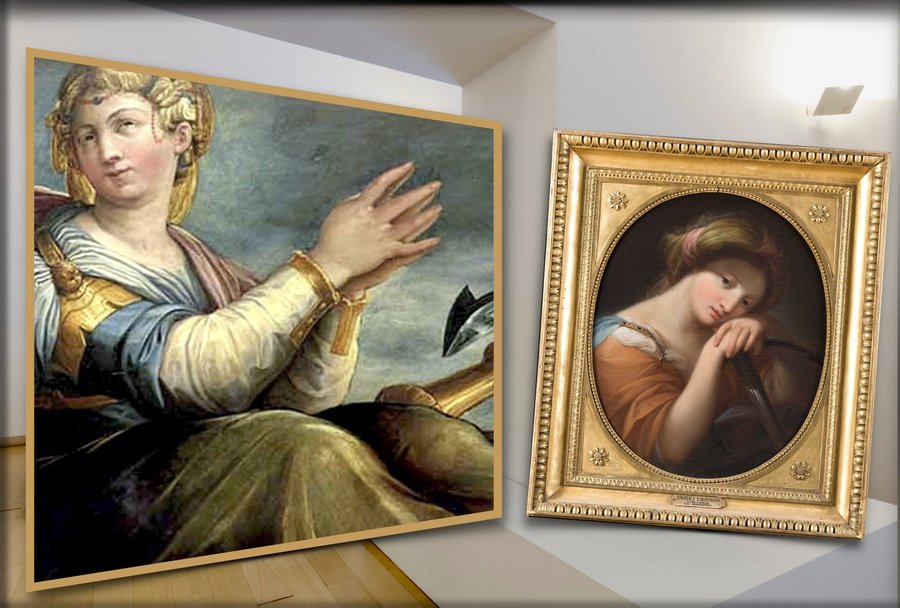
Hope, the smallest yet strongest of virtues. Pope Francis has often spoken of hope, encouraging us to look at our existence with new eyes, especially when it is severely tested, in the certainty that darkness will turn into light.
In the collage, Hope bears the face of the woman with folded hands beside the traditional symbol of the anchor, painted in 1542 by Giorgio Vasari, alongside the Allegory of Hope by the Swiss painter Angelica Kauffman (1765), in which many have recognized a self-portrait of the artist. For the Italian poet Giacomo Leopardi, hope is man's greatest good, because it allows him to cultivate pleasure even in anticipation of it.
Temperanza (Temperance)
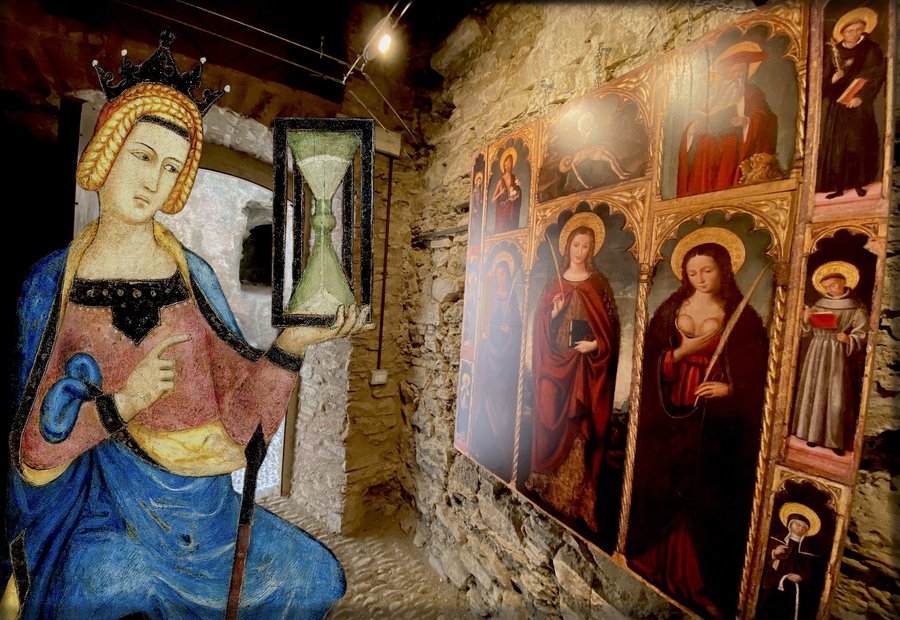
Temperance is a virtue that moderates the attraction of pleasures, ensures the mastery of the will over instincts, and keeps desires within the limits of honesty and proper measure — bringing inner harmony and moderating passions and senses.
The hourglass held by Temperance is a reminder to use time wisely, a detail drawn from the great fresco by Ambrogio Lorenzetti, painted in Siena between 1338 and 1339. The hourglass is also a symbol of political virtue, representing balanced public governance — the union of moderation with the awareness of the finiteness of time.
Vices vs Virtues is part of Blu Artworks' wider body of work — 577 original SIAE-registered collages in total. Explore the Vices vs Virtues fa parte del lavoro più ampio di Blu Artworks — 577 collage originali registrati SIAE in totale. Esplora la Full GalleryGalleria Completa.