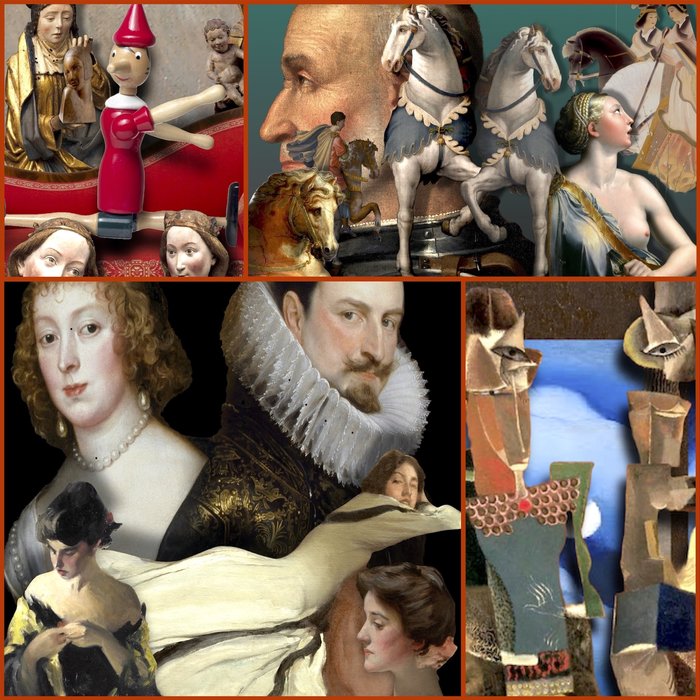
Tema Libero
Twenty-Seven Collages Bound by No Single Theme
27 collages in this catalogcollage in questo catalogo
Tema Libero — Italian for “free theme” — is the catalog with no unifying subject by design: twenty-seven collages that range from Artemisia Gentileschi's Judith retold twice over, to a Venetian carnival diptych, to Bruegel's Tower of Babel measured against the modern skyline. Each piece is available as a high-resolution, 300dpi, royalty-free download for €39, ready for print at any size.
View Full Gallery →Vedi la Galleria Completa → View All Collections →Vedi Tutte le Collezioni →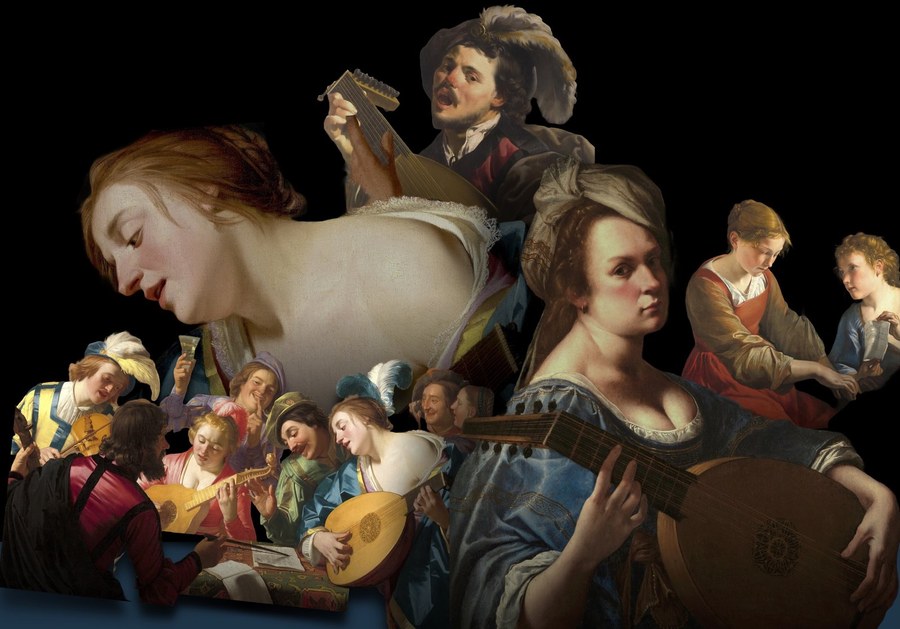
A Mysterious Hand
A pale reclining woman, one arm curved above her head in an unmistakably classical pose, occupies the foreground while a cluster of musicians sing and play matching lutes behind her, lit with the warm chiaroscuro of an early Baroque tavern scene.
The pose echoes the reclining Venus convention Titian fixed for good in his Venus of Urbino (1538), while the huddle of lute players recalls Caravaggio's own early Roman years and paintings like The Musicians (c.1595, Metropolitan Museum of Art) — pairing the idealized nude with the boisterous, unglamorous music-making Caravaggio preferred over myth.
Angelic Vision
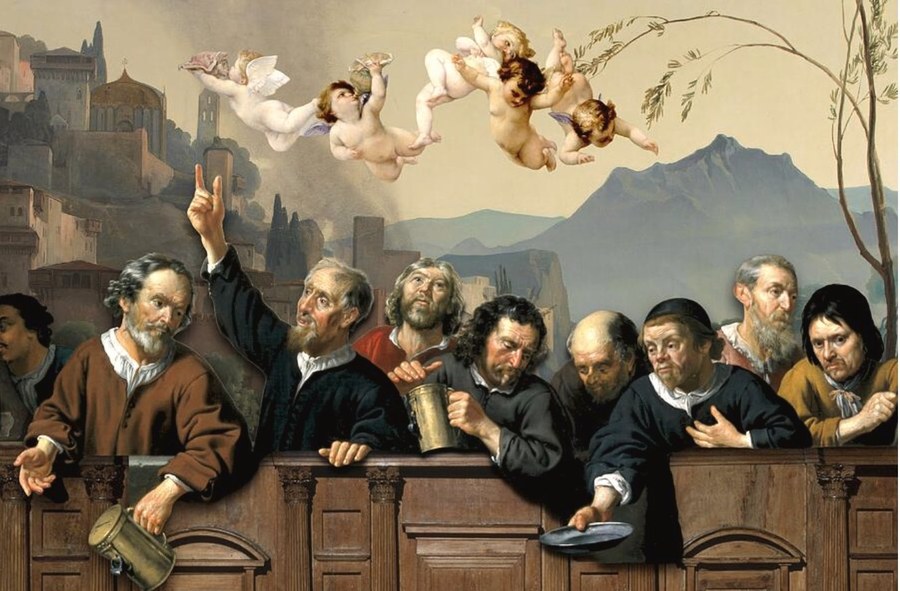
A cluster of men in dark Northern-European dress lean together over a table in earnest conference, gesturing and conferring, while small winged cherubs hover in the pale sky above them, one pointing downward as if delivering a message no one below has noticed yet.
The gathered, deliberating men recall the Dutch tradition of civic group portraiture — Rembrandt's The Syndics of the Drapers' Guild (1662) above all — while the putti overhead borrow a much older Baroque religious device: divine sanction or warning breaking quietly into an otherwise unremarkable meeting.
Attack on Symbols
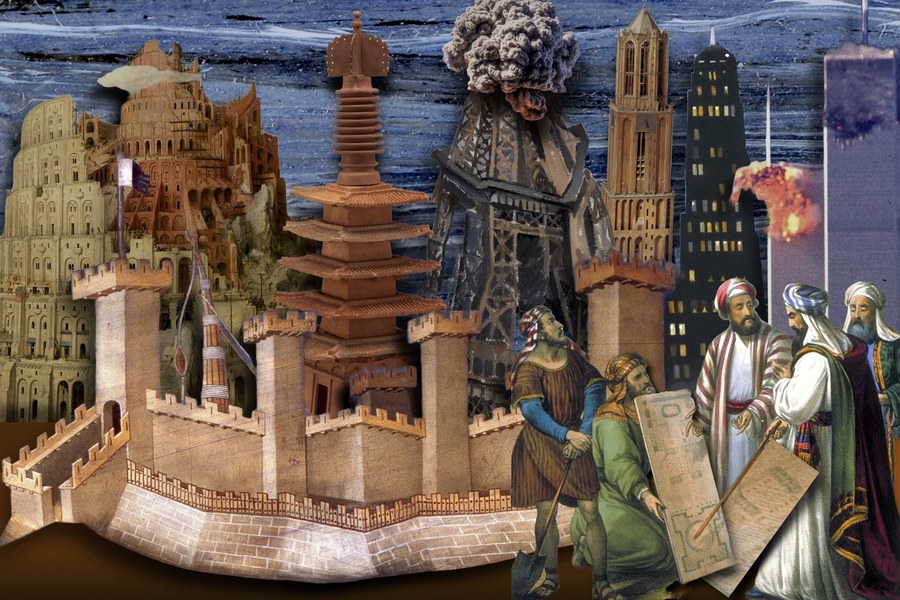
A procession of humanity's most ambitious towers spans centuries in a single band: Bruegel's tiered Tower of Babel anchors the left, a Japanese pagoda and a Gothic cathedral spire continue the theme of building toward the sky, and on the right a modern high-rise stands beside two towers rendered mid-catastrophe, smoke rising against a night skyline.
The Tower of Babel, as Pieter Bruegel the Elder painted it around 1563, was already a warning about the fate of monuments built to rival heaven; setting it beside a cathedral spire and a modern skyline — both marked here by loss, real losses this studio does not take lightly — extends that same old caution across architectural history rather than pointing at any single event. The robed figures below, plan in hand, stand in for the master builders every one of these towers once needed.
Attempted Corruption
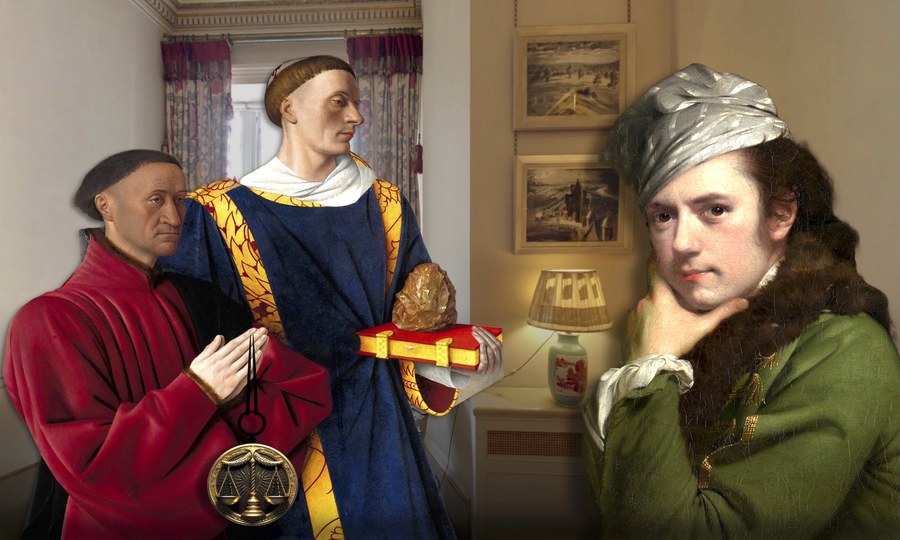
Three richly dressed Renaissance men huddle close around a small gleaming object passing between two pairs of hands, one man in a red robe and gold chain of office, an older man in a dark cap watching the exchange with narrowed, unreadable eyes.
Northern Renaissance painting returned again and again to exactly this kind of scene — Quentin Matsys' The Moneylender and His Wife (1514) and Marinus van Reymerswale's tax-collector paintings both used still, watchful faces gathered around a coin or ledger to moralize about greed without ever needing to spell it out.
Awkward Silences
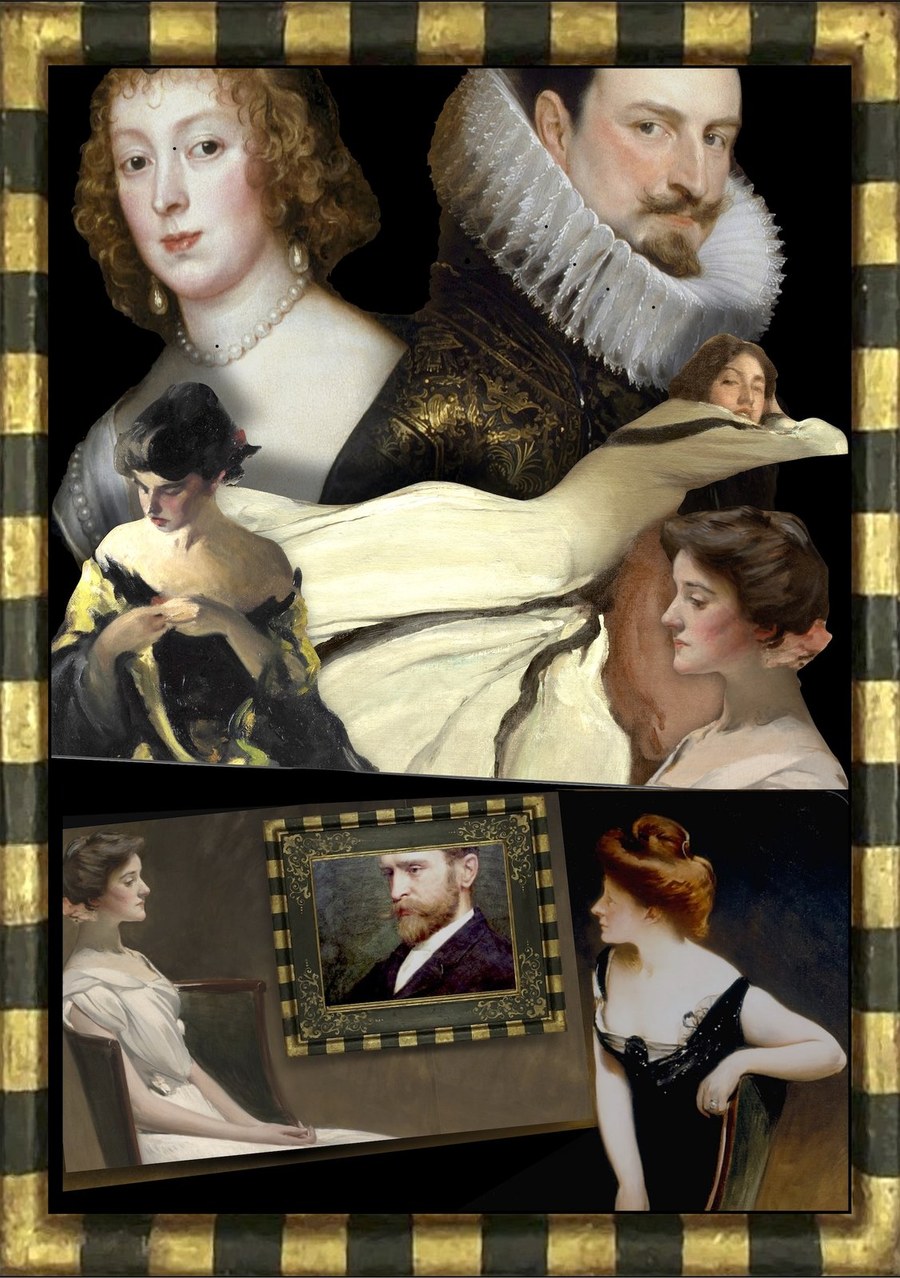
A tall filmstrip-bordered column stacks individual portraits one above the other — a man in a starched lace collar, a woman in a wide ruff, another woman in dark Golden Age dress — each sealed in its own frame, one hung slightly askew, none of them looking toward each other.
The lace collars and severe black dress belong to the world of Frans Hals and his Dutch Golden Age contemporaries, portraitists who painted sitters to be self-possessed and psychologically closed. Stacking those closed-off likenesses into one column, each facing a different direction, turns a wall of individual portraits into a room where no two people in it ever quite meet each other's eyes.
Baroque Horror
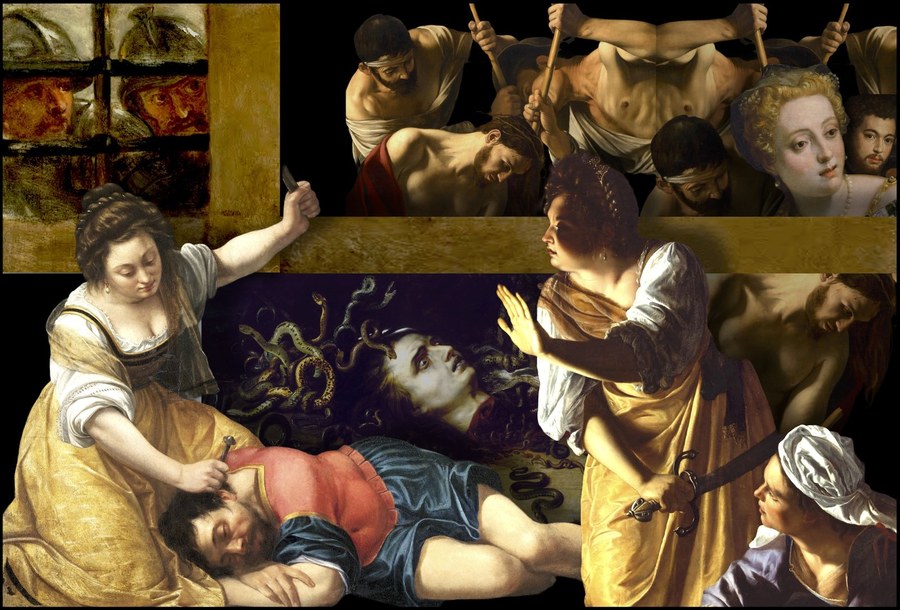
A woman in a golden bodice braces a man's head against a bed while a second woman drives a blade through his neck, blood and struggle rendered in unflinching close range; above them, a flagellation scene shows a bound man struck by raised rods, and Medusa's snake-wreathed head shrieks in the same frame.
The beheading is Artemisia Gentileschi's Judith Beheading Holofernes (c.1620, Uffizi), among the most physically direct paintings of the Italian Baroque, made not long after Gentileschi's own well-documented trial for assault; the screaming head is Caravaggio's Medusa (c.1597). Both painters built reputations on refusing to soften violence for comfort — this piece keeps that refusal intact, and its subject overlaps deliberately with this same catalog's Judith and Holofernes, a far gentler telling of the identical episode.
Beginners at La Scala
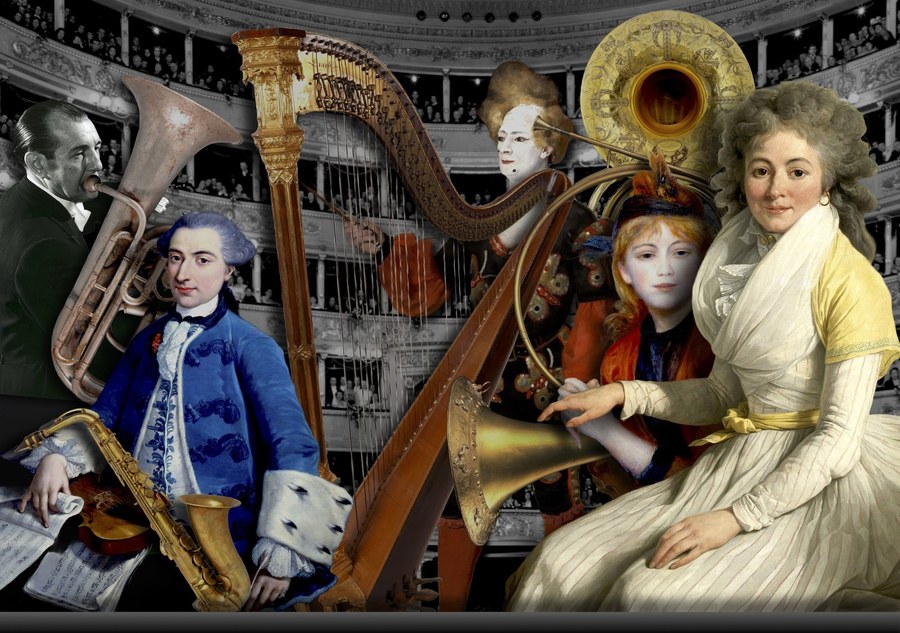
Young musicians pose with instruments too large for them — a gleaming tuba, a harp taller than its player — alongside elegant women in powdered wigs and pale silk, sheet music close at hand, the whole scene lit like a rehearsal room rather than a stage.
Teatro alla Scala has anchored Milan's musical life since it opened in 1778, and every performer who has ever taken its stage started exactly here — outsized instruments, aristocratic patronage, and the unglamorous work of practicing before anyone is watching.
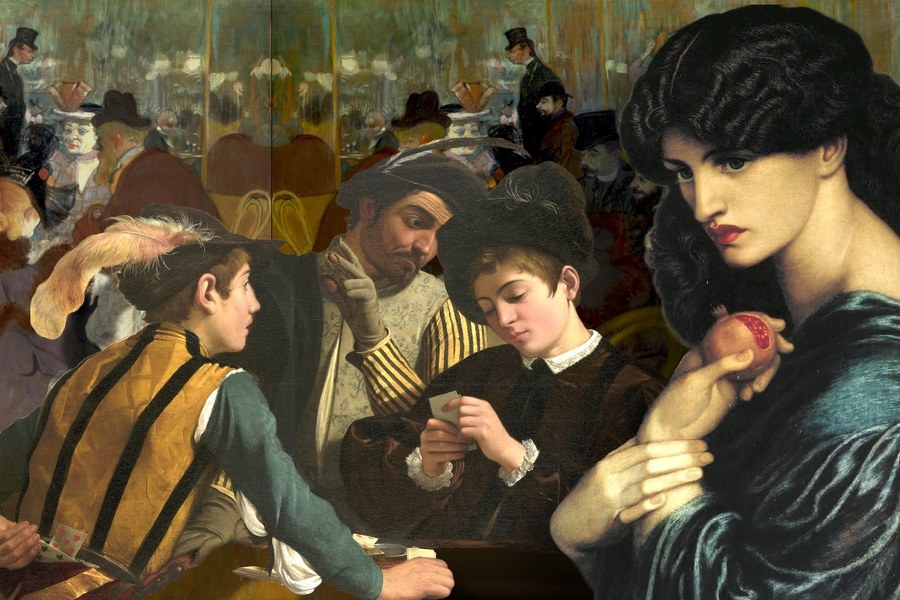
Cafe Chantant
Patrons in dark coats and top hats gather around small café tables while a dark-haired woman in the foreground turns to meet the viewer's eye directly, an apple or piece of fruit held loosely in one hand, her expression cool and appraising rather than inviting.
The café chantant was a real Belle Époque institution — informal Parisian singing-cafés that flourished from the 1880s through the 1900s and gave Toulouse-Lautrec many of his best subjects. The woman's direct, unbothered gaze back at the viewer owes just as much to Manet's A Bar at the Folies-Bergère (1882), which turned that same appraising stare into one of the era's defining images.
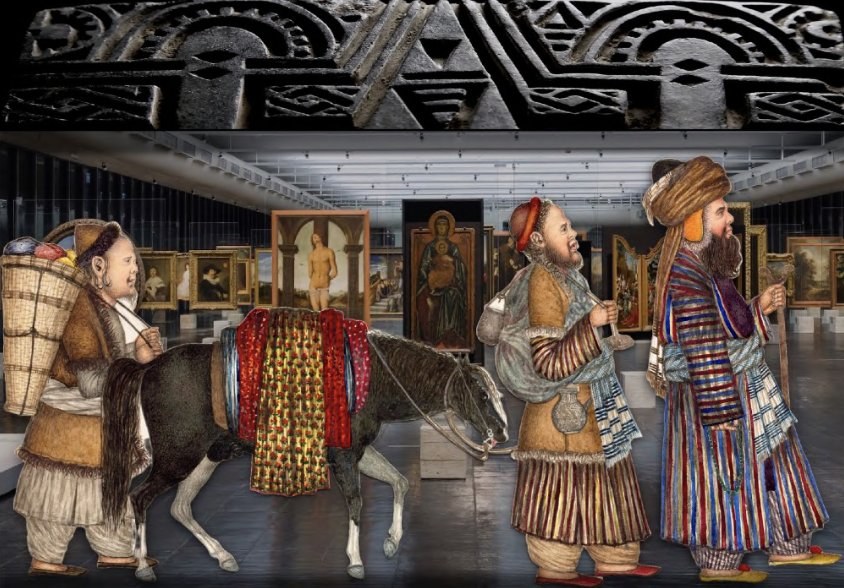
Closing Time
A gallery hung with framed paintings sits empty of visitors at day's end, its usual quiet interrupted by a small procession — travelers in richly patterned Central Asian robes and turbans leading a horse and a laden pack animal straight through the room.
Museum collections are built from objects that traveled immense distances to end up on a gallery wall; imagining those distant origins as literal travelers, still moving, still en route, arriving just as the doors are meant to close, makes visible the journey every framed object in the room already quietly represents.
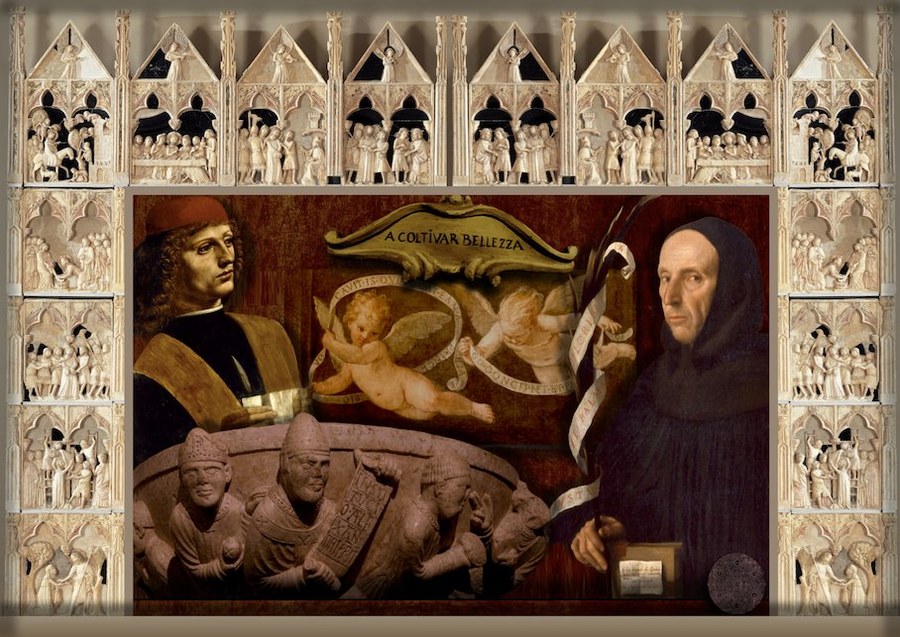
Coltivar Bellezza
A tier of small gold-ground saint portraits runs across the top of the panel like an altarpiece predella, while below, a hooded friar in dark robes stands beside a solemn portrait bust of a fur-collared nobleman and a cherub unfurling a ribbon banner.
Quattrocento Italian altarpieces almost always paired their grand central image with a predella — a horizontal strip of smaller devotional scenes running along the base, a convention the Sienese and Florentine schools used for generations. Borrowing that structure for a nobleman's portrait and a monk's quiet vigil treats coltivar bellezza, cultivating beauty, as a pursuit worth the same reverence once reserved for saints.
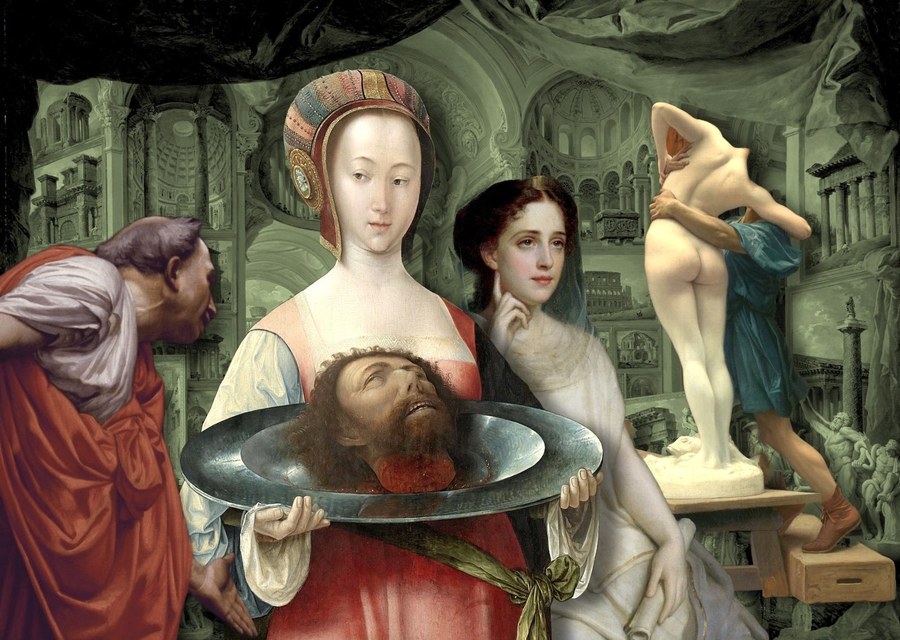
Compassion Lost Forever
A young woman in profile holds a wide platter bearing a bearded man's severed head, her expression composed and untroubled rather than horrified, flanked by two other women and a pale sculpted nude figure in the shadows behind them.
This is Salome, holding the head of John the Baptist, and the calm, almost serene handling belongs to Andrea Solario's Salome with the Head of Saint John the Baptist (c.1507–09, Louvre) — a Lombard treatment prized for its coolness, in sharp contrast to the anguished versions later Baroque painters preferred. That very absence of visible horror is what gives the title its edge.
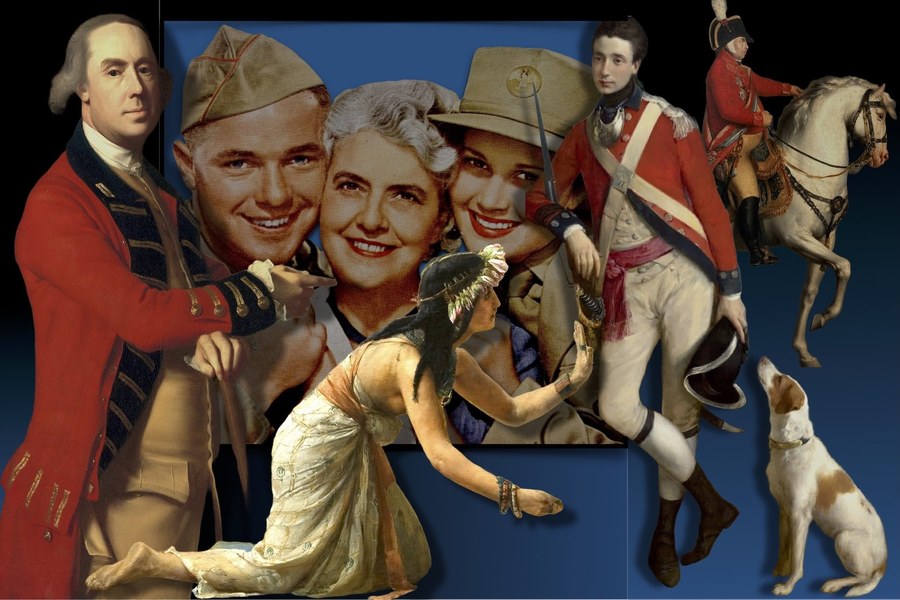
Compulsory Conscription
A colonial-era officer in red coat and tricorn stands beside a mounted cavalryman, both rendered in eighteenth-century military dress, while black-and-white photographic portraits of mid-twentieth-century servicemen and an older woman fill the space behind them.
Laid side by side, an eighteenth-century officer and a photographed twentieth-century recruit describe the same demand made of very different generations — men in uniform across two hundred years of American military history, called to serve by an obligation that changed its face far more than its substance.
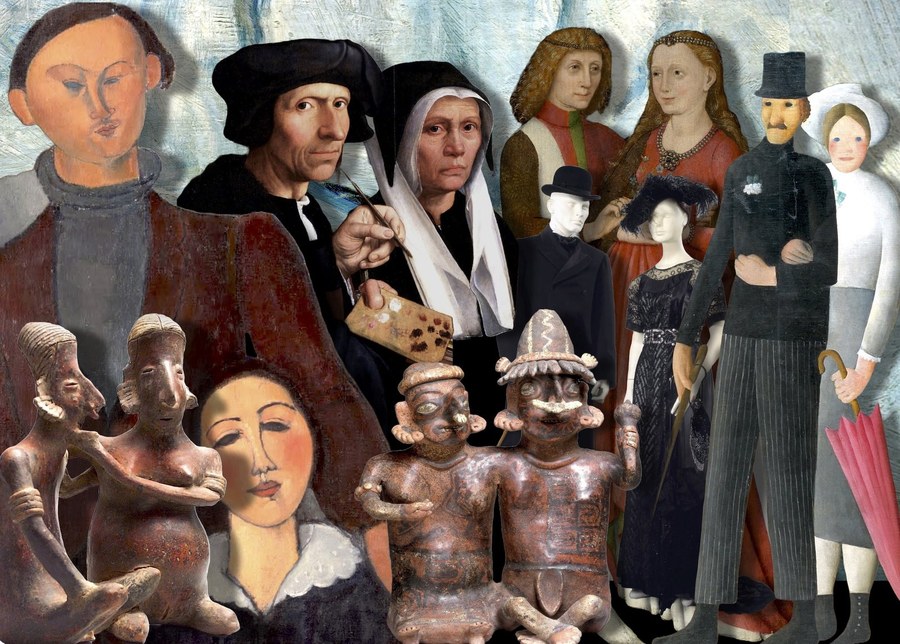
Couples
Small terracotta and stone busts with simplified, mask-like features sit beside a hooded monk in dark robes, a cluster of Renaissance-dressed portrait figures, and a modern man in a black suit and top hat standing apart from all of them.
None of the figures here are paired off romantically — the title works instead as a study in unlikely companionship, sculpture set beside painting, a monastic habit set beside modern tailoring, each pairing making the other look stranger and more particular by contrast.
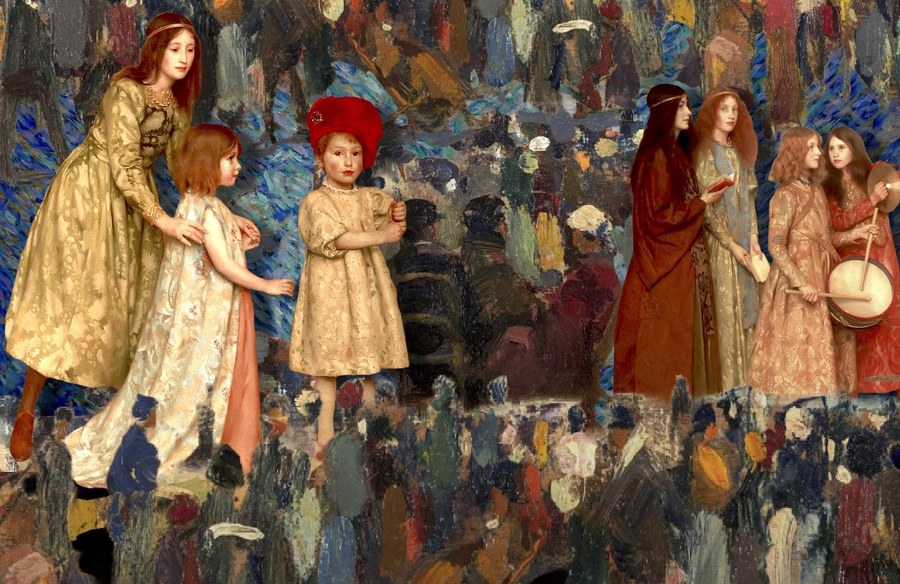
Far from the Madding Crowd
A dense, sunlit crowd of women and children in warm Edwardian dress moves through a busy public gathering, rendered in the loose, broken brushwork of Impressionist plein-air painting, the multitude filling nearly the entire frame.
The title borrows Thomas Hardy's 1874 novel Far from the Madding Crowd, which itself lifted the phrase from Thomas Gray's 1751 Elegy Written in a Country Churchyard — both promising rural solitude away from the crowd. This piece delivers the opposite on purpose: not solitude but its total absence, a crowd so dense there's no quiet corner left in the frame.
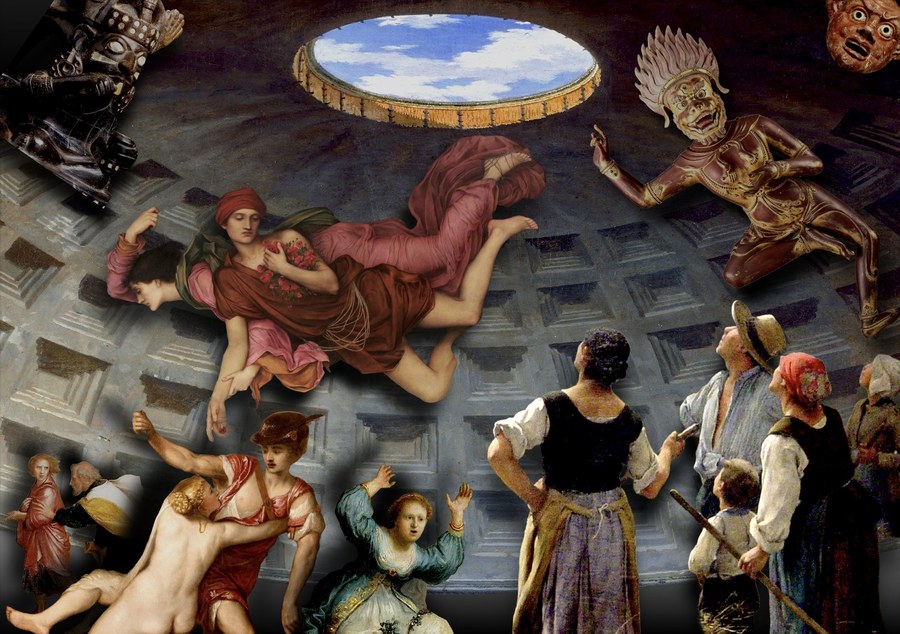
Fear at the Pantheon
A circular opening in a coffered ceiling frames a patch of blue sky, draped classical figures tumbling and floating around its rim, while a pale skeletal apparition looms at the edge of the light and Renaissance-dressed figures below react with alarm.
The oculus is unmistakably Rome's Pantheon, whose open ceiling has been its sole source of light — and, in every storm, of rain — for nearly two thousand years. Imagining that same ancient opening as a portal for something stranger than daylight turns the building's most famous architectural feature into the source of the fear the title names.
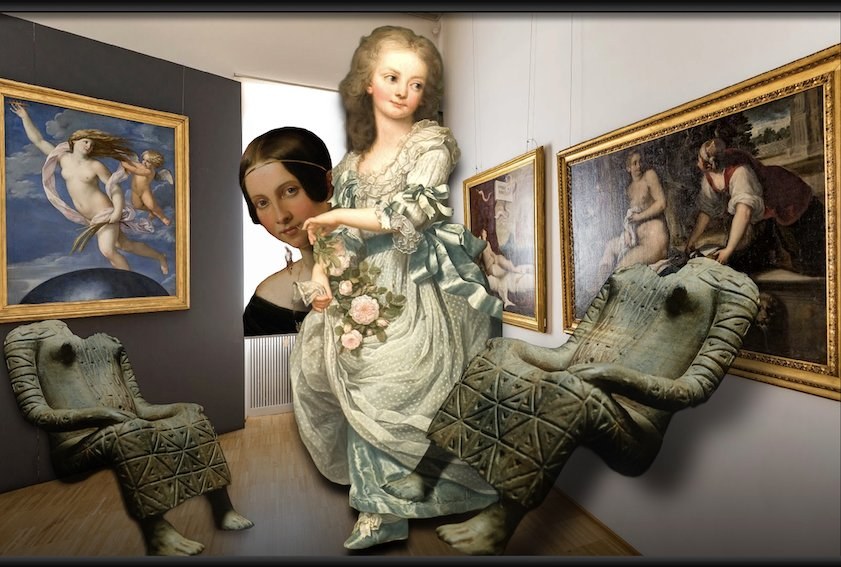
Guardians Absent
An elegant woman in white lace stands in a gallery-like domestic interior, a heavily carved wooden bench with animal-paw feet beside her and a gilt-framed reclining nude hanging on the wall just behind, the room otherwise still and unattended.
Nothing in the scene is out of place, which is exactly the point — a private collection or gallery room caught in the ordinary quiet of a moment when whoever usually watches over it has simply stepped away.
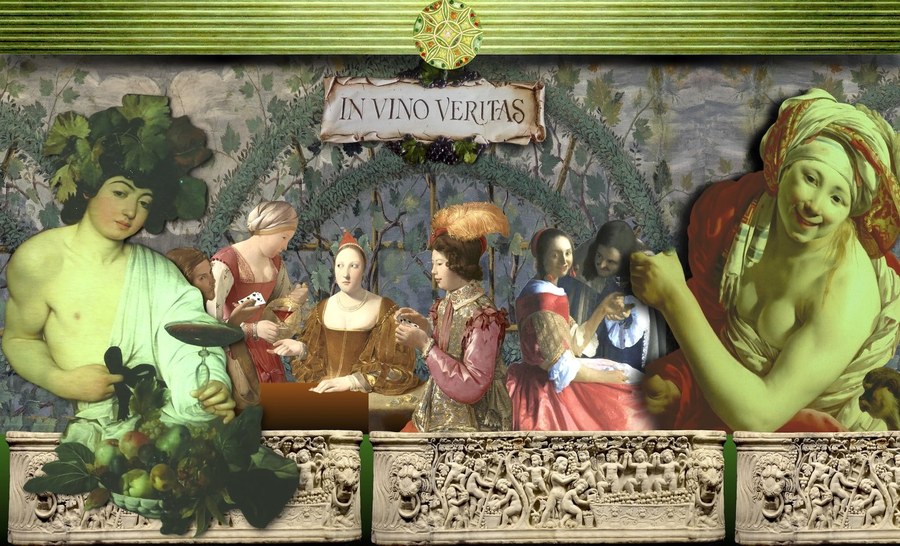
In Vino Veritas
A banner reading IN VINO VERITAS crowns a scene of seated women in Renaissance dress gathered around a reclining, green-skinned figure, a second green-tinted face looking on nearby, while carved skull reliefs run along the base of the composition.
"In wine, truth" is traced back to Pliny the Elder and was popularized for later centuries by Erasmus; pairing that old proverb about wine loosening the tongue with carved memento mori skulls follows a long vanitas-painting habit of setting pleasure and mortality in the same frame, so that neither one gets the last word.
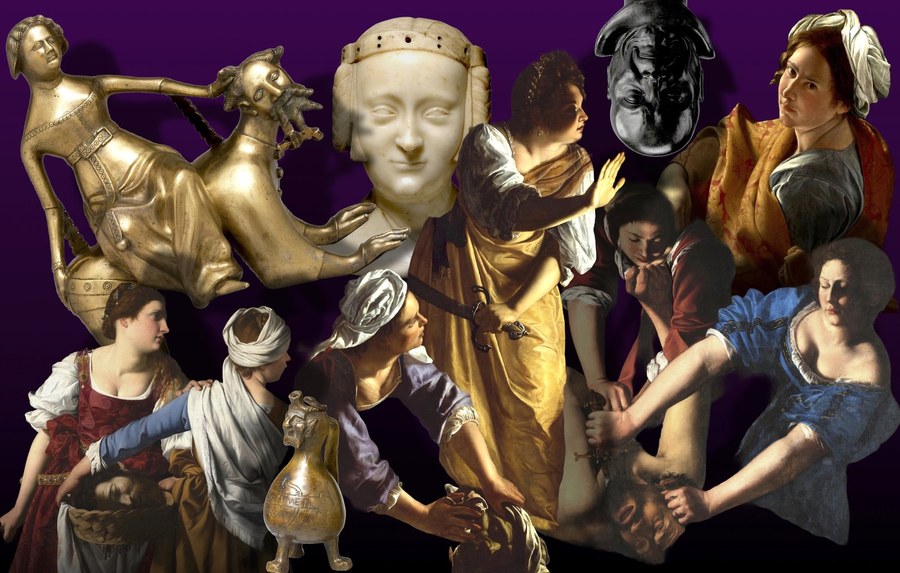
Judith and Holofernes
A woman in a golden robe grips a sword at her hip while a servant lowers a severed head into a basket nearby; a marble bust of a crowned woman, an ornate gilt statuette of a winged creature, and a fourth painted Judith in warm red all share the same purple ground.
Few biblical episodes have been painted as differently as this one: Artemisia Gentileschi and Caravaggio both rendered Judith's killing of Holofernes as raw physical struggle, Cristofano Allori turned it into a coded self-portrait with his own former lover cast as Judith, and Gustav Klimt later stripped the violence out entirely for Judith I (1901), an ornamental, gold-drenched icon closer in spirit to the gilt statuette included here. Gathering four centuries of that disagreement into one frame is the point — and this catalog's own Baroque Horror retells the same story from its most violent angle.
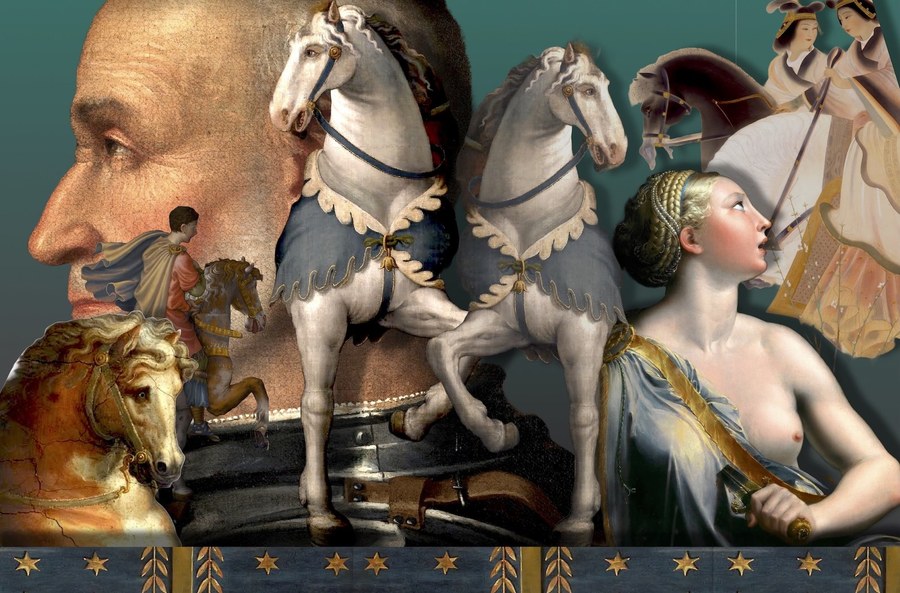
Knights and Amazons
An armored man's profile looms beside two rearing white horses rendered like heraldic statuary, a small mounted figure caught mid-charge below them, while a bare-shouldered woman wearing a jeweled headband looks upward, a border of stars and heraldic devices running along the base.
Rearing horses shown in strict profile are a convention as old as equestrian statuary and medieval tournament manuscripts, while the woman's raised gaze and diadem place her in the Amazon warrior-queen tradition — figures like Penthesilea and Hippolyta — that Renaissance and Baroque painters kept reviving as chivalry's mirror image and equal.
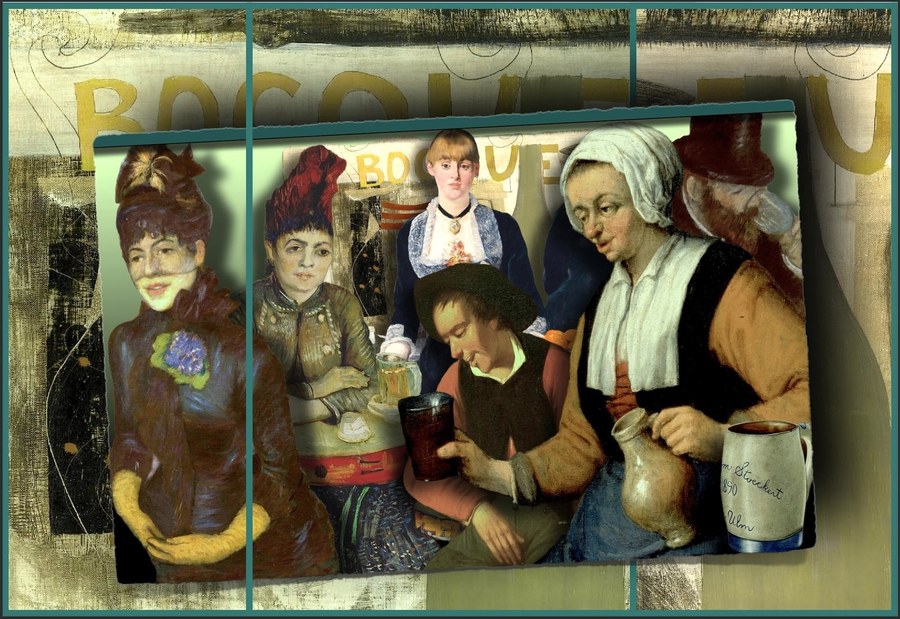
Loneliness
A faded, deliberately crackled panel shows peasants gathered around a table in muted earth tones, the paint surface aged and worn as though the scene itself has been quietly deteriorating for centuries, a fragment of lettering just barely legible along the top edge.
The cracked surface and Northern peasant-genre subject recall the tavern and cottage interiors Pieter Bruegel the Elder and his followers painted repeatedly in the sixteenth century — ordinary people gathered close together, rendered here as if age itself had slowly pulled them further apart.
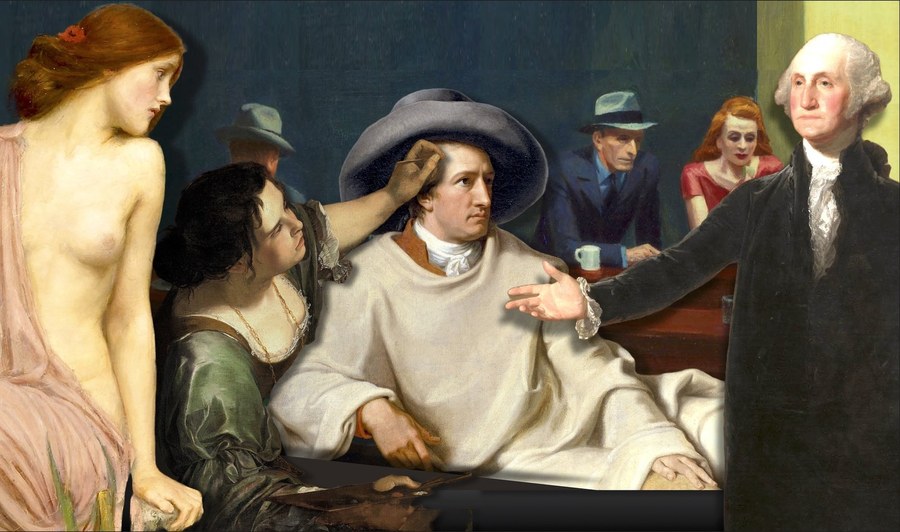
Makeup Mania
A woman with heavily rouged cheeks, dark-rimmed eyes and a flower tucked in her hair anchors one side of the frame, a nude academic figure and a bonneted Golden Age-style sitter fill the middle ground, a broad-hatted gentleman echoes Rembrandt's own self-portraits, muted diner patrons recall an American realist bar scene, and Gilbert Stuart's iconic, unfinished portrait of George Washington closes the composition on the right.
The theatrical stage makeup on the woman at left — powder, rouge, deliberate artifice — gives the piece its title and its organizing idea: every face gathered here, whether painted from life, staged for a cabaret audience, or immortalized on American currency, is in some sense made up, presented rather than simply seen.
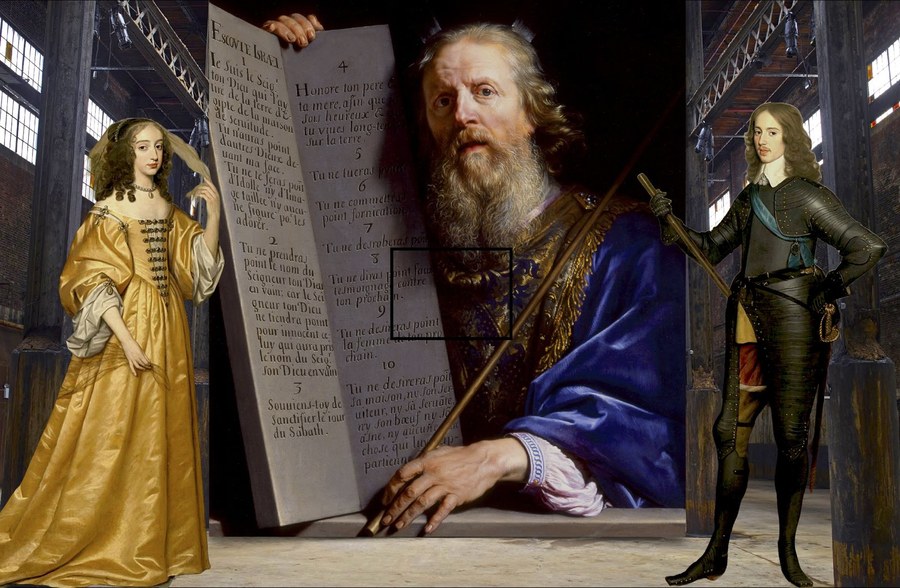
Marriage Contract
A man in a blue robe holds a slender rod while gesturing toward an open document held up by a woman in a gold gown, a young page attending quietly in the background, the whole scene staged with the formality of a legal signing rather than a private moment.
Renaissance marriage portraits were frequently built around exactly this kind of shared documentary gesture — Lorenzo Lotto's Messer Marsilio Cassotti and His Wife Faustina (1523) is the best-known example, showing a newlywed couple joined by a cupid tying their union together with a length of cord. Here the cord is replaced by the paperwork itself, marriage rendered as contract before it's rendered as romance.
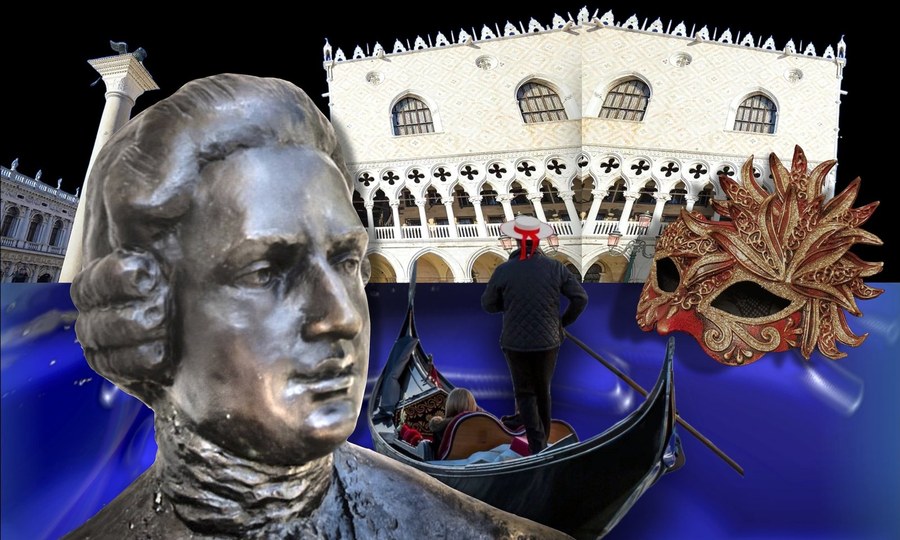
Near Future
A weathered bronze bust presides over a nighttime view of Venice's Doge's Palace loggia, a gondolier poling silently across dark water and an ornate red carnival mask floating at the edge of the frame.
Venice's Carnevale, revived in its modern form since 1979 after centuries of on-and-off suppression, has always traded on exactly this kind of anonymity — a mask that lets the wearer become, briefly, someone else. Setting that old ritual under a title pointed forward rather than back treats Venice's past as something still arriving, not yet settled.
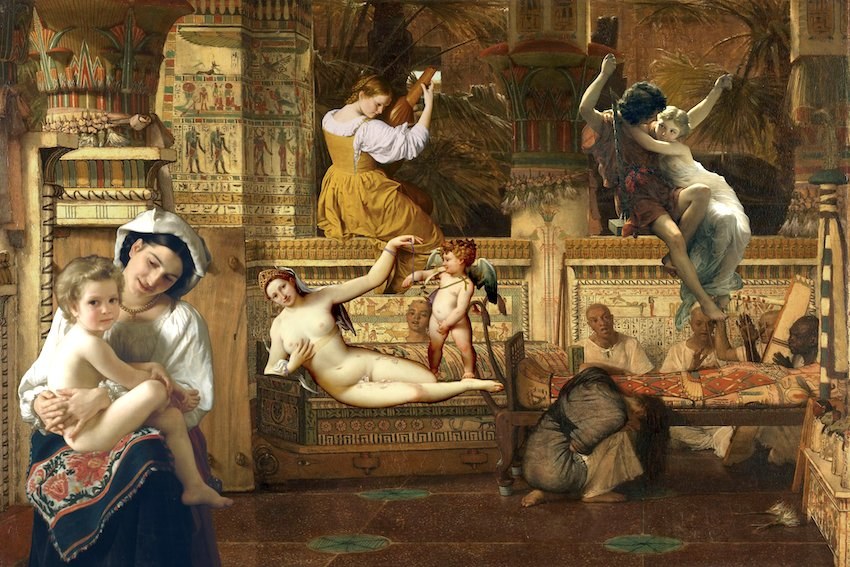
Relaxation Room
Nude and semi-draped women recline together in an intimate domestic interior, a child held close by one of them, the mood unhurried and companionable rather than staged for display.
European painting has a long-running fascination with imagined communal bathing and rest — Jean-Auguste-Dominique Ingres' The Turkish Bath (1862) is the tradition's best-known example — and this piece keeps that tradition's core subject, restful female company at ease with itself, without the Orientalist stage-setting that usually came attached to it.
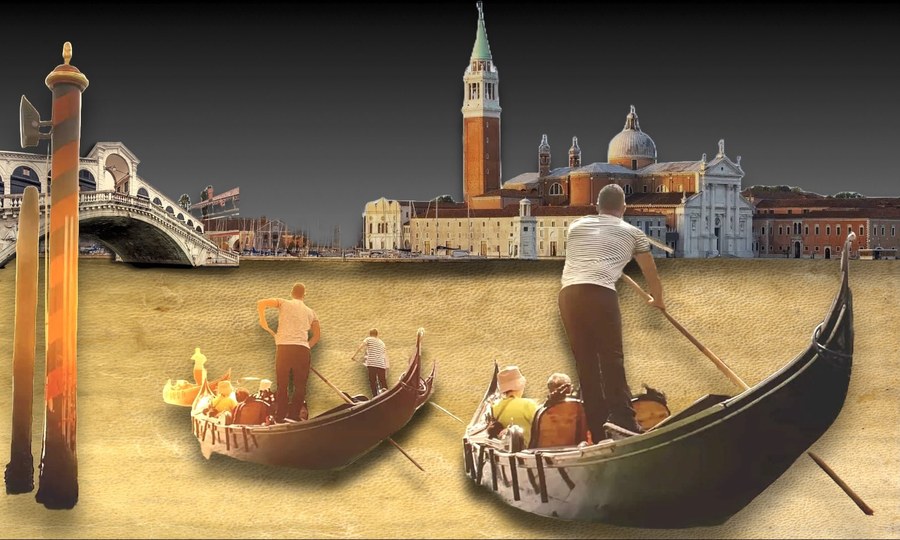
Remote Future
Two gondolas cross a wide, sunlit lagoon toward St. Mark's Campanile and the domes of San Giorgio Maggiore in the distance, the water rendered in warm, sandy tones under a pale afternoon sky.
Paired with this catalog's own Near Future, the two pieces frame the same historic city from opposite ends of a single question — Venice's Campanile has stood, rebuilt after its 1902 collapse, as one of the most photographed silhouettes in the world, a monument that keeps meaning both permanence and, given the city's ongoing struggle with rising water, an uncertain future at once.
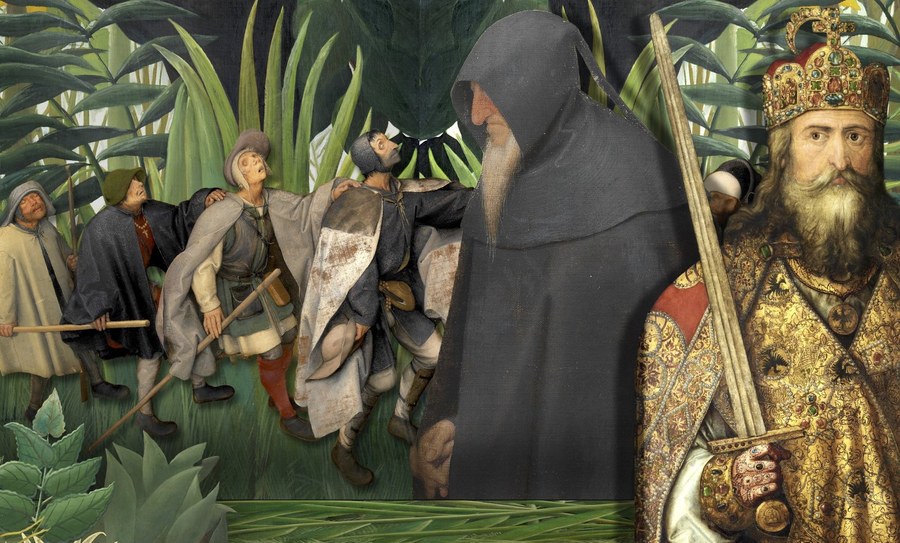
Repressive Power
A hooded, dark-robed monk leads a small group of armed men through dense forest undergrowth toward a crowned king who grips a drawn sword, the whole scene staged like a confrontation from medieval legend rather than a battle.
Crown and drawn sword together have functioned as the standard visual shorthand for temporal authority since medieval coronation imagery first paired them, a convention this studio also drew on for The Patriarchy in its Variety catalog; setting that same authority against a hooded monk in a wooded, liminal setting stages the far older tension between church and crown as unresolved legend rather than settled history.
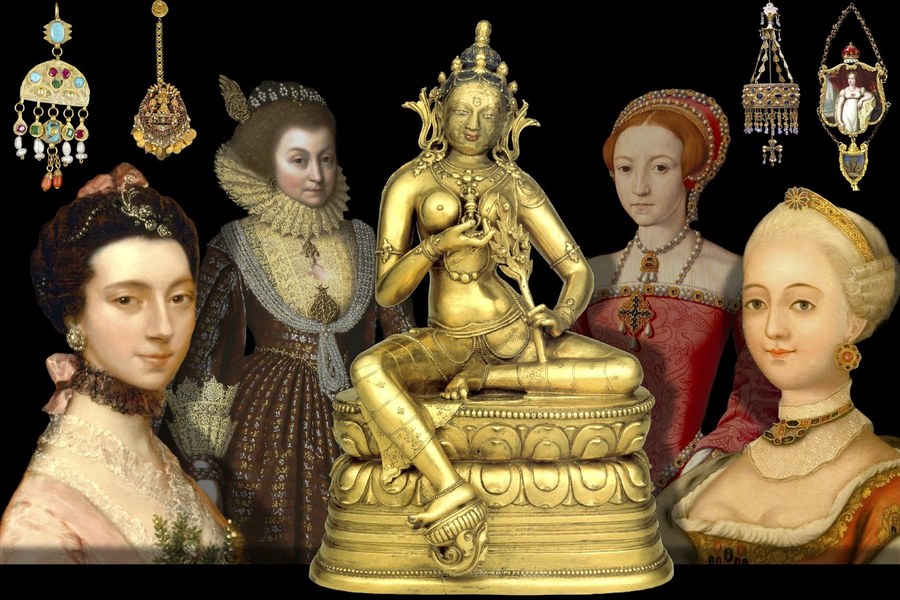
Sterile Jewelry
A large gilt statue of a seated, many-jeweled goddess-like figure dominates the center of the frame, ornate drop earrings suspended above her like a canopy, while portraits of women in Renaissance dress and pearls look on from either side.
The statue's pose and gilding recall devotional Buddhist and Hindu bronzes — seated deities like Tara, traditionally gilded and hung with real jewelry as acts of devotion — set here beside European sitters whose own jewelry serves a much more secular purpose: pure status display rather than sacred offering, ornament with nowhere left to grow.
Tema Libero is part of Blu Artworks' wider body of work — 577 original SIAE-registered collages in total. Explore the Tema Libero fa parte del lavoro più ampio di Blu Artworks — 577 collage originali registrati SIAE in totale. Esplora la Full GalleryGalleria Completa.