Tema Libero 2
Thirty More Collages Bound by No Single Theme
30 collages in this catalogcollage in questo catalogo
Tema Libero 2 continues the studio's free-theme series with thirty further collages bound by no single subject: Vincent van Gogh's swirling Starry Night sky set beside a WWII Coast Guard portrait, Caravaggio's Medusa staged against a Laocoön-like wrestling match, the ruins of the Temple of Vesta at Tivoli, and seven standalone studies built entirely around one dominant color — black, white, red, orange, green, brown, and blue. Each piece is available as a high-resolution, 300dpi, royalty-free download for €39, ready for print at any size.
View Full Gallery →Vedi la Galleria Completa → View All Collections →Vedi Tutte le Collezioni →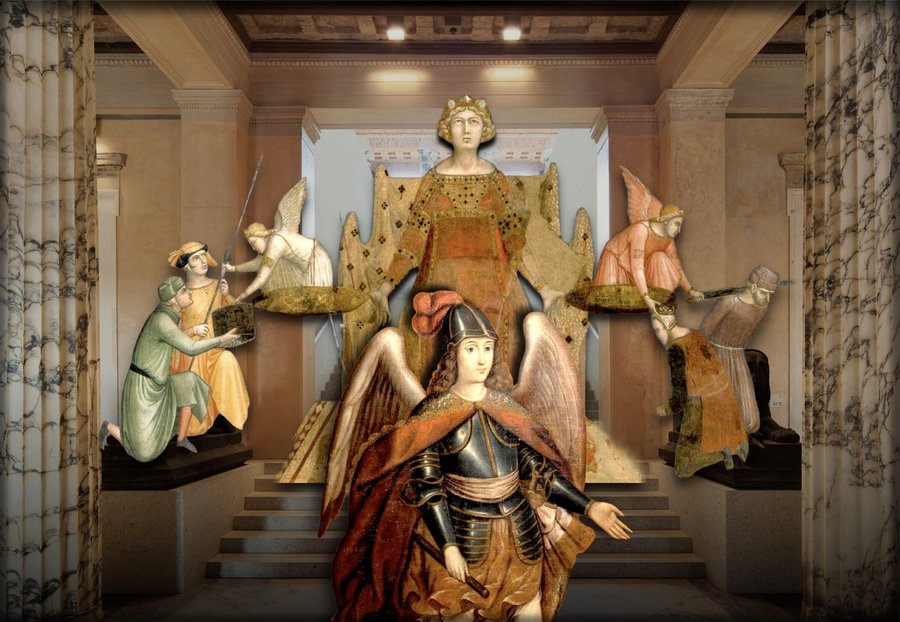
Allegorical Justice
The allegory of Justice traditionally represents one of the four cardinal virtues and, throughout art history, has been codified through precise, universal symbols: a female figure equipped with a scale (symbolizing fairness and deliberation), a sword (emblem of punitive power and the force of the law), and, starting from the High Renaissance, a blindfold (guaranteeing absolute impartiality).
However, art history includes several famous pictorial interpretations that enrich or vary this complex iconography.
ArtDeco
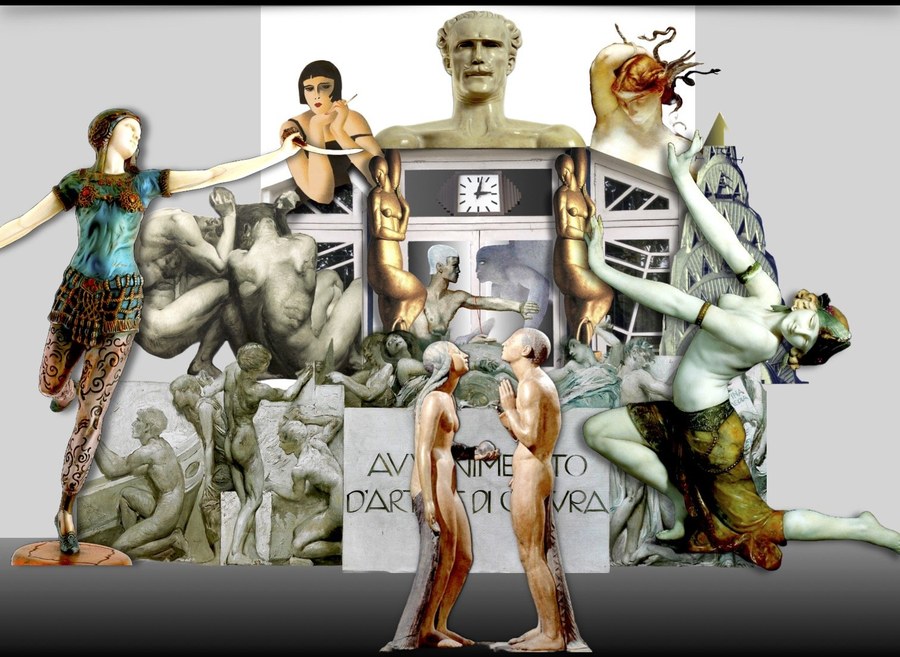
A troupe of stylized dancers in flowing Art Deco silhouette leap and twist around a monumental classical bust and a clock-faced pavilion inscribed “AVVENIMENTO D’ARTE E DI CULTURA” (an art-and-culture event), while a frieze of wrestling marble figures runs along the base like a classical relief brought to life.
The angular, elongated dancer poses and jazz-age energy belong squarely to the Art Deco vocabulary that swept Europe’s exhibition pavilions in the 1920s and 30s — the same decorative confidence that shaped Paris’s 1925 Exposition Internationale des Arts Décoratifs, the movement’s namesake event. Grounding that modern energy in a Greco-Roman wrestling frieze and a togate bust ties the era’s fascination with speed and youth back to the classical ideal it never entirely left behind.
Artistic Flowers
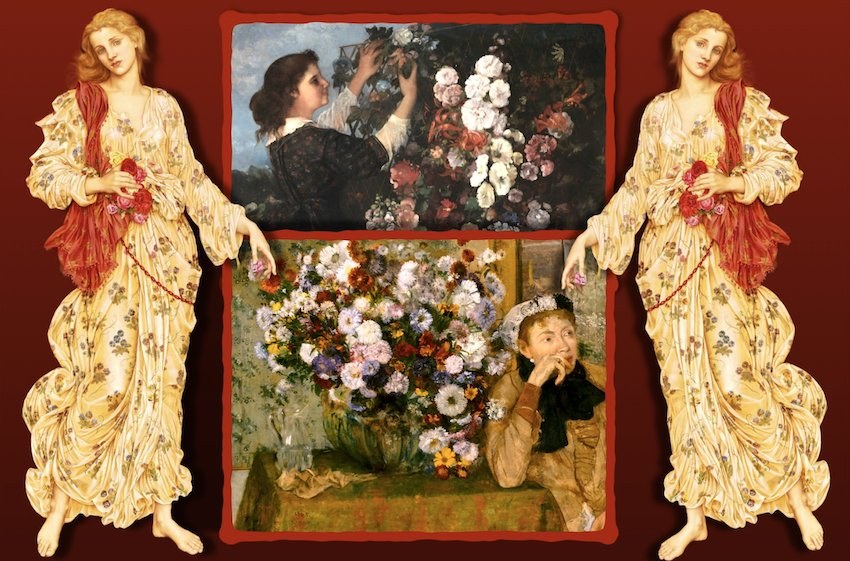
Two identical women in floor-length gold gowns patterned with swirling florals stand as mirrored bookends around a framed still life of full-blown pink and white blossoms in a vase, a small boy peeking around its edge as if caught spying on the flowers.
The doubled, mirror-symmetric figure is a favorite device of decorative Art Nouveau design, while the loose, richly worked floral still life at center recalls the garden bouquets long associated with Impressionist flower painting — Renoir’s own are among the best known, painted, by his account, purely to relax the hand before tackling a portrait, which makes the boy’s curious, uninvited glance at the results feel entirely apt.
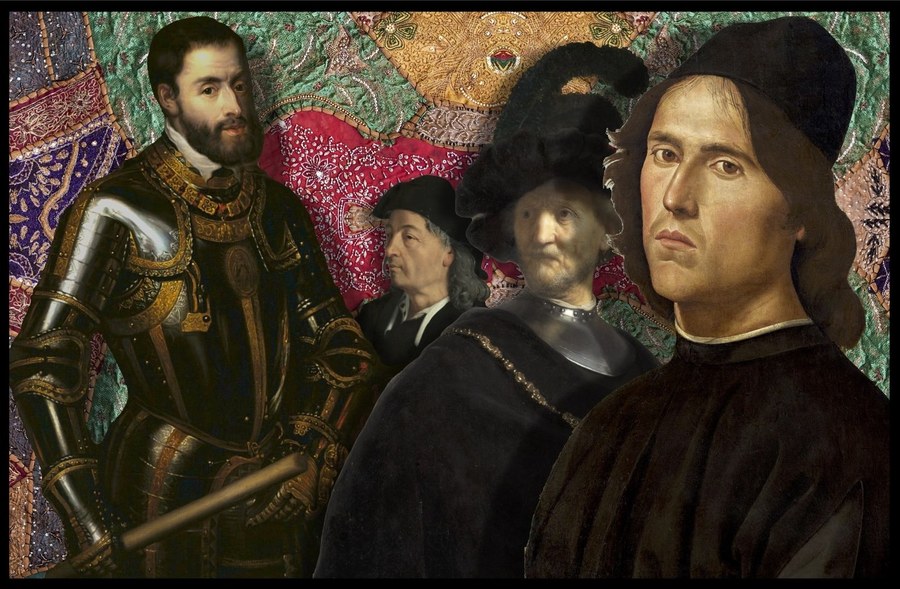
Black color
A knight in blackened plate armor stands beside two men in dark clerical robes and wide black hats, while a young man in a black cap and dark tunic gazes out at the viewer from the foreground, his composed three-quarter profile lit softly against the shadow behind him.
The young man’s steady gaze and simple black cap are painted in the hushed, closely observed manner of Florentine Quattrocento portraiture — the kind of restrained likeness Sandro Botticelli and his workshop produced for Florence’s merchant class. Set against the knight’s armor and the clerics’ robes, the piece reads as a study in how many different kinds of authority black alone was once used to signal.
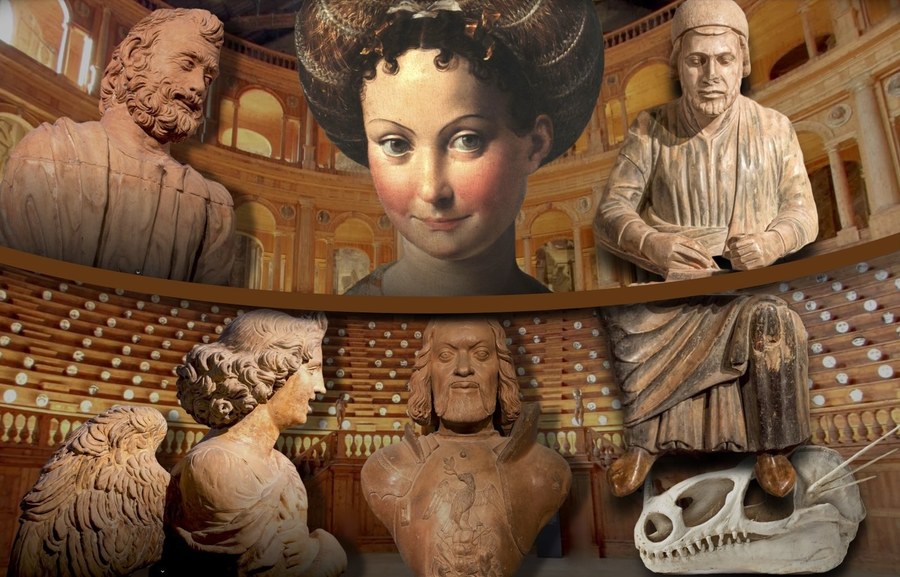
Brown color
Weathered marble busts and fragments — a bearded philosopher, a veiled matron, a helmeted youth — ring the curved balcony of an ornate theater interior, a small skull tucked among them at the base, while a young woman’s rosy-cheeked portrait floats serenely at the composition’s center.
Placing classical portrait busts inside a theater’s horseshoe balcony treats the building itself as a kind of living museum, an old theatrical habit of gathering grand houses for looking at as much as being seen in — while the skull tucked among the marble is a quiet reminder, in proper vanitas tradition, that even the grandest audience eventually empties out.
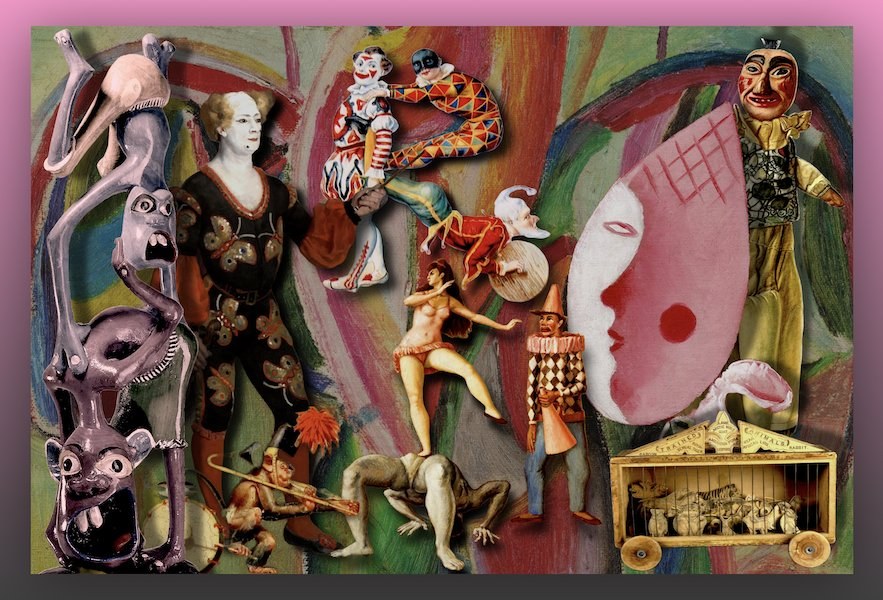
Circus Xp
A jumble of circus performers spills across a bright, patchwork ground — harlequins in diamond-patterned costume, tumbling acrobats, a grinning puppet on a wheeled cart, and a fantastical long-nosed creature — while an oversized flat pink face, split by a single red circle for an eye, presides over the whole scene like a carnival backdrop.
The flattened, two-toned pink face with its single red disc is drawn from Pablo Picasso’s Cubist portrait language of the 1920s and 30s, while the diamond-patterned harlequin figures belong to an even older tradition — the commedia dell’arte troupes whose stock characters Picasso himself painted repeatedly during his own Rose Period circus years.
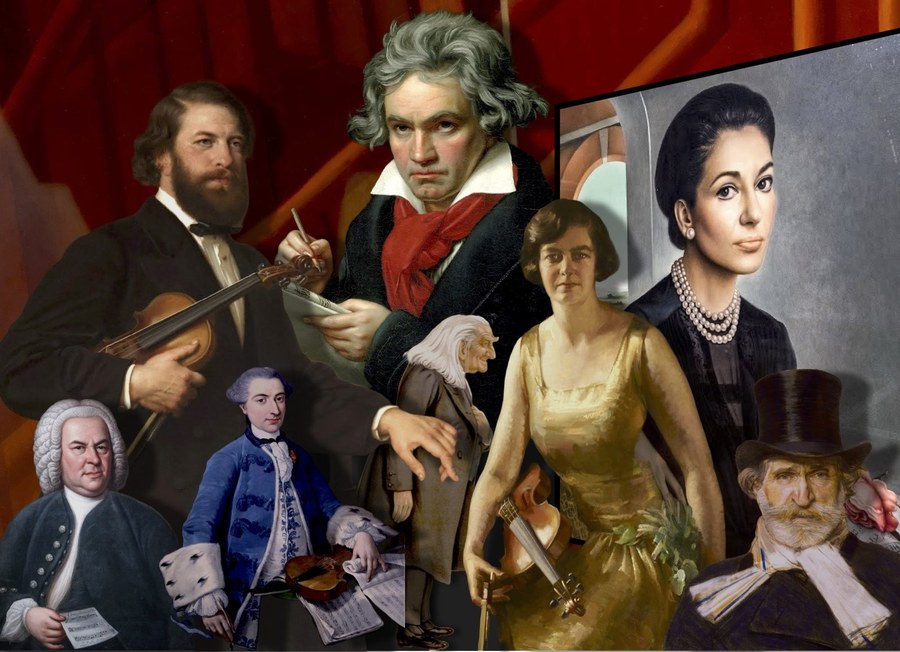
Classical Music Quiz
A gathering of composers and performers fills the frame — a bewigged musician cradling a violin and quill, a disheveled man in a red cravat with wild grey hair unmistakably Beethoven, an older bearded man in dark robes bent over a page, and two elegant women in gold silk and pearls posed like concert-hall portraits from different eras.
The violin-and-quill figure follows the standard visual shorthand for Johann Sebastian Bach composing at his instrument, while the wild grey hair and red cravat belong to Ludwig van Beethoven’s own instantly recognizable likeness, drawn from the many posthumous portraits that fixed his image as the archetypal Romantic genius. Surrounding those two fixed points with more anonymous, elegantly dressed listeners turns the piece into an informal quiz of faces any concertgoer might be expected to know on sight — hence the title.
Colorful Futurist
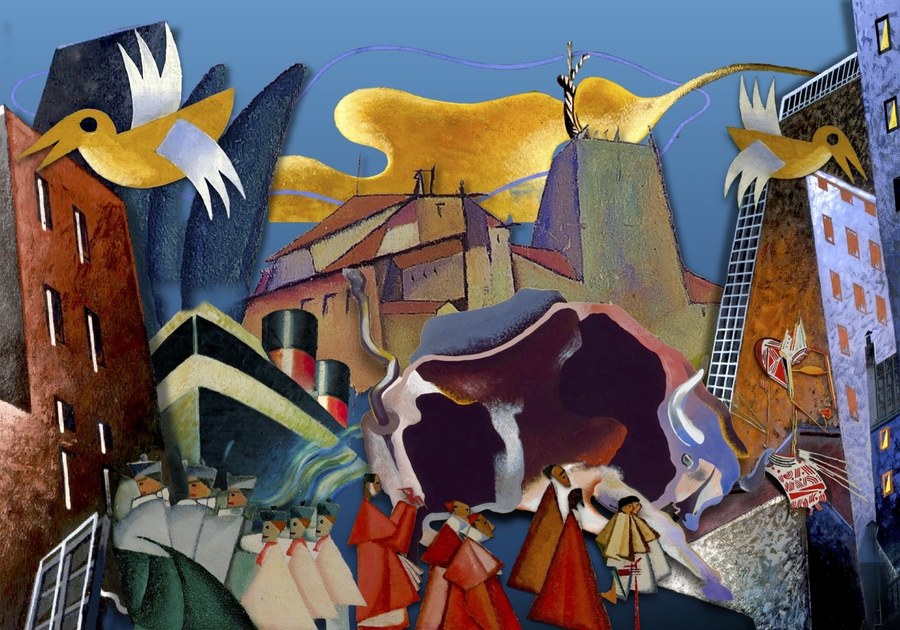
Geometric buildings in warm ochre and blue stack behind a striped ocean liner in dock, while golden birds swoop through a swirling yellow sky and a line of small, brightly costumed marching figures parades along the base of the composition.
The flattened geometric forms, saturated primary color, and toy-like marching figures are the signature style of Fortunato Depero, the Italian Futurist best known for his 1920s advertising posters and his stint painting sets and costumes for the Ballets Russes — Futurism’s vision of a modern world built from clean color and hard-edged motion, here compressed into one busy harbor scene.
Craquele of Times gone by
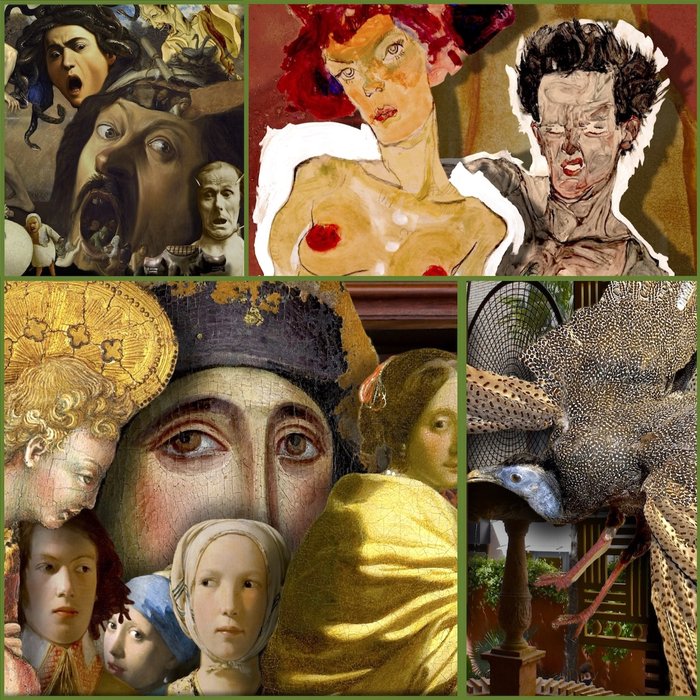
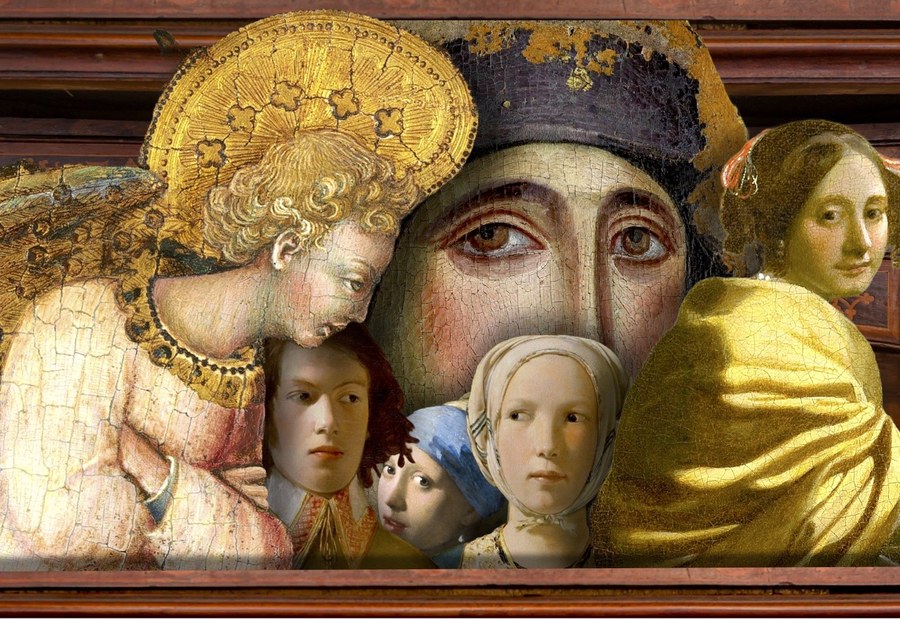
A gold-haloed Madonna’s face, its surface webbed with the fine cracked varnish of an aged panel painting, looms at the center of a cluster of smaller devotional faces in veils and gilded robes, the whole composition lit like a dim chapel interior.
Craquelure — that fine network of surface cracks that forms naturally in old tempera and oil paint as it ages — is usually something conservators work to stabilize rather than celebrate; foregrounding it here instead, on a Madonna clearly modeled on Byzantine and early Italian gold-ground icon painting, turns the visible wear itself into the subject: centuries of devotion left as a literal mark on the paint.
Dominant Blue
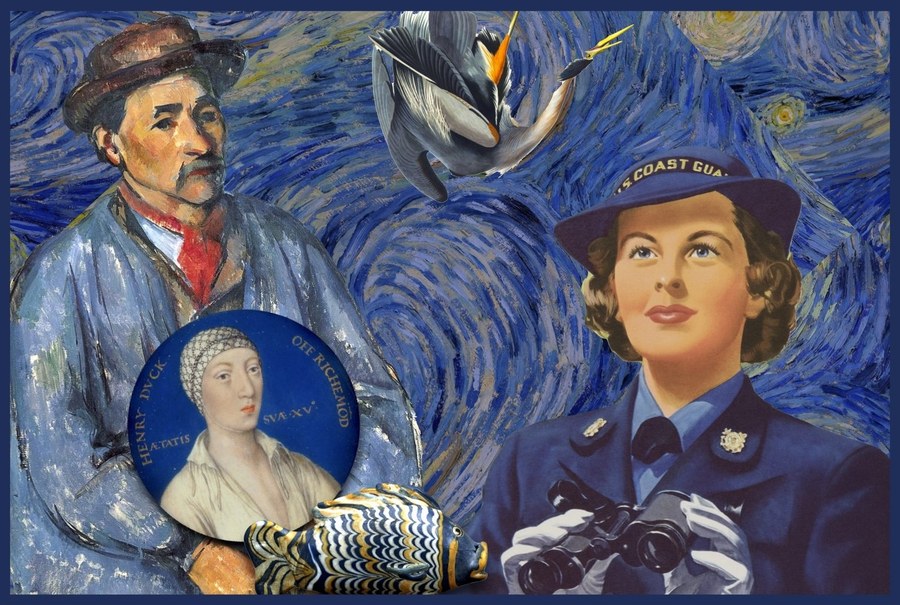
A weathered man in a blue coat and red scarf stands before a swirling midnight sky lifted straight from a Post-Impressionist masterpiece, a heron gliding overhead, while a poised young woman in a Coast Guard uniform and binoculars looks skyward beside a small oval cameo portrait of an earlier-era woman in lace.
The turbulent blue-and-gold sky is an unmistakable quotation of Vincent van Gogh’s The Starry Night (1889), and the weathered face beside it borrows the same warm, thickly built brushwork Van Gogh used in his own self-portraits. Setting his nineteenth-century sky behind a mid-twentieth-century U.S. Coast Guard servicewoman collapses a century of blue-toned imagery — night sky, uniform, ocean — into one continuous shade.
Eternal Guernica
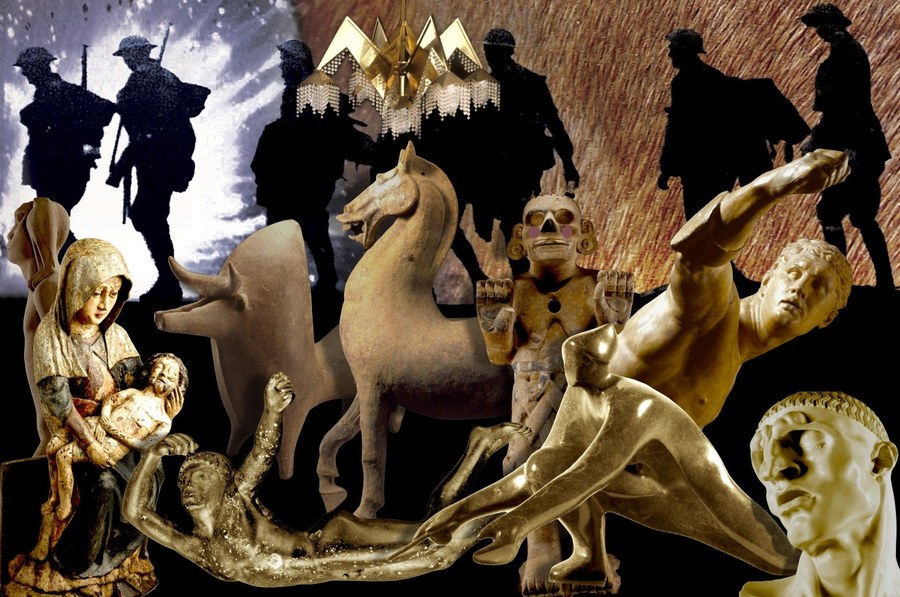
Silhouetted soldiers march beneath jagged mountain peaks in the upper register, while below, a screaming horse’s head, tangled marble figures echoing ancient battle sculpture, a swaddled mother and child, and a bleached skull crowd together in anguished disorder.
The screaming horse and the huddled mother-and-child group draw directly on Pablo Picasso’s Guernica (1937), his monumental protest against the 1937 bombing of the Basque town — a painting built almost entirely from animal and human suffering rendered in stark, fractured forms. Surrounding that twentieth-century image with silhouetted infantry and classical marble casts the same anguish as something that recurs across every century of war, not a single historical event, which is what the title’s “eternal” points toward.
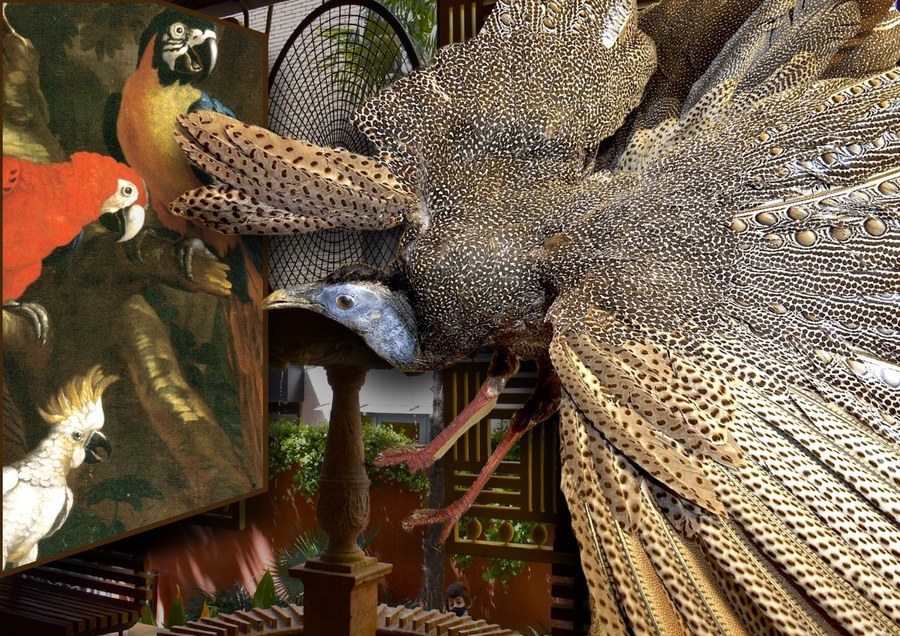
Evasion
A brilliantly patterned peacock’s tail fans out across most of the frame, its eye-spotted feathers rendered almost abstractly close-up, while a scarlet macaw, a grey parrot, and a white cockatoo perch at the edges beside a spinning wheel-like fan.
Peacock feathers have carried a double meaning in painting for centuries — vanity and pride in one reading, freedom and escape in another, since the bird itself was prized in aristocratic aviaries as a living ornament rather than a working animal. Filling the frame with feather rather than bird narrows the image down to pure pattern and color, an escape from representation itself that the title, evasion, names directly.
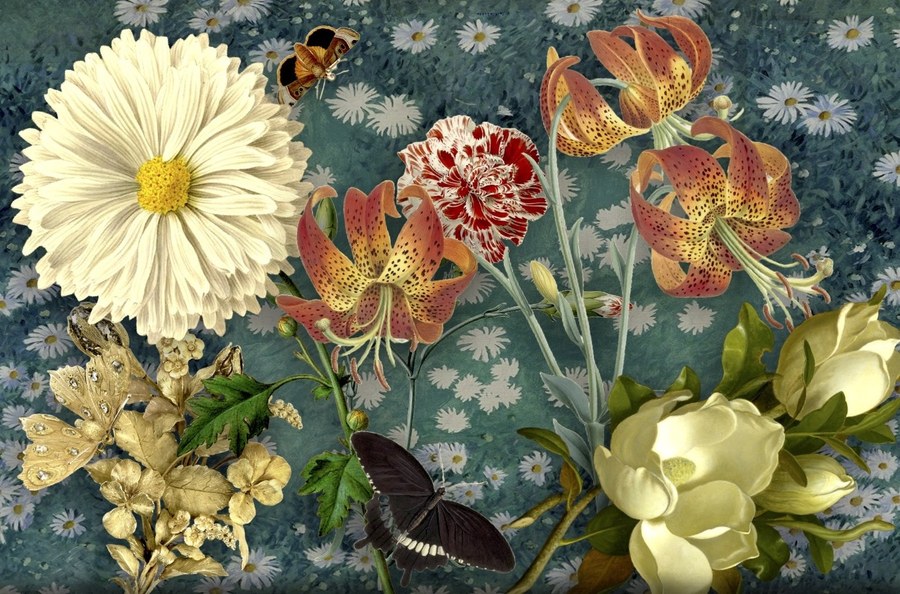
Free Composition
A loose arrangement of white daisies, spotted orange lilies, a red carnation, and a pale magnolia bloom scatters across a dense floral-print ground, a dark butterfly settled among the petals as if it had wandered in from the wallpaper itself.
With no single art-historical quotation anchoring it, this piece leans on the long tradition of the informal floral still life — flowers gathered without the strict symbolic vocabulary of a vanitas arrangement, chosen instead for how their colors and shapes sit together on the page, true to its own title.
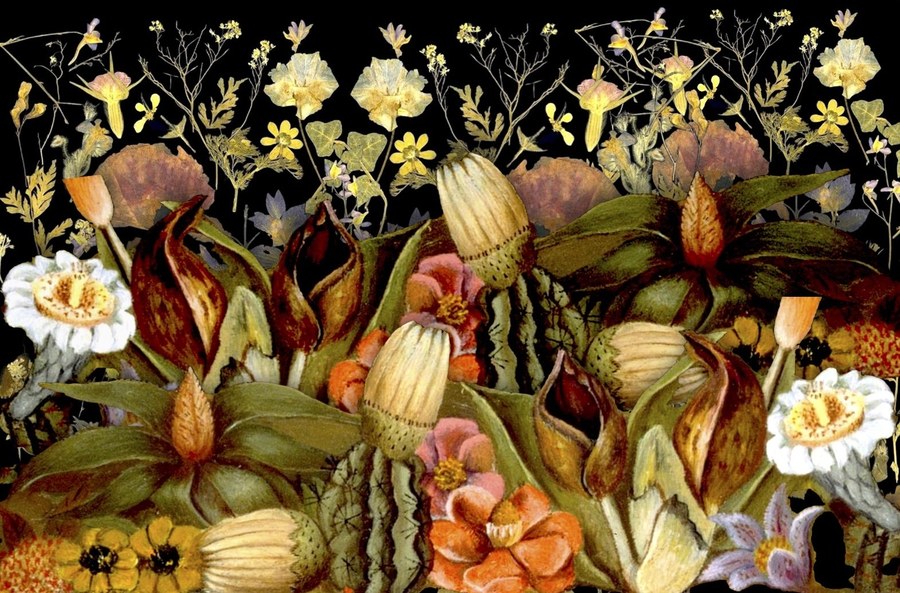
Frida's Flowers
Wildflowers and cactus-like blooms in muted pink, cream, and rust spread against a near-black ground, painted with the flattened, decorative precision of a botanical study rather than a loose garden bouquet.
Frida Kahlo filled her own paintings and her Casa Azul garden with exactly this kind of regional Mexican flora — marigolds, cacti, and wildflowers rendered with the same graphic clarity found here — and used flowers throughout her work as a recurring stand-in for fertility, pain, and endurance all at once, which this piece’s title makes explicit.
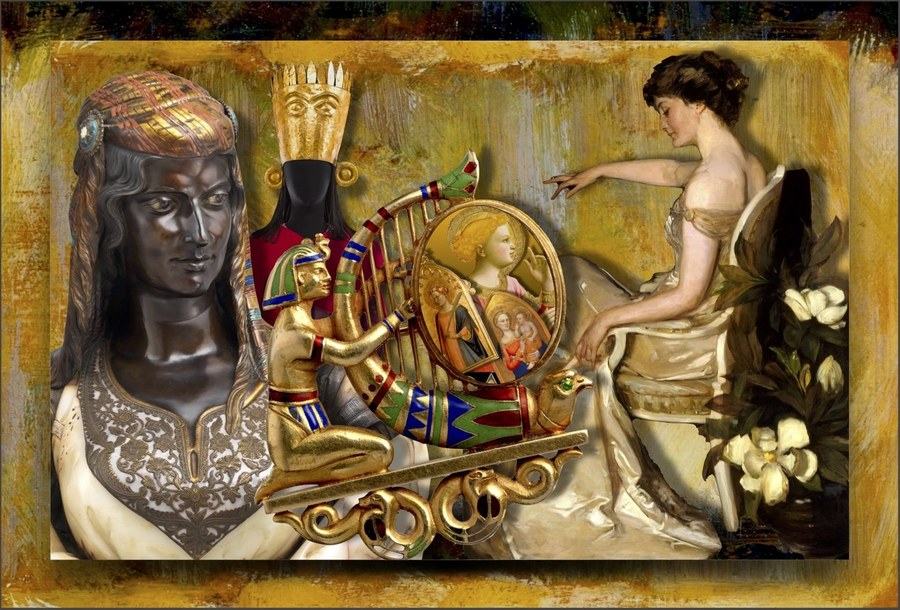
Gold Incense and Myrrh
A dark bronze pharaoh’s bust and a small gilt figure in a jeweled cape and headdress anchor one side of the frame, an oval icon-like medallion glowing gold at the center, while an elegant woman in a pale gold gown reaches toward the arrangement as though selecting a gift.
Gold, frankincense, and myrrh are the three gifts the Magi bring the infant Christ in the Gospel of Matthew, traditionally read as tributes fit for a king, a god, and a mortal who will die — and gold alone, independent of that story, was also the material ancient Egypt reserved for its pharaohs and funerary treasures, which is the reference the bronze bust and gilt regalia pull from here.
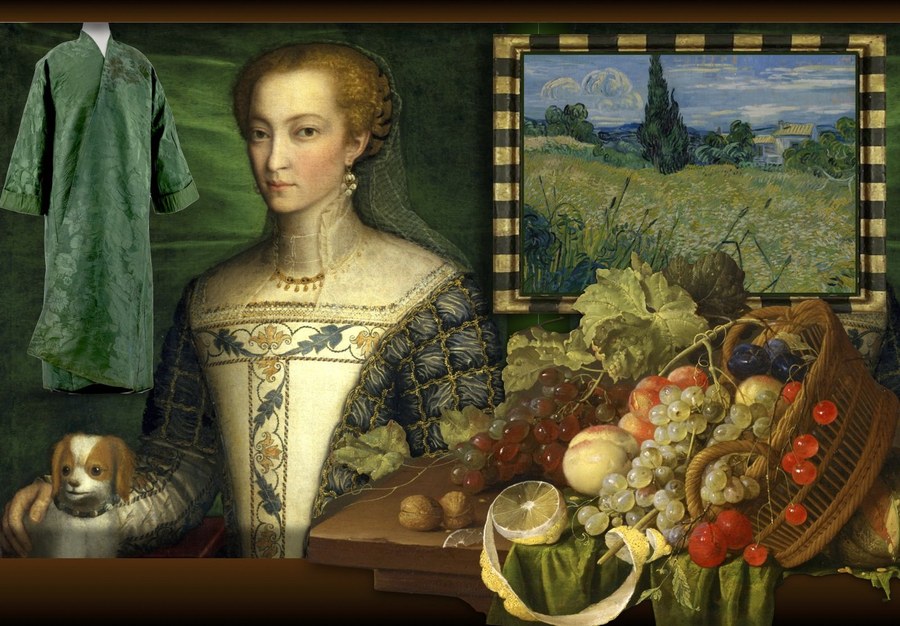
Green color
A young woman in an ornate Renaissance gown of cream and gold stands beside a hanging green silk robe, a small spaniel at her feet and a basket of grapes, cherries, and citrus spilling across the table before her, while a framed Post-Impressionist landscape of a green wheat field and cypress hangs quietly in the background.
The formal three-quarter portrait, small lapdog, and abundant fruit belong to the conventions of Northern Renaissance portraiture, where such details signaled wealth, fidelity, and prosperity all at once; the wheat-and-cypress landscape glimpsed behind her borrows its palette and brushwork from Vincent van Gogh’s late Provence landscapes, letting one shade of green carry the piece across four centuries of painting.
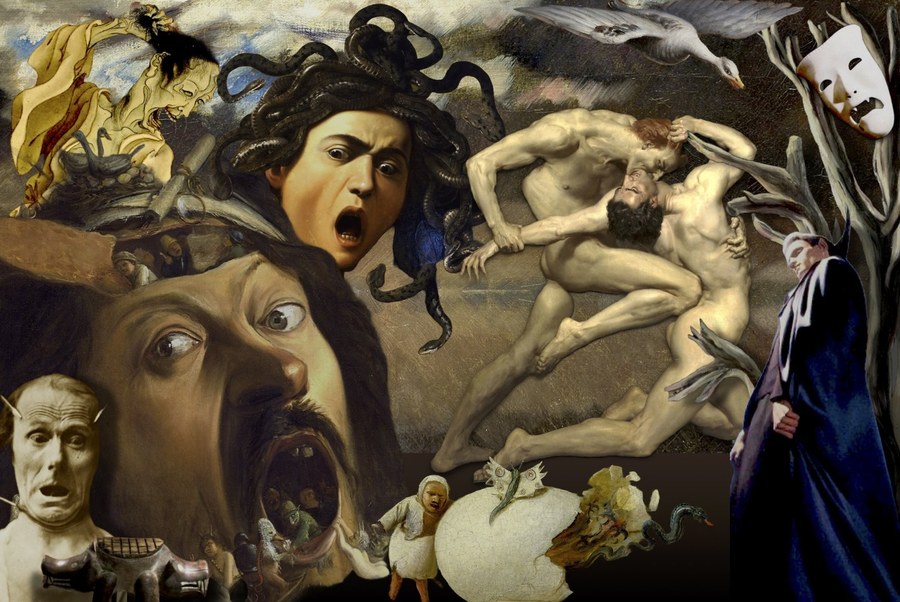
Horror Style
Medusa’s head shrieks amid a nest of writhing snakes in the upper corner, while below, two straining nude figures grapple in a knot of muscle and anguish, flanked by a chorus of screaming, distorted faces and a pair of black-and-white comedy-tragedy theater masks.
The screaming Medusa is a direct quotation of Caravaggio’s Medusa (c.1597, Uffizi), painted onto a real jousting shield to unsettle anyone who looked at it head-on, while the wrestling nude figures recall the agonized twisting bodies of the ancient marble Laocoön and His Sons — two of art history’s most enduring images of physical and mythic terror, gathered here under the comedy-and-tragedy masks that have symbolized theater itself since ancient Greece.
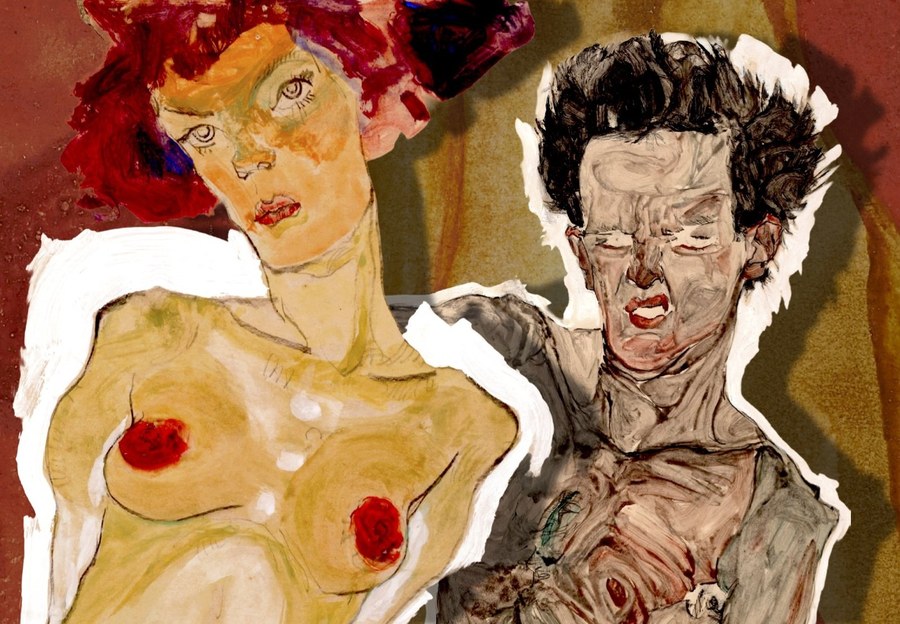
Impotence Feel
A bare-shouldered woman rendered in the raw, angular linework of early twentieth-century Expressionism turns her head aside, her expression guarded, while beside her a man’s face twists into a grimace of frustration, painted in the same loose, unfinished-looking brushwork.
The flattened planes, visible outlines, and emotionally raw handling belong to the Viennese Expressionist tradition Egon Schiele made his own in the years before the First World War — an approach that used the body’s rawness, not its idealization, to put psychological states directly on the canvas. Read together, the two figures’ averted eyes and clenched expression stage exactly the private, wordless frustration the title names, without ever spelling out its cause.
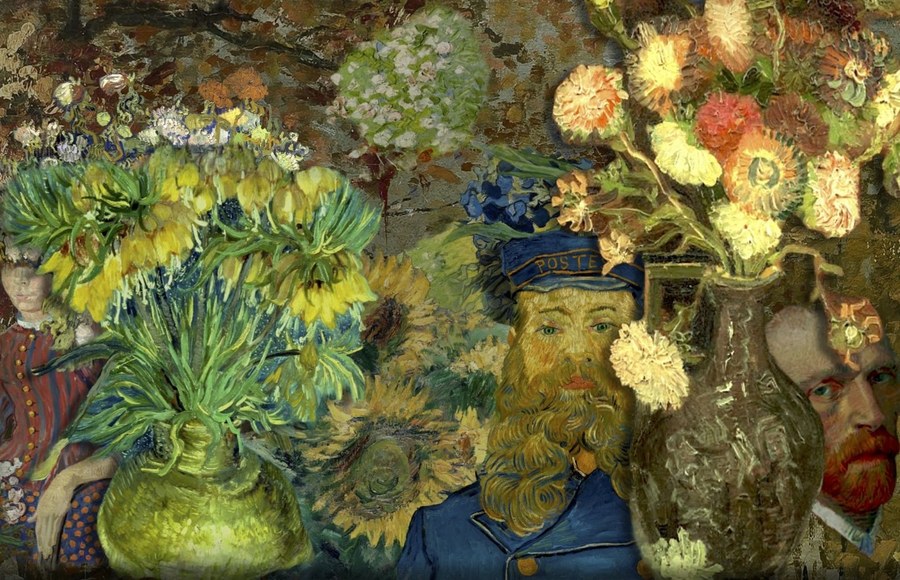
In Vincent's Greenhouse
A weathered man in a battered straw hat, painted in thick impasto strokes of blue and ochre, stands framed by an abundance of flowers — a vase of golden lilies, dahlias, and daisies crowding both sides of the composition like a greenhouse in full bloom.
The straw hat, ruddy beard, and heavy brushwork are Vincent van Gogh’s own self-portrait likeness, an image he returned to more than thirty times across his short career; surrounding it here with the kind of vivid, thickly painted flower still lifes he produced at Arles and Auvers imagines the two halves of his late work — portrait and bouquet — sharing the same room at last.
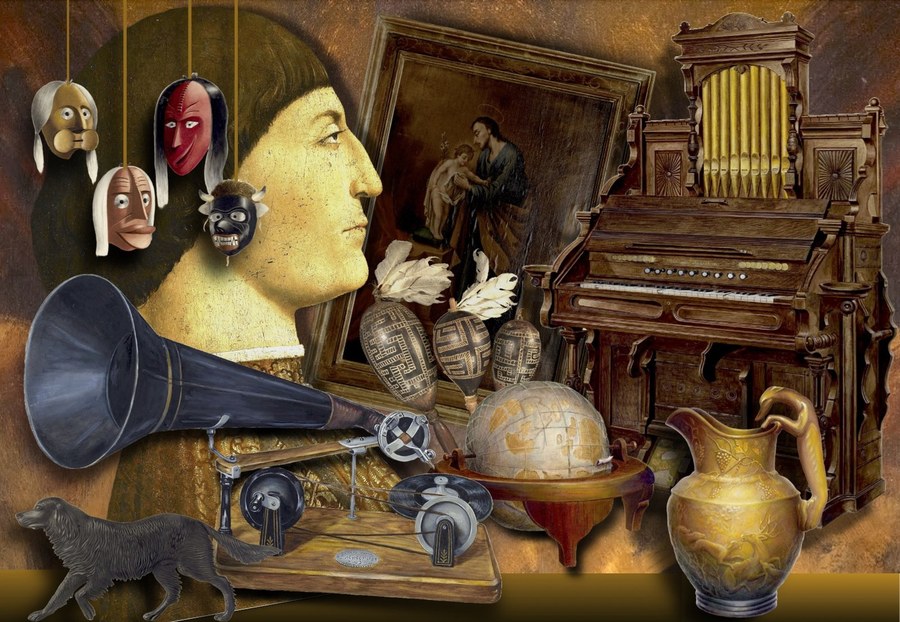
Malatesta's dreams
A profile portrait of a man in a flat black cap and gold-trimmed robe, painted against a warm ground, presides over a cabinet of curiosities — a brass gramophone horn, a pump organ, a terracotta jar, a gilt pitcher, tribal masks hanging from strings, a small globe, and a small black dog at the base.
The profile, cap, and warm-toned portrait style recall Piero della Francesca’s celebrated likeness of Sigismondo Pandolfo Malatesta (c.1451, Louvre), the condottiero-lord of Rimini also frescoed kneeling by della Francesca inside the Tempio Malatestiano; this studio used the same fifteenth-century profile and cabinet-of-curiosities arrangement for a piece of the same name in the Realtà Surreale catalog, and this version revisits it with its own set of gathered objects.
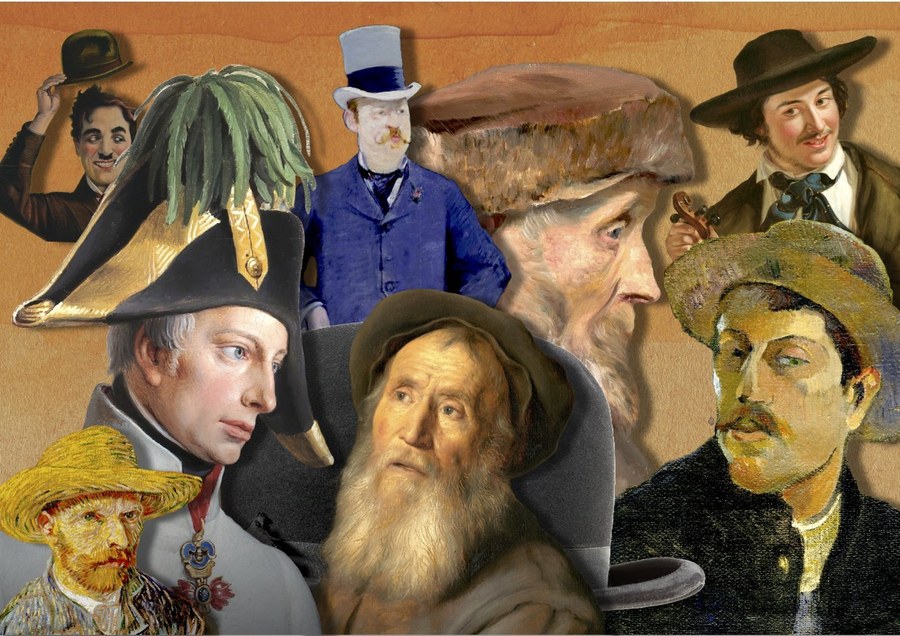
Men's Hats
A crowd of men’s faces fills the frame, each topped by a different era’s headwear — a black top hat, a green-plumed bicorne, a wide-brimmed straw hat, a laurel-wreathed profile, a floppy felt hat — gathered so closely together that the hats themselves become the composition’s real subject.
Reading history through hats alone is a genuinely old trick of costume and portrait scholarship, since headwear changed faster and more legibly than almost any other article of dress — a top hat reads instantly as nineteenth-century bourgeois, a plumed bicorne as military ceremony, a laurel wreath as classical antiquity revived. Stacking them together compresses several centuries of that visual shorthand into one crowded gallery of heads.
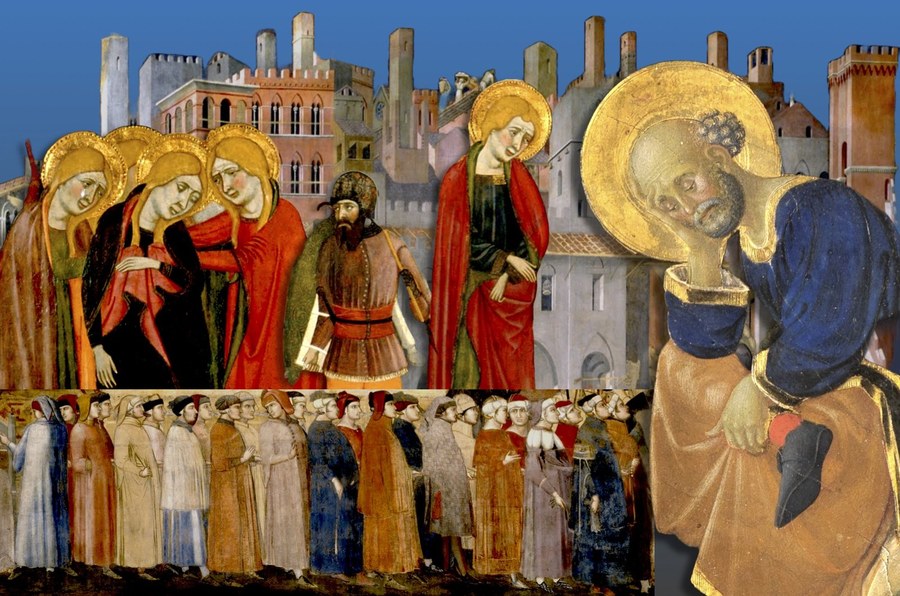
Moments of Devotion
A long procession of robed pilgrims and clergy in gold halos winds past a skyline of Gothic towers and chimneys, led by a bishop and a haloed saint carrying religious standards, the whole scene painted in the flat gold-ground style of an early panel painting.
The gold haloes, stiff processional poses, and Gothic-city backdrop belong to the Sienese and early Florentine tradition of narrative altarpiece painting, where processions like this one were used to depict a saint’s public feast day or the translation of holy relics through a city’s streets — civic devotion staged as public spectacle, exactly as it would have looked to the crowds who lined up to watch it happen.
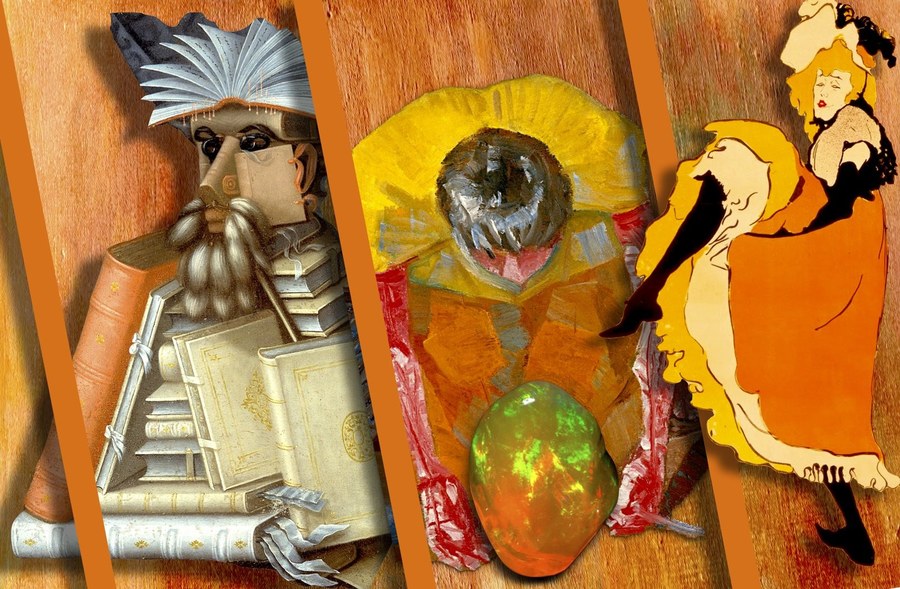
Orange color
A bearded harlequin in a plumed cap holds a stack of ledgers beside a cracked, glowing egg-like orb, while a Belle Époque cabaret dancer in flame-orange skirts kicks up her heels at the frame’s edge, the whole composition divided into diagonal orange-toned bands.
The bearded, book-laden figure recalls the allegorical scholar-fool type common in Northern Renaissance prints, weighing knowledge against folly; the high-kicking dancer, by contrast, is pure Belle Époque cabaret, the kind of poster subject Toulouse-Lautrec built his career on at the Moulin Rouge — two very different eras’ takes on performance and spectacle, joined here by nothing but a shared, saturated shade of orange.
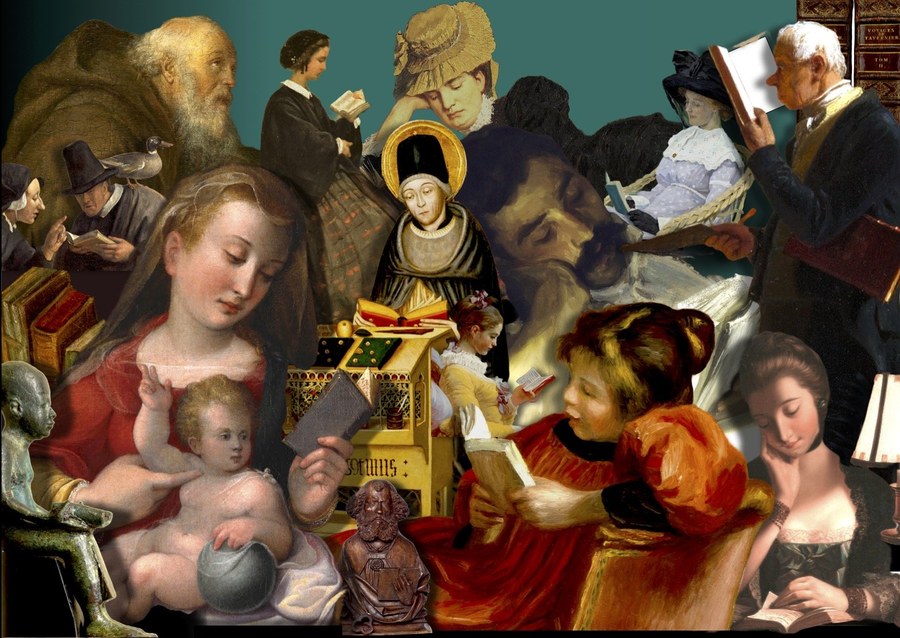
Reading Group
A cluster of readers in period dress bends over open books and letters — an old man in a wide-brimmed hat, women in bonnets and lace, a mother tenderly nursing a child — gathered around a marble bust and a devotional Madonna and Child painting as though the whole group had settled into the same quiet library corner.
Reading has been one of genre painting’s most reliable subjects for centuries, prized for the stillness and inwardness it lets an artist capture on a sitter’s face; folding a Madonna and Child image into that same hushed company treats devotional reading and domestic reading as versions of the same quiet, private act.
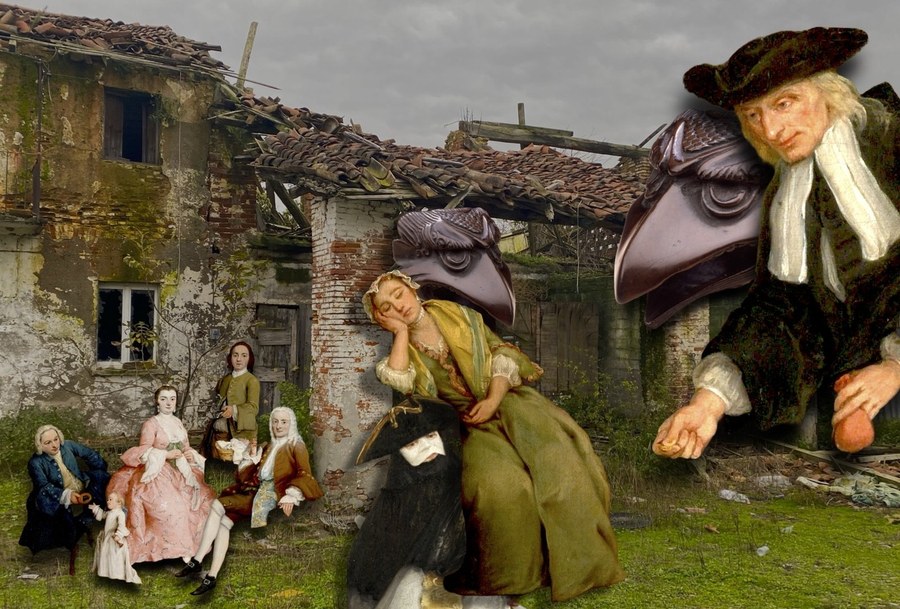
Real Estate Speculation
A family in eighteenth-century dress sits composed on a lawn in the foreground while, behind them, a once-grand house stands roofless and crumbling, its windows empty — and from the frame’s edge, an oversized human hand reaches bodily into the scene, fingers curling toward the ruin.
English conversation-piece portraiture regularly posed families in front of their own estates as proof of standing and permanence, a convention this piece deliberately undercuts by leaving the house behind them in ruins; the intruding, disproportionately large hand — grasping at property the family appears not to notice slipping away — turns a genteel portrait tradition into pointed commentary on speculation and loss.
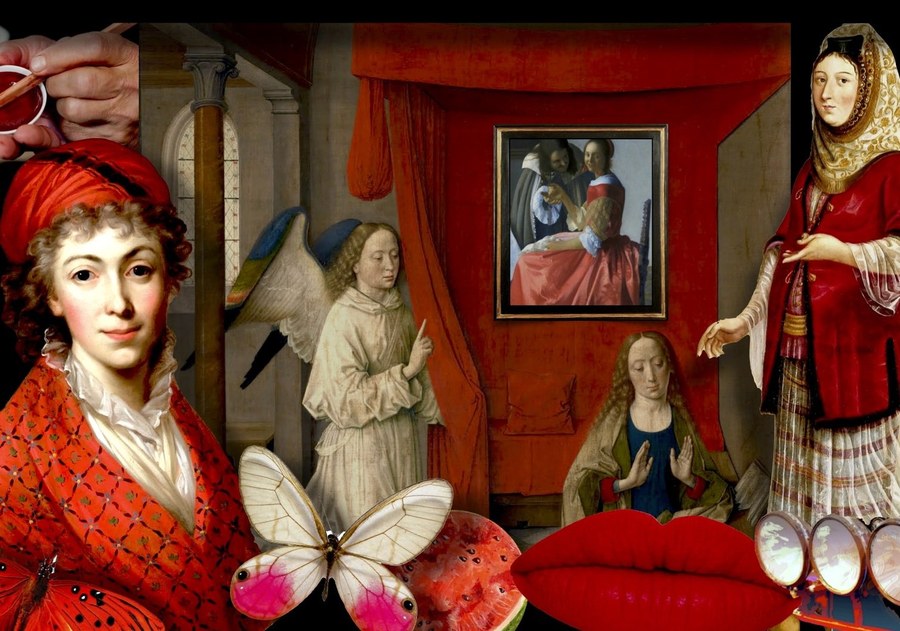
Red color
A woman in a richly patterned red gown and matching turban occupies one side of the frame, a parrot perched nearby and a scarlet-lipped mouth and butterfly scattered below like isolated fragments, while an angel in white and a second red-robed woman flank a small framed portrait at center, hand mirrors catching the light beneath them.
Red carries an unusually wide range of meanings across the paintings this piece draws from — status and wealth in a sitter’s dress, warning in a parrot’s plumage, allure in a painted mouth — and gathering all of them under one dominant hue turns what would otherwise be a mixed bag of quotations into a genuine color study, red examined for everything it can mean at once.
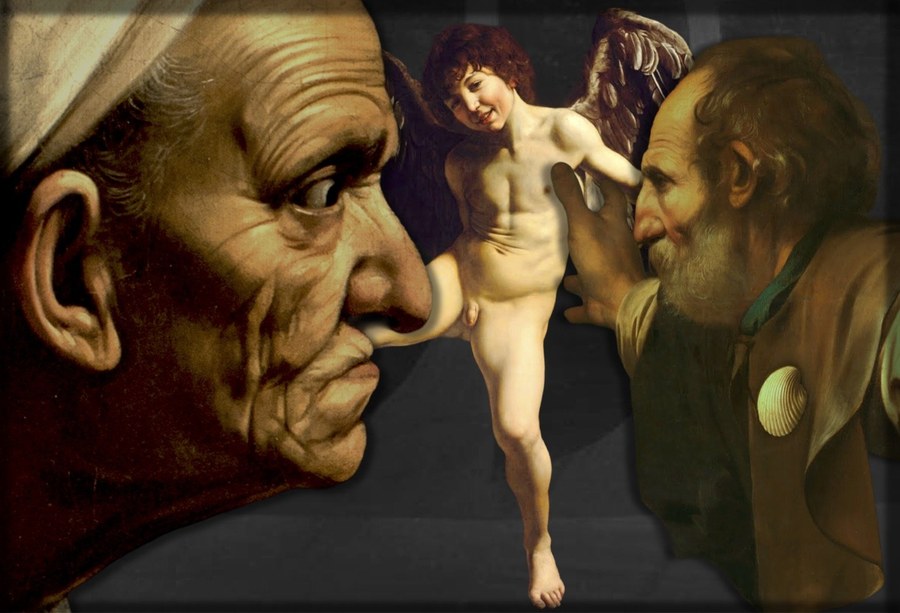
Scandalous Painting
An elderly man’s deeply lined, sharply hooked profile fills most of the frame, his gaze fixed on a small nude winged figure held gently between two hands, while a second man in plain robes looks on from the shadows behind.
The old man’s unflinchingly honest profile recalls Domenico Ghirlandaio’s Portrait of an Old Man and His Grandson (c.1490, Louvre), one of Renaissance portraiture’s most famous refusals to flatter its sitter; pairing that same unsparing honesty with a small winged putto — a stock Renaissance figure of innocence, not the subject of any real scandal — makes the title more provocation than description, daring the viewer to find something illicit in a composition that, looked at plainly, has nothing of the kind in it.
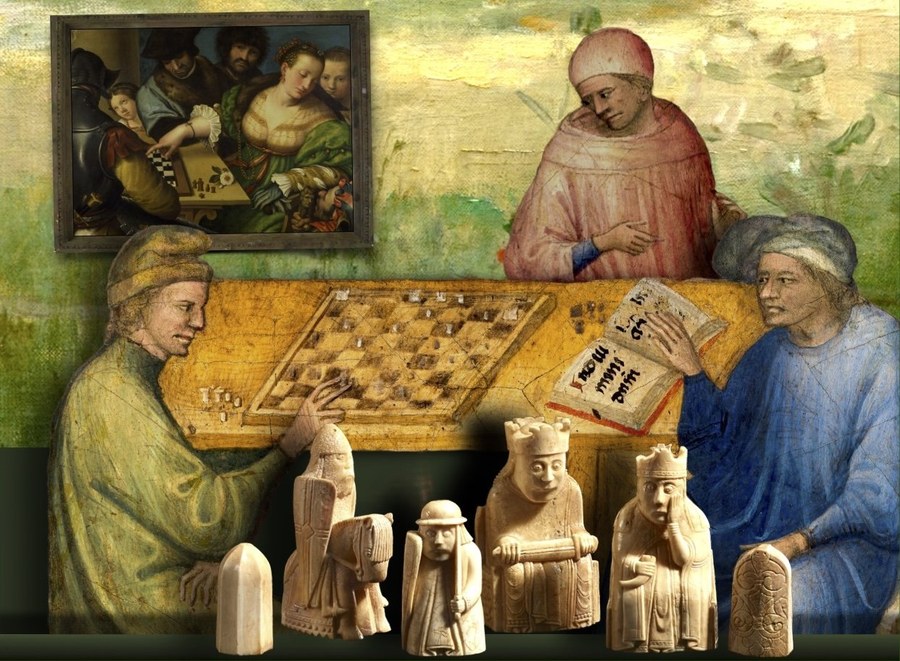
The Rules of the Game
Two hooded monks and a third man in blue lean over a checkered board mid-game, elaborately carved ivory chess pieces — kings, bishops, and pawns modeled on medieval figures — lined up before them, while a small framed painting on the wall behind shows two men and a woman absorbed in a card game of their own.
The stout, wide-eyed chess pieces are unmistakably modeled on the Lewis Chessmen, the twelfth-century Norse ivory set discovered on Scotland’s Isle of Lewis in 1831 and now split between the British Museum and National Museum of Scotland; the card game glimpsed in the background painting echoes Caravaggio’s The Cardsharps (c.1594), another game where the real stakes were never just the game itself.
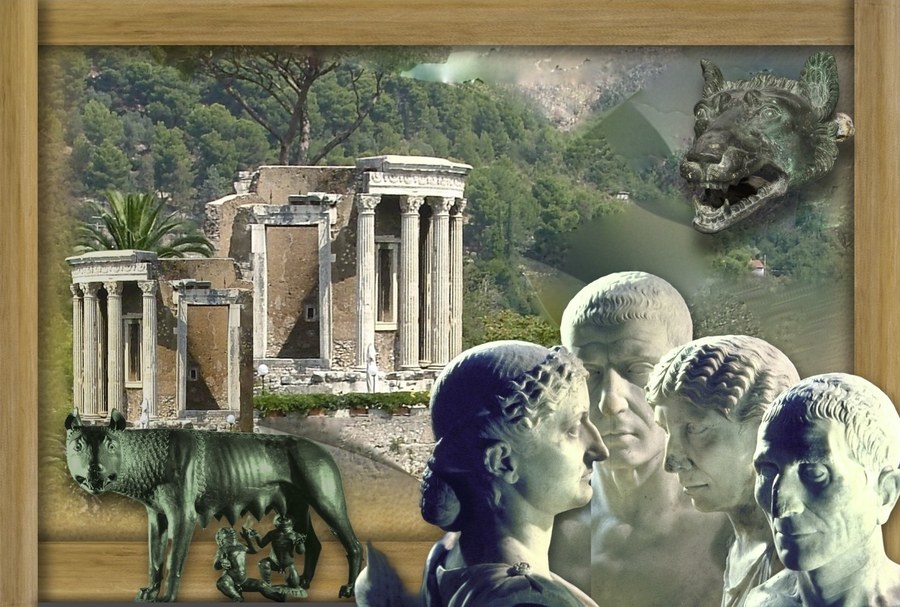
Tourists in Tivoli
The circular colonnade of an ancient temple stands amid green hillside pines, four weathered marble emperor busts arranged in profile before it, a bronze wolf suckling two infants at their feet and a stone gargoyle’s snarling face looming from the upper corner.
The round temple is the Temple of Vesta at Tivoli, just outside Rome, one of the best-preserved circular temples from the Roman Republic and a fixture of the Grand Tour itineraries that first turned Italian ruins into tourist destinations; the bronze wolf is the Capitoline Wolf, Rome’s own founding emblem of Romulus and Remus, placed here as a reminder of exactly whose empire these ruins, and these tourists, came to see.
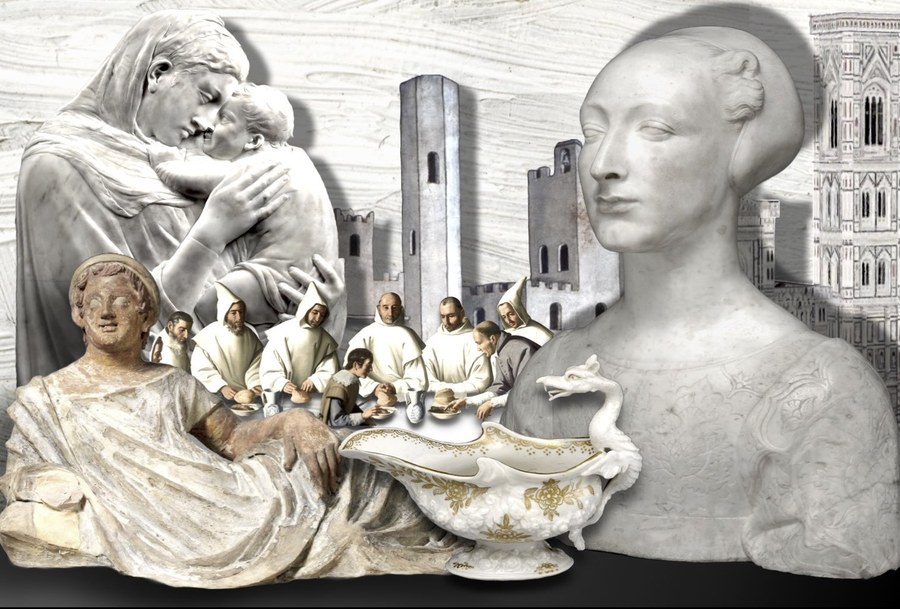
White color
Rendered entirely in the cool grey and white of unpainted marble, a mother cradles a child in a pose recalling classical sculpture, a serene woman’s bust gazes past a Gothic city skyline, and a line of hooded friars processes below beside an ornately carved ceremonial vessel.
Stripping every element down to a single grayscale palette treats the whole composition as though it had been carved from one continuous block of stone — a marble world where mother and child, portrait bust, city, and procession all share the same material and, by implication, the same permanence, white read here as the color of monument rather than absence.
Tema Libero 2 is part of Blu Artworks' wider body of work — 577 original SIAE-registered collages in total. Explore the Tema Libero 2 fa parte del lavoro più ampio di Blu Artworks — 577 collage originali registrati SIAE in totale. Esplora la Full GalleryGalleria Completa.