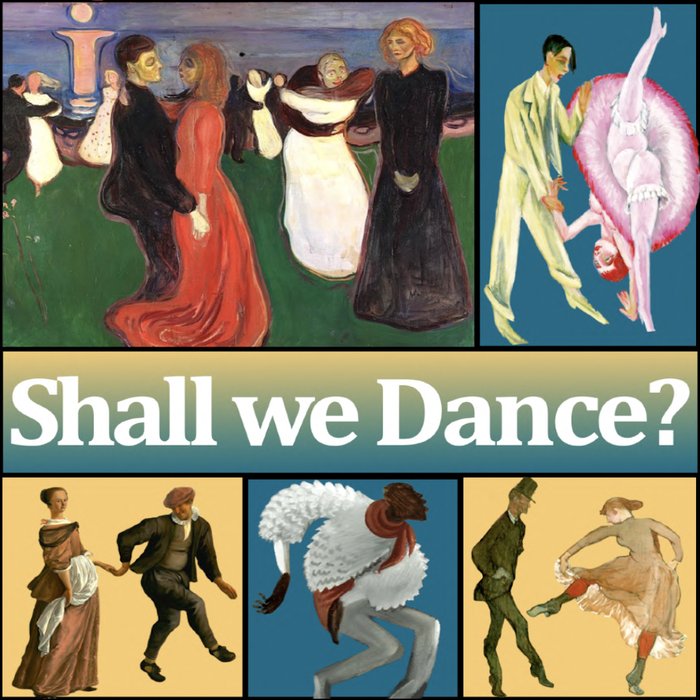
Shall we Dance?
Twelve Collages Following One Gesture Across Five Centuries
12 collages in this catalogcollage in questo catalogo
Dance has given painters an excuse to study the human body in motion since long before photography could freeze a step for them — Bruegel’s stomping peasants, Renoir’s sunlit couples, Degas’ rehearsal-room dancers, Matisse’s circling nudes. This catalog follows that single gesture — a body, mid-turn — through paintings, sculpture, poster art and costume illustration spanning roughly four hundred years, twelve very different rooms all built around the same instant. Each piece is available as a high-resolution, 300dpi, royalty-free download for €39, ready for print at any size.
View Full Gallery →Vedi la Galleria Completa → View All Collections →Vedi Tutte le Collezioni →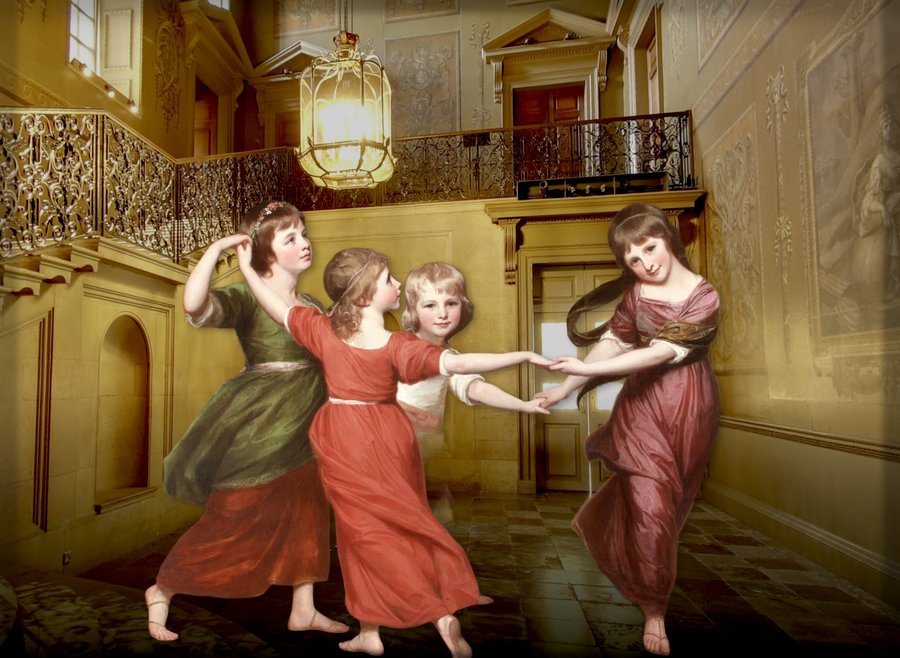
Dance 01
A ring dance among four women in high-waisted Regency-era gowns, the pose and setting borrowed from a genre long favored by 19th-century academic painters: young women caught mid-turn on a private terrace, lit by a single wall lantern rather than any grand public ballroom.
The style belongs to the wave of late-19th-century painters — Sargent, Leighton, and their many followers — who found in this kind of intimate, decoratively lit dance scene the same appeal Impressionism found in Paris’s public dance halls, just moved indoors and dressed a half-century earlier.
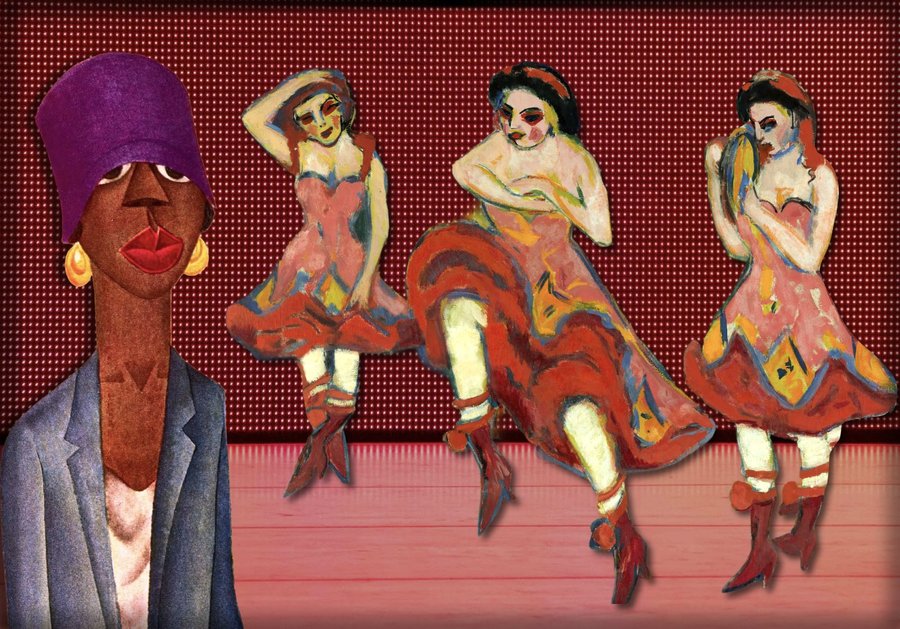
Dance 02
Flat, hard-edged color fields and a graphic sense of pattern place this piece closer to 20th-century cut-paper collage than to painted illusion — the kind of technique Henri Matisse pioneered in his late career, when failing health pushed him from brush to scissors and he began composing directly in cut, colored paper.
The tall dark hat, the polka-dot ground, and the three matching dresses turn a dance into pure rhythm and repetition, letting silhouette and color carry the composition rather than facial expression or perspective.
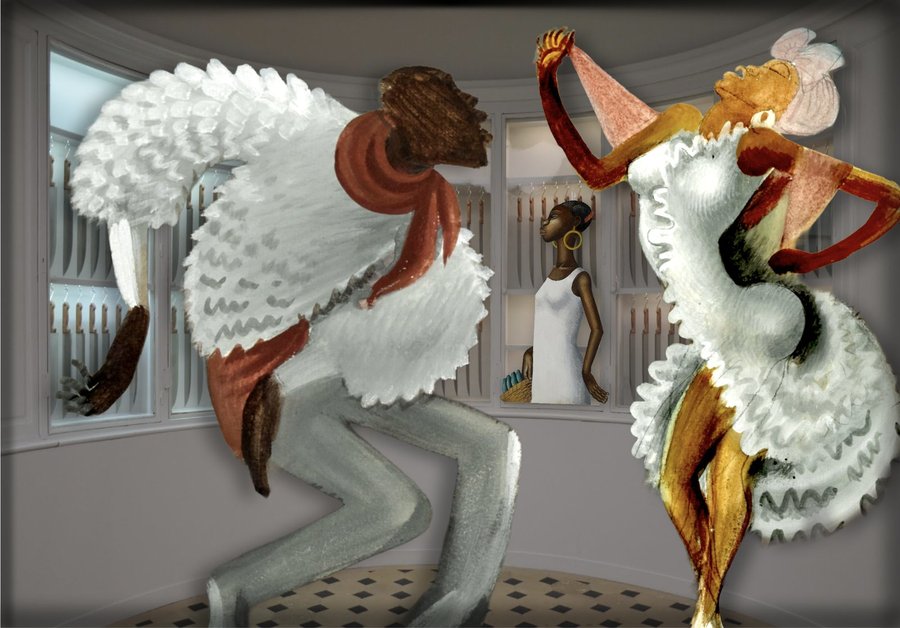
Dance 03
Ruffled white costume and a sweeping, off-balance pose built for motion rather than stillness — this piece reads less like a painted dance scene than a fashion plate caught mid-performance, the kind of stylized figure illustration that flourished in early-20th-century magazine and costume design.
Illustrators like Erté built entire careers turning stage costume into pure graphic silhouette; the checkerboard floor here grounds that fantasy in a real room even as the costume itself dissolves into something closer to plumage than fabric.
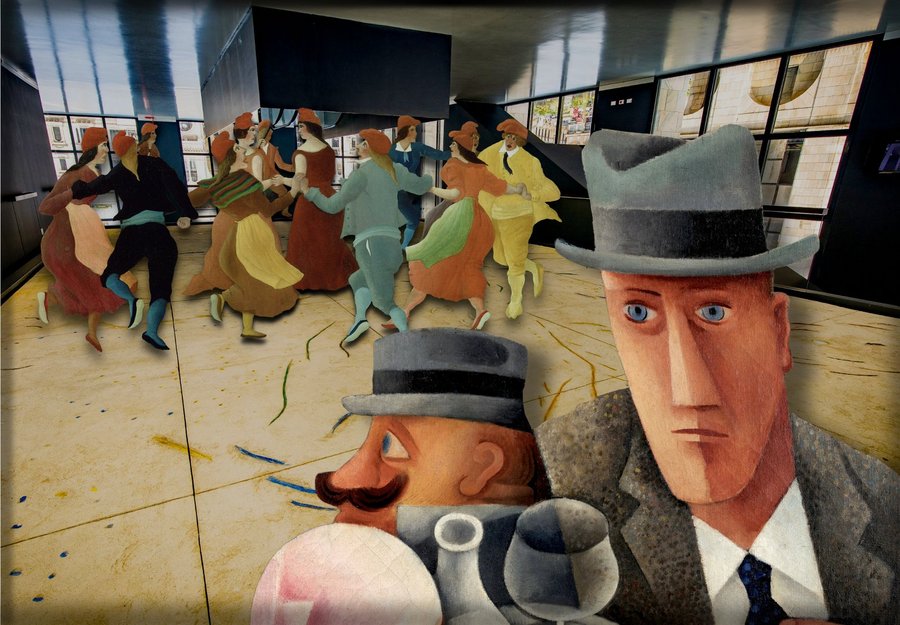
Dance 04
A man and woman rendered with pointed, almost caricatured features stare directly outward while a crowd dances, unfocused, behind them — a composition that owes more to satirical portraiture than to romantic dance painting.
The style recalls the sharp-edged, socially observant illustration of the interwar years, when artists across Europe turned ballroom and cabaret scenes into vehicles for character study, letting a hat, a jawline, or a fixed stare say more about a sitter than the dance itself.
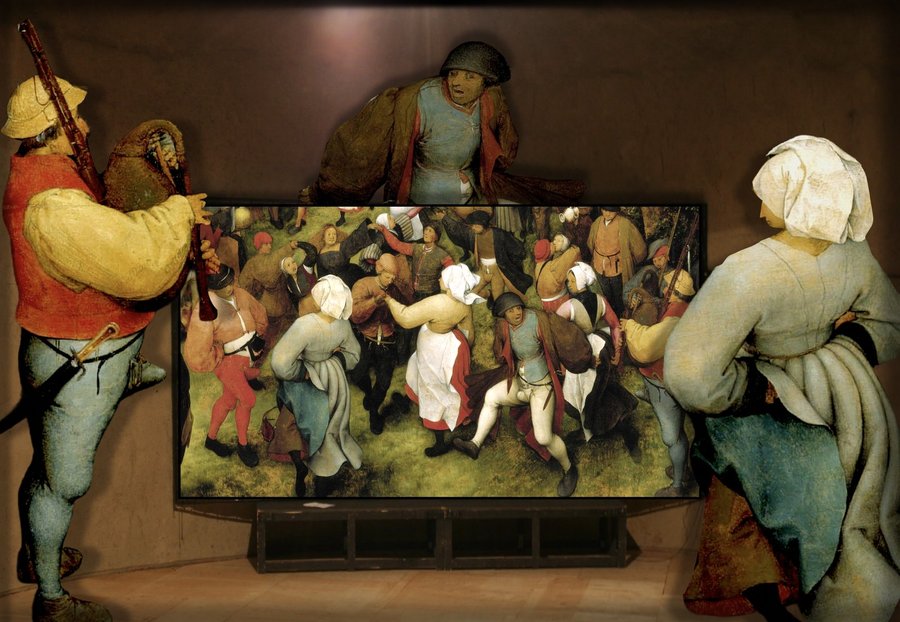
Dance 05
The bagpiper, the boisterous circle of dancers, and the loose, earthy palette all point directly to Pieter Bruegel the Elder’s Peasant Dance (c. 1567), one of the defining images of 16th-century Netherlandish village life and among the first major paintings to treat ordinary rural festivity as a subject worthy of serious composition.
Bruegel painted peasants dancing, drinking, and brawling with the same compositional rigor other artists reserved for saints and nobility — a quiet argument, four and a half centuries early, that everyday life deserved the same attention.
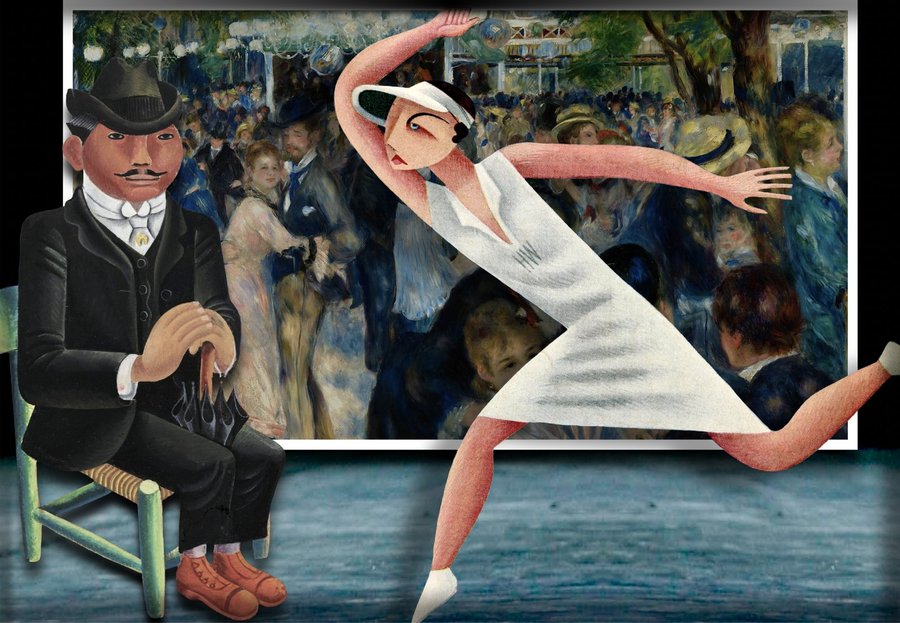
Dance 06
A seated figure, a twirling partner in white, and a dappled outdoor setting place this collage firmly in the tradition of Pierre-Auguste Renoir’s dance paintings of the 1880s — Dance at Bougival, Dance in the City, and Dance in the Country, the trio he painted in quick succession.
Renoir was less interested in the mechanics of the dance itself than in the particular charge of a couple caught mid-turn, a subject this piece borrows almost exactly, down to the loosely brushed, sun-warmed background.
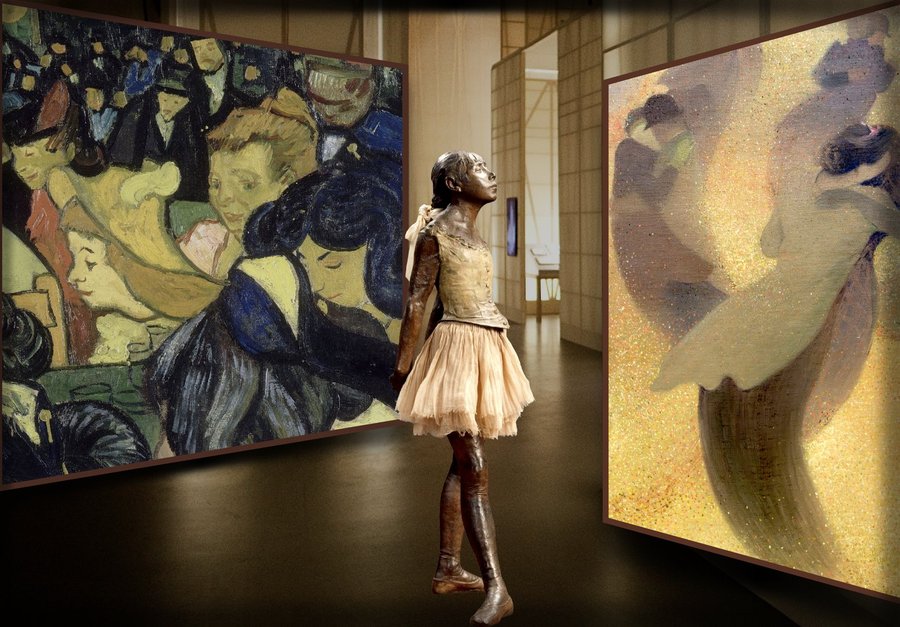
Dance 07
A bronze ballerina in the foreground and a flat, poster-bright painting behind her stage a meeting between two very different ways 19th-century Paris looked at dance. The sculpture recalls Edgar Degas’ Little Dancer of Fourteen Years (1881), the wax-and-fabric figure that scandalized critics for its unidealized realism when first shown.
The painted backdrop, with its saturated color and theatrical flatness, echoes the poster art Henri de Toulouse-Lautrec made for Montmartre’s dance halls a decade later — sculpture and poster, private study and public advertisement, meeting in the same room.
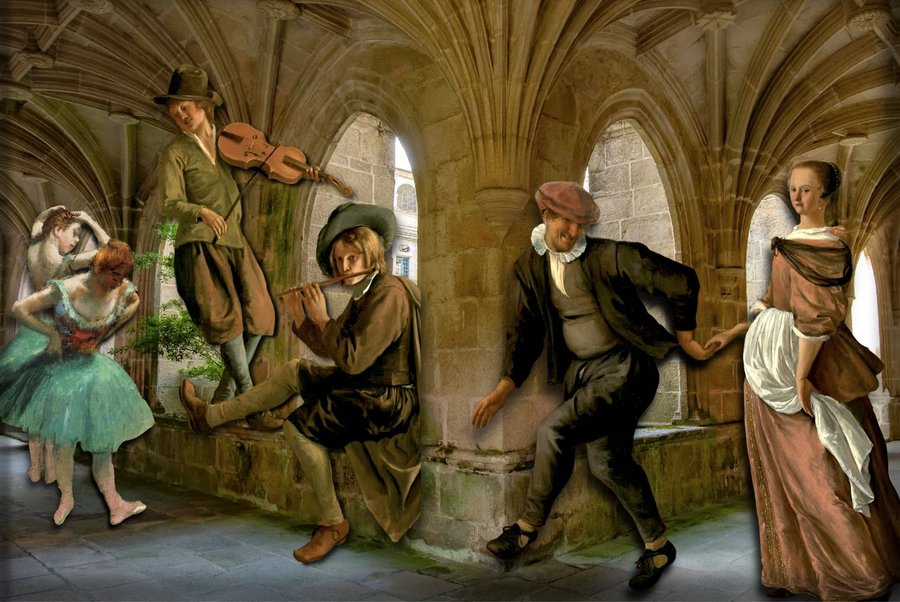
Dance 08
Pointed Gothic arches and a cloistered courtyard frame this dance, pulling it out of any ballroom and into the architecture of a medieval monastery or cathedral close — the kind of setting more often associated with Pre-Raphaelite and Gothic Revival painters of the 19th century.
Those painters found in genuine medieval architecture a ready-made stage for scenes of courtly or communal life; a piper, dancing couples, and the deep perspective of the vaulted cloister behind them turn an ordinary dance into something closer to pilgrimage or festival.
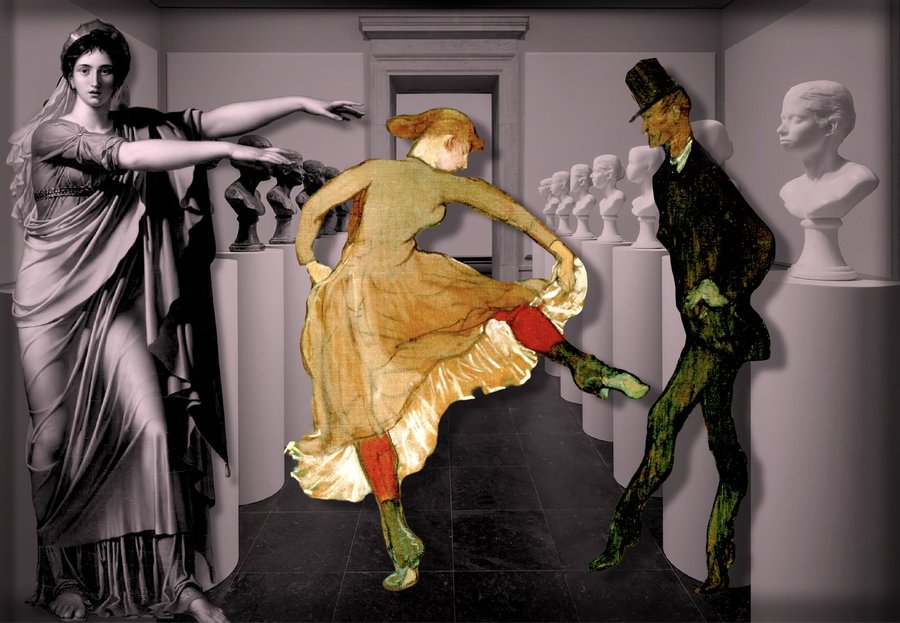
Dance 09
A dancer flung dramatically off-center in a pale dress, watched by a seated, hatted companion — the pose and the loose, sketch-like handling of the background figures recall the Parisian dance-hall scenes Pierre-Auguste Renoir and his Impressionist contemporaries painted through the 1870s and ’80s.
La Grenouillère and the Moulin de la Galette turned casual outdoor dancing into one of the era’s defining subjects; the dress itself, more airborne than worn, is doing most of the compositional work here.
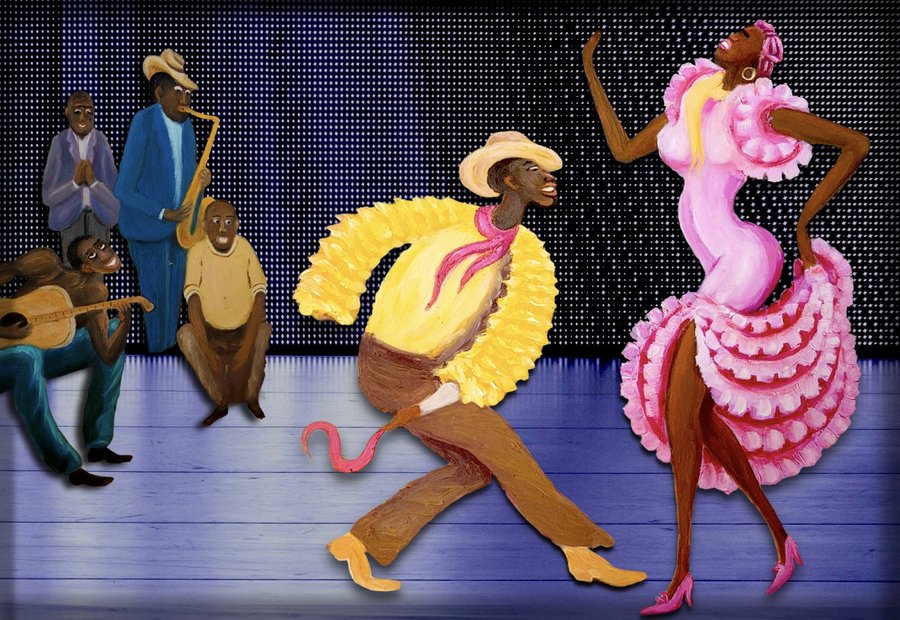
Dance 10
Flat cut-paper color blocking returns here, the same technique as elsewhere in this catalog, applied now to a jazz-age dance floor: a saxophonist and guitarist in silhouette, and a couple mid-step in a cream suit and a ruffled pink dress.
The visual vocabulary — bold color fields, simplified figures, syncopated composition — echoes the way early-20th-century illustrators translated jazz’s improvisational energy into flat graphic design, trading painterly detail for the same rhythm the music itself was built on.
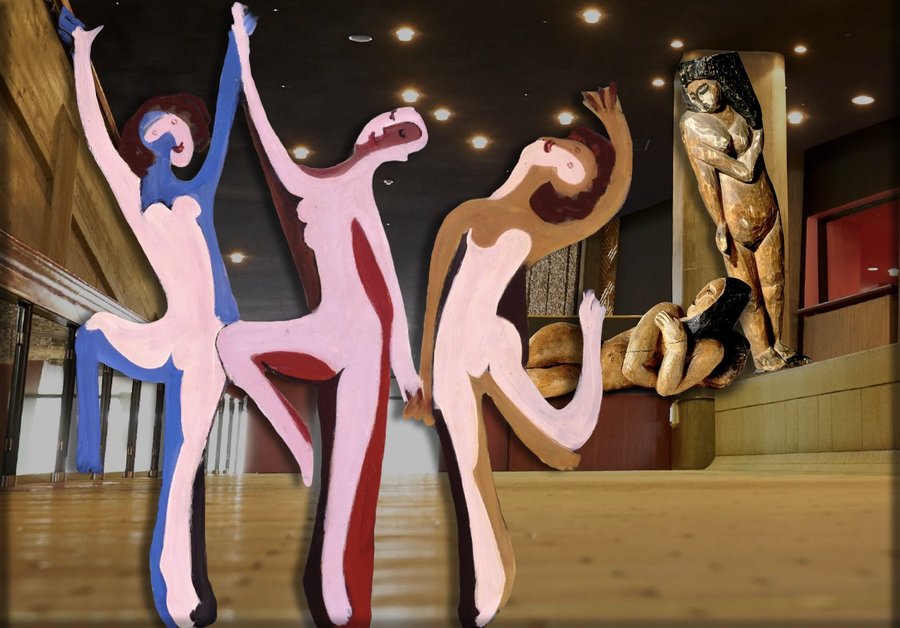
Dance 11
The pink-and-blue palette and the ring of simplified, interlocking figures are an unmistakable quotation of Henri Matisse’s La Danse (1909–10), the circle of five nude dancers rendered in flat red, green, and blue that Matisse painted for the Russian collector Sergei Shchukin.
It remains one of the most reproduced images of early modernism; placing fragments of that famous circle inside an ordinary gallery, alongside an unrelated sculpture, turns a century-old scandal — critics found the nudity and the flatness equally shocking in 1910 — into gallery furniture.
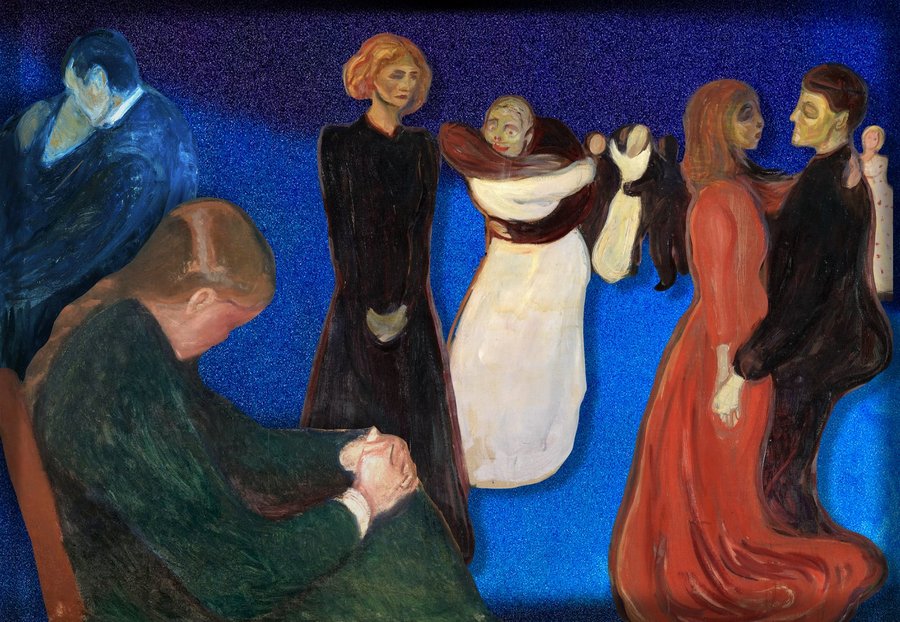
Dance 12
A deep blue nocturnal palette, formally dressed couples turning in pairs, and musicians barely visible at the edge of the frame recall the moody, symbol-laden ballroom and dance-hall scenes Nordic and Central European painters favored around the turn of the 20th century — Edvard Munch chief among them.
Munch’s own dance and ball paintings used exactly this kind of blue-toned nocturnal light to turn a social occasion into something closer to a fever dream; the single figure in red against all that blue pulls the eye toward one unresolved emotional note in an otherwise composed scene.
Shall we Dance? is part of Blu Artworks' wider body of work — 577 original SIAE-registered collages in total. Explore the Shall we Dance? fa parte del lavoro più ampio di Blu Artworks — 577 collage originali registrati SIAE in totale. Esplora la Full GalleryGalleria Completa.