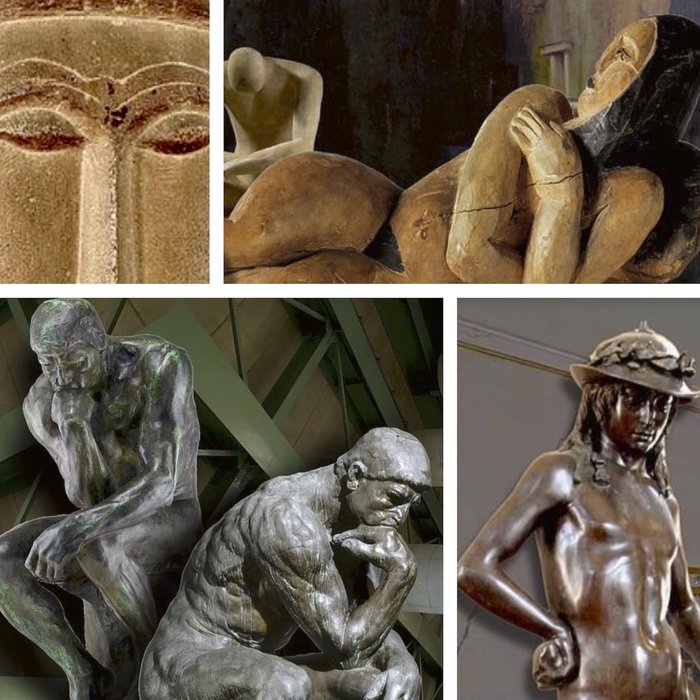
Sculptors and Sculptures
Twenty Collages Built From Three Thousand Years of Carved and Cast Form
20 collages in this catalogcollage in questo catalogo
From Bernini's breathing marble popes to Rodin's bronze embraces, this catalog gathers twenty collages built entirely from sculpture — ancient terracotta figurines, Renaissance bronze, Baroque devotional carving, Neoclassical marble, and the raw wood of German Expressionism, spanning roughly three thousand years of three-dimensional art compressed onto a flat page. Each piece is available as a high-resolution, 300dpi, royalty-free download for €39, ready for print at any size.
View Full Gallery →Vedi la Galleria Completa → View All Collections →Vedi Tutte le Collezioni →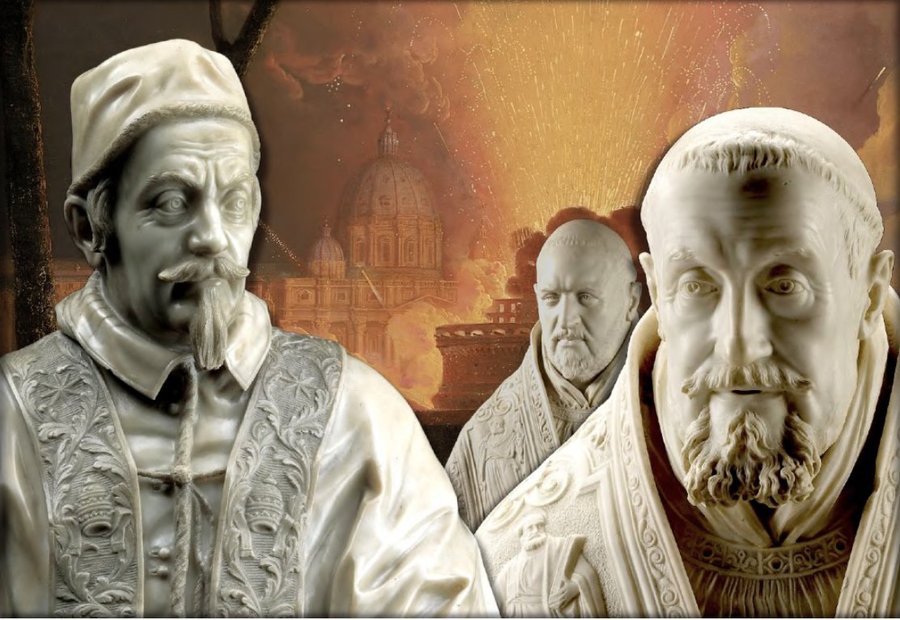
Bernini's Popes
If Michelangelo is one of the greatest representatives of the Renaissance, Bernini is that of the Baroque. The Girandola, painted by the Englishman Joseph Wright of Derby in 1775—which serves as the background for the collage—was a fireworks display staged in Rome to mark the installation of a new pope. Wright was in Rome in 1775 and an eyewitness to the election of Pope Pius VI. This portrait of Rome celebrating a new pope led us to choose, from Bernini's vast body of work, only the sculptures dedicated to the three pontiffs the artist personally knew. The first on the left is the austere Pope Clement X; the second marble bust in the center is Pope Paul V; the third is Pope Gregory XV. Note that these last two pontiffs wear traditional papal vestments. The thick cope covering their shoulders is decorated with the image of the Apostle Peter (holding keys and a book).
Gian Lorenzo Bernini (1598-1680). Se Michelangelo è uno dei maggiori rappresentanti del Rinascimento, Bernini lo è del Barocco. Una delle caratteristiche distintive dello stile di Bernini era la sua abilità nel catturare il movimento e la vita nelle sue sculture. La Girandola, dipinta dall’inglese Joseph Wright of Derby nel 1775, che fa da sfondo al collage, era uno spettacolo pirotecnico allestito a Roma, in occasione dell'insediamento di un nuovo Papa. Wright fu a Roma nel 1775 e testimone oculare in occasione dell’elezione di papa Pio VI. Questo ritratto di Roma, nel festeggiamento per un nuovo papa, ci ha condotto a scegliere, tra la vasta produzione di Bernini, solo le sculture dedicate ai tre pontefici, che ha conosciuto l’artista. Il primo a sinistra è l’austero Papa Clemente X; il secondo busto marmoreo al centro è Papa Paolo V; il terzo è Papa Gregorio XV. Da notare che questi due ultimi pontefici vestono i tradizionali paramenti pontifici. Lo spesso piviale che gli ricoprono le spalle è decorato con l’immagine dell’apostolo Pietro (con in mano le chiavi e un libro). Gian Lorenzo Bernini (1598–1680).
Canova never seen
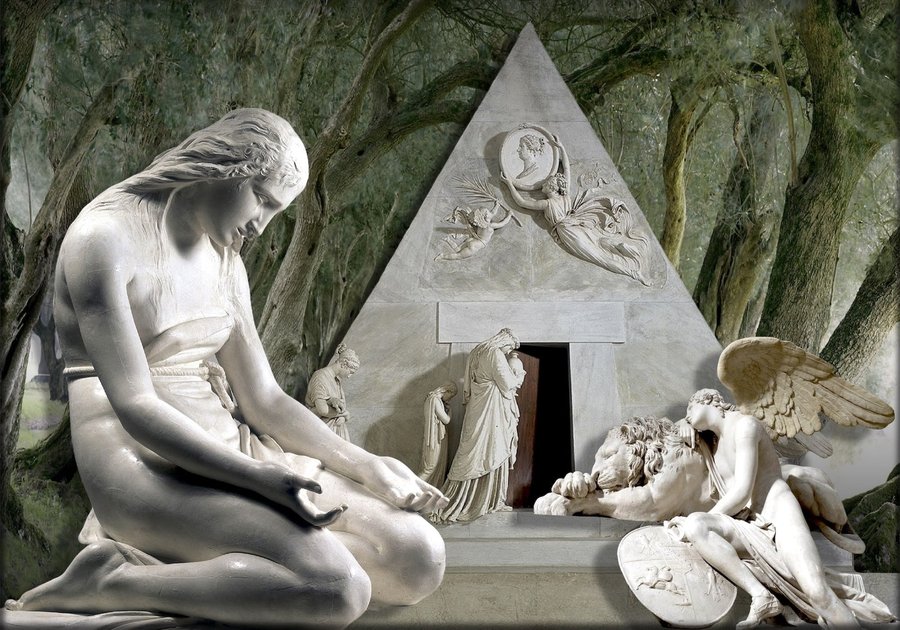
Antonio Canova (1757–1822), a Venetian painter and sculptor, is one of the main representatives of Neoclassical sculpture. Encouraged by his grandfather, he began his artistic training at a very young age, eventually coming to be considered the finest sculptor in Europe since the era of Bernini. Our collage focuses on one of the artist's most monumental works: the funerary monument to Maria Christina of Austria, located in the Augustinian Church in Vienna, which was created by Canova during two stays in Austria, in 1798 and 1805. The work was commissioned by Prince Albert of Saxony, husband of the late daughter of Empress Maria Theresa. On the left, in the foreground, we have placed the figure of the Magdalene, which Canova sculpted in 1796; the marble was exhibited in Paris and was described as 'miraculous' for its beauty. The woman appears in an act of contrition, her face seeming to weep real tears and inspiring a feeling of indefinite religious sorrow, fully in harmony with the context of the funerary composition.
Antonio Canova (1757 - 1822), pittore e scultore veneziano, è uno dei principali rappresentanti della scultura neoclassica. Incoraggiato dal nonno, ha iniziato la sua formazione artistica molto giovane, fino ad arrivare a essere considerato il miglior scultore d’Europa dall’epoca di Bernini. Il nostro collage si incentra su una delle opere più monumentali dell’artista: il monumento funebre di Maria Cristina d’Austria, che si trova nella chiesa degli Agostiniani di Vienna, viene realizzato da Canova durante due soggiorni in Austria, nel 1798 e nel 1805. L’opera gli viene commissionata dal principe Alberto di Sassonia, marito della defunta figlia dell’imperatrice Maria Teresa. A sinistra abbiamo posto in primo piano la figura di Maddalena che Canova scolpì nel 1796; il marmo fu esposto a Parigi e venne definito "miracoloso" per la sua bellezza. La donna appare in atto di contrizione, il suo volto sembra "piangere lacrime vere e ispira un sentimento di indefinito religioso dolore, in sintonia quindi con il contesto della composizione funebre.
Christian Charity
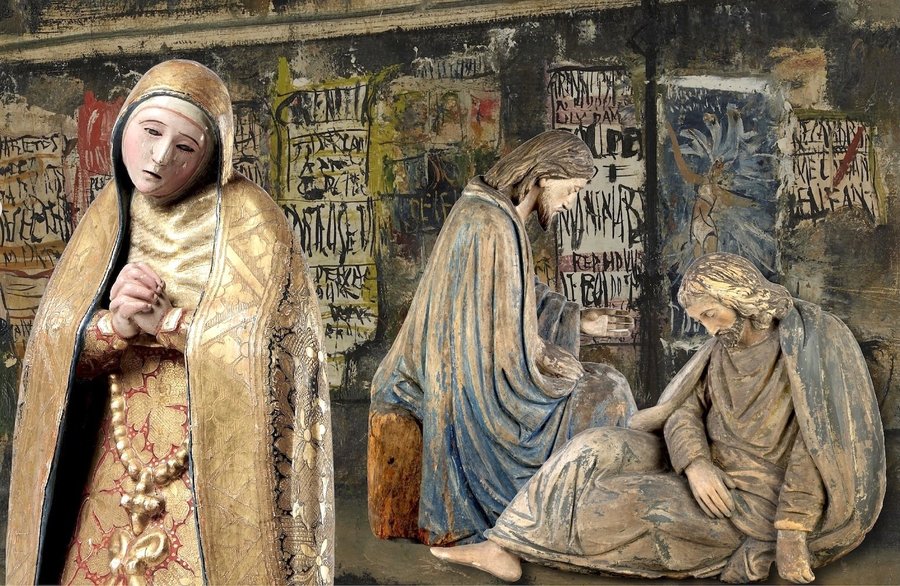
Among ancient civilizations, it is undoubtedly the Egyptian one that held the highest humanitarian ideal: equality under the law, rights for women and children, rights for slaves, and mandatory assistance for the poorest. In the Greco-Roman world, a poor person was considered a detriment to the city and to humanity. As for the concept of charity, Buddhism holds a special place among the major non-Christian religions. Compassion releases one from selfishness, which otherwise closes its eyes to the suffering of the world. Poverty, which is even more present than ever in the modern world, is represented in our collage by a graffiti-covered wall where two beggars lean, one of whom—the seated one—has facial features reminiscent of the figure of Jesus. The two were sculpted by the Polish artist Jan Wnęk in the mid-19th century. On the left, a compassionate witness to the scene, stands the Virgen de la Soledad, a small statuette carved in wood and painted by an anonymous 18th-century Latin American artist.
“Tra le antiche civiltà è senza dubbio quella egiziana che ha avuto una più alta idea umanitaria: uguaglianza nella giustizia, diritti alle donne e ai bambini, diritti agli schiavi, assistenza dovuta ai più miseri. Nel mondo greco-romano, il povero è considerato un danno per la città e per l’umanità. Per quel che concerne il concetto di carità, il buddismo ha un posto particolare fra le grandi religioni non cristiane. La compassione fa uscire dall’egoismo, che chiude gli occhi sulla sofferenza del mondo.” L’attualità che ancora oggi è più che mai presente nel mondo moderno, l’abbiamo rappresentata nel nostro collage con lo sfondo di una strada metropolitana, con un muro coperto da graffiti dove si appoggiano due mendicanti, uno dei quali, quello seduto, con i tratti somatici che ricordano la figura di Gesù. I due sono stati ritratti dallo scultore polacco Jan Wnek nella metà del XIX secolo. A sinistra assiste pietosa alla scena “Virgen de la Soledad”, una statuetta intagliata nel legno e dipinta da un artista dell’America Latina nel XVIII secolo.
Claudel forgotten
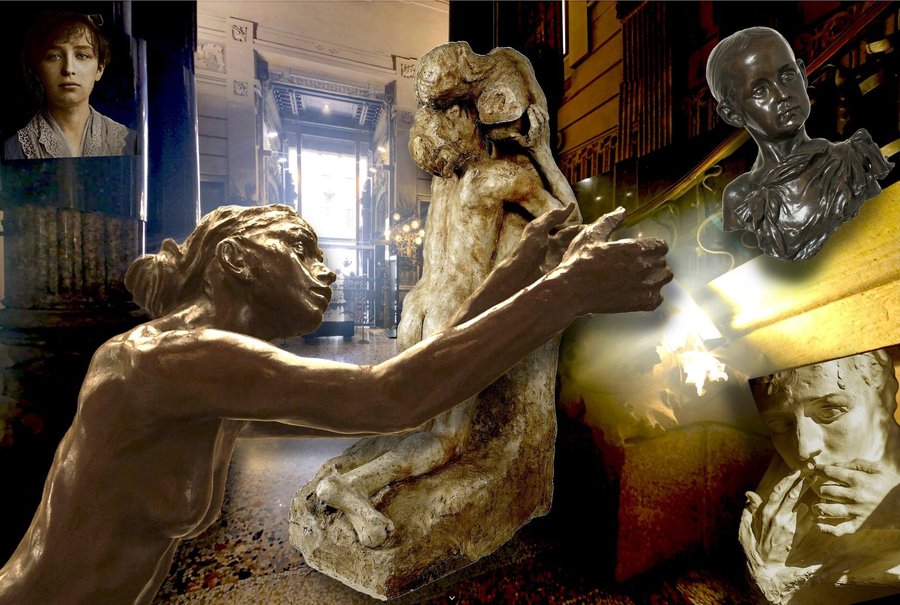
Camille Claudel (1863–1943), sister of the famous French writer Paul Claudel, is one of those female names in art history who fell victim to an era incapable of accepting their talent. Thanks to recent studies, Camille Claudel's role in sculpture between the 19th and 20th centuries has finally been examined and placed in its proper light. For a long time, however, her art was undervalued and overshadowed by the powerful personality of Auguste Rodin, the other great French sculptor. Camille was twenty years old and Auguste forty-four when the young artist moved as a collaborator into Rodin's atelier at 182 Rue de l'Université. Although the sculptor was married and twenty-four years older than her, the two fell in love and began a passionate and, as we shall see, tragic relationship. Rodin saw her as a muse: she was his model, but also his most talented, determined, and passionate student. The fact that Claudel had become involved with a married man was a huge scandal. Claudel was betrayed by her own family who, unable to tolerate her free and non-conformist lifestyle, had her committed to the Montfavet asylum, despite the doctors' doubts regarding any actual mental health issues in young Camille.
Camille Claudel (1863 – 1943), sorella del celebre scrittore francese Paul Claudel, Camille è uno di quei nomi femminili della storia dell'arte vittime di un'epoca incapace di accettare il suo talento. Grazie a studi recenti, il ruolo di Camille Claudel nella scultura tra Ottocento e Novecento è stato finalmente studiato e messo nella giusta luce. Per molto tempo, tuttavia, la sua arte è stata sottovalutata e messa in ombra dalla forte personalità di Auguste Rodin, l'altro grande scultore francese. Camille aveva vent'anni e Auguste quarantaquattro, quando la giovane artista si trasferì come collaboratrice nell'atelier di Rodin al 182 di rue de l'Université. Sebbene lo scultore fosse sposato e avesse ventiquattro anni più di lei, i due si innamorarono e iniziarono una relazione travolgente e, come vedremo, tragica. Rodin la vedeva come una musa: era la sua modella ma anche la sua studentessa più talentuosa, determinata e appassionata. Il fatto che Claudel non fosse sposata, anzi, che si fosse legata a un uomo impegnato fu un grande scandalo. Claudel fu tradita dalla sua stessa famiglia che, non tollerando la sua vita libera e anticonformista, la fece internare nel manicomio di Montfavet, nonostante i dubbi dei medici che non riconoscevano a Camille particolari problemi mentali.
Clay Actors
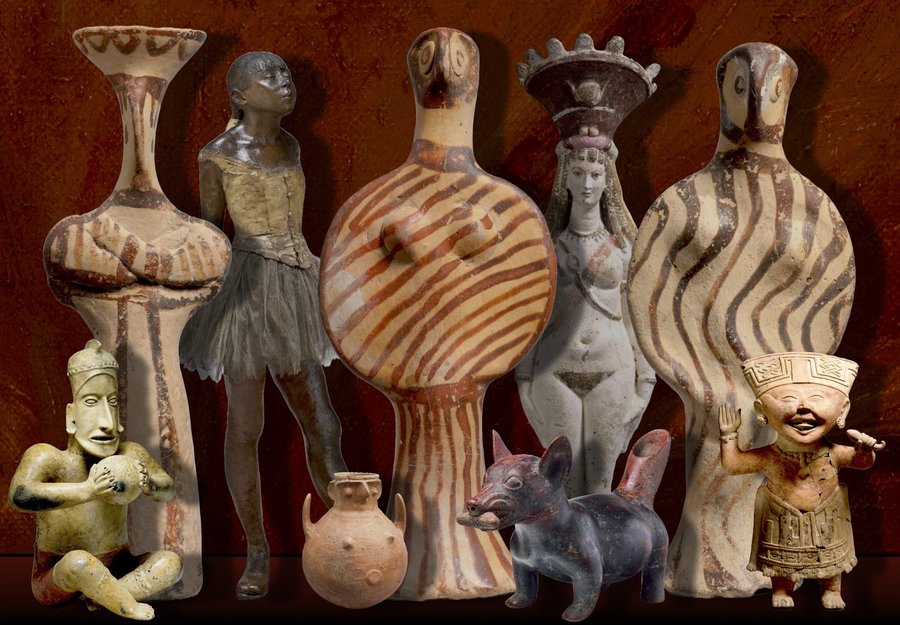
Thanks to its malleability in contact with water, clay is elastic and easily workable. When it dries, it irreversibly loses its ductility and becomes solid and compact. This characteristic and many other qualities have made clay a timeless material. Intimately linked to the evolution of civilizations, clay has told our story since the time of the Sumerians, who were among the first to understand the potential of working with this material. Humanity has made everything from clay, from building bricks for houses to utensils and sculptures. Numerous historical artifacts have survived from antiquity, helping historians and anthropologists reconstruct our past. Modern humans continue to make vases, bricks, and clay sculptures, while also using this mineral in technical and industrial fields thanks to its unique properties. Among its many uses, clay is regularly employed in soil remediation as an anti-pollution agent.
Grazie alla sua malleabilità a contatto con l'acqua, l'argilla è elastica e facilmente manipolabile. Quando si asciuga, perde irreversibilmente la sua duttilità e diventa solida e compatta. Questa caratteristica e molte altre qualità hanno reso l'argilla un materiale senza tempo. Legata a doppio filo all'evoluzione delle civiltà, l'argilla ci ha raccontato la nostra storia fin dai tempi dei Sumeri che furono tra i primi a comprendere le potenzialità della lavorazione di questo materiale. L'uomo ha realizzato di tutto con l'argilla, dai mattoni per costruire le case, agli utensili, alle sculture. Sono tante le testimonianze storiche giunte fino a noi dall'antichità che hanno aiutato storici e antropologi a ricostruire il nostro passato. L'uomo del XXI secolo continua a realizzare vasi, mattoni e sculture in argilla, ma è riuscito anche a utilizzare questo minerale in campo tecnico e industriale grazie alle sue virtù. Tra i suoi molteplici utilizzi, l'argilla viene regolarmente impiegata nella bonifica dei terreni come agente anti- inquinamento.
Confession and Repentance
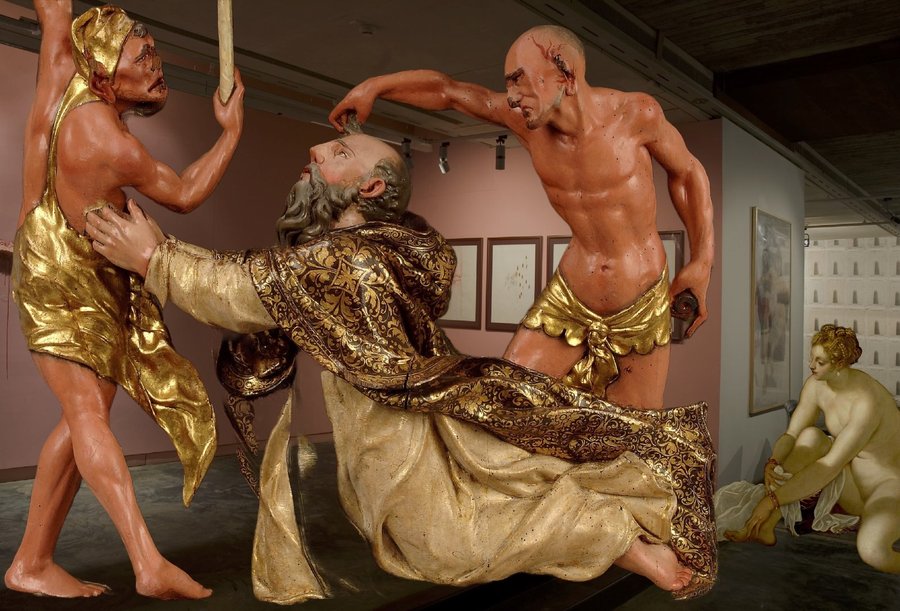
To illustrate our collage, we have included the bas- relief sculpted by the Spanish artist Diego Rodríguez in 1555: Temptations of Saint Anthony the Abbot. Temptation is represented (in the lower right) by the seated nude woman, a detail from the famous 1555 painting by the Italian artist Tintoretto titled Susanna and the Elders, held at the Kunsthistorisches Museum in Vienna.
Per illustrare il nostro collage abbiamo inserito il bassorilievo scolpito dallo spagnolo Diego Rodriguez nel 1555: Tentazioni di Sant'Antonio Abate. La tentazione è rappresentata (in basso a destra) con la donna nuda seduta, un particolare del celebre dipinto dell'italiano Tintoretto dello stesso 1555: “Susanna e i vecchioni”, conservato al Kunsthistorisches Museum di Vienna. Negli ultimi decenni, gli scandali sessuali all'interno della Chiesa cattolica sono stati ricondotti all'obbligo del celibato: un sacerdote deve essere celibe, il che significa che deve vivere in totale castità, non solo astenendosi da qualsiasi rapporto sessuale, ma anche mantenendo un cuore puro, un cuore libero anche emotivamente, perché è consacrato al Signore. Nella sua enciclica sul celibato sacerdotale, papa Paolo VI ha ribadito la necessità del celibato ecclesiastico.
Cubist Style
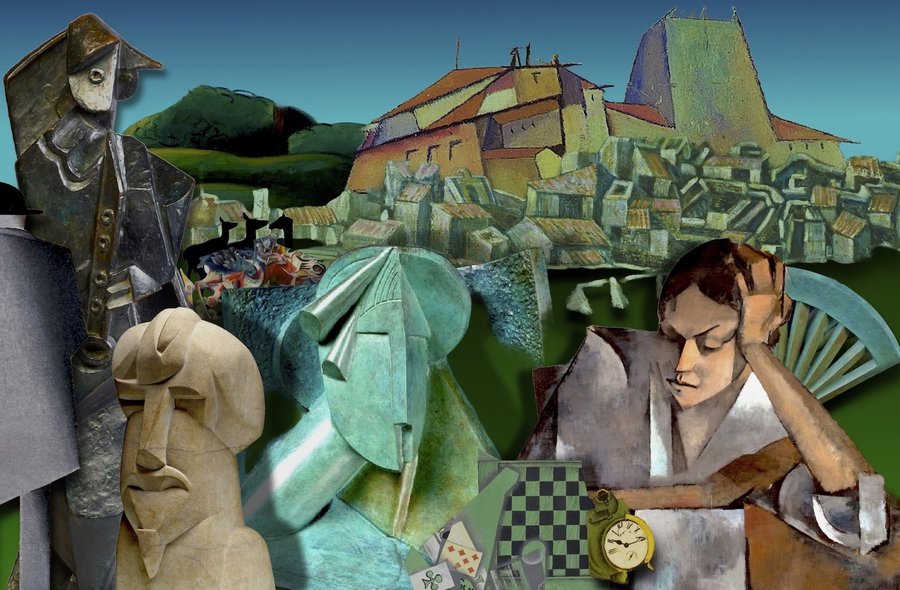
When considering sculpture, which is three- dimensional by its very nature, Cubism remains the benchmark style: formal, pure, geometric, essential, almost primitive; much like the head of the American poet Ezra Pound, sculpted in 1914 by the Frenchman Henri Gaudier-Brzeska (in the lower left of the collage). The poet was one of the leading figures of early 20th- century modernism and poetry. His stubborn, taciturn, and impenetrable character is well represented by the Cubist style in the marble used to carve the portrait. In the center, rendered in an evocative green bronze, is our second example of Cubist sculpture: Woman with a Fan by the Ukrainian artist Oleksandr Archipenko, created in 1914. Oleksandr studied sculpture in Kyiv and Moscow; in 1908 he moved to Paris, where his style—deeply influenced by the Cubists—took shape through an alternation of voids and solids, concaves and convexes, straight and oblique lines. Between 1913 and 1923, he opened art schools in Berlin and later in New York, where he taught art for the rest of his life.
Quando consideriamo la scultura, tridimensionale per sua natura, il cubismo rimane uno stile formale puro, geometrico, essenziale, quasi primitivo: come nella testa del poeta americano Ezra Pound, scolpita nel 1914 dal francese Henri Gaudier-Brzeska (in basso a sinistra). Il poeta è stato uno dei protagonisti del modernismo e della poesia dei primi del Novecento. Il suo carattere ostinato, taciturno e impenetrabile è ben rappresentato dallo stile cubista del marmo con cui è stato ritratto. Al centro, in un suggestivo bronzo verde, abbiamo il nostro secondo esempio di scultura cubista: "Donne con un divertimento" dell'artista ucraino Oleksandr Archhypenko realizzata nel 1914. Oleksandr studia scultura a Kiev e Mosca; nel 1908 si trasferisce a Parigi e il suo stile, profondamente influenzato dai cubisti, si struttura in un'alternanza di vuoti e pieni, concavi e convessi, linee rette e oblique. Tra il 1913 e il 1923 apre scuole d'arte a Berlino e poi a New York, dove insegna arte per il resto della sua vita.
Donatello Tribute
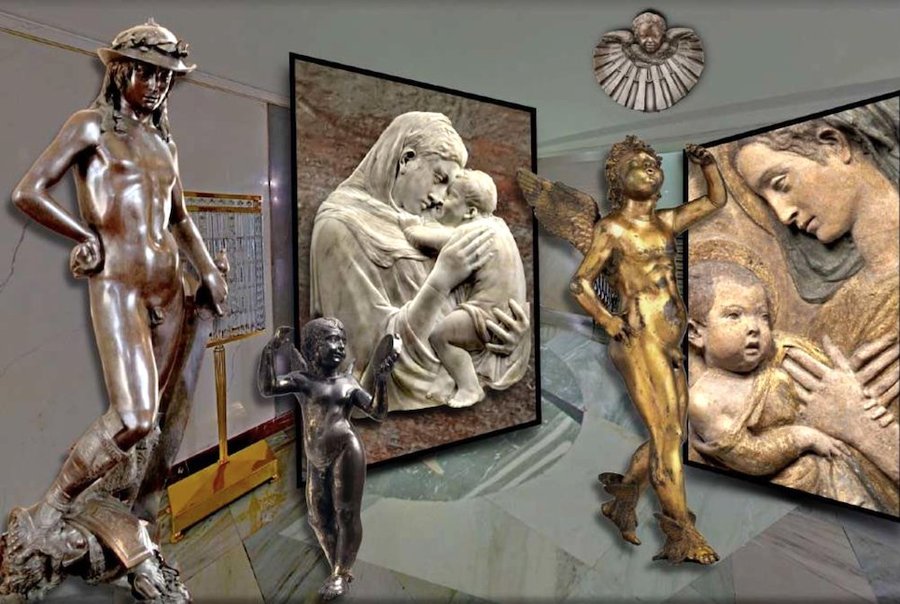
Donatello (1386–1466), the greatest Italian sculptor of the early Renaissance, is one of the most famous sculptors of all time. The white marble Madonna with the gentle expression alongside the Child is known as the Pazzi Madonna, dated to 1420. The name appears to stem from the fact that this beautiful bas-relief was discovered in the Palazzo Pazzi in Florence. The Pazzi family was one of the most powerful and noble families of Florentine bankers, bitter enemies of the Medici. The second Madonna and Child, a painted terracotta from 1450, was commissioned from the sculptor by another family of bankers and merchants operating between Milan, Padua, and Venice: the Borromeos. On the left is the famous David, depicted by Donatello immediately after slaying Goliath; standing completely nude, save for his boots and a broad-brimmed hat. His left hand rests on his hip holding a stone, while his right arm lies along his body, hand gripping the hilt of a sword. His left foot rests atop Goliath's severed head at the base of the work, almost nonchalantly.
Donatello (1386 - 1466), il più grande scultore italiano del primo Rinascimento, è uno dei più celebri scultori di tutti i tempi. La Madonna di marmo bianco con la dolce espressione accanto al Bambino, è conosciuta come Madonna Pazzi, datata 1420. Sembra che il nome sia dovuto al fatto che questo bellissimo bassorilievo sia stato rinvenuto nel Palazzo Pazzi a Firenze. La famigli a Pazzi era una delle più potenti e nobili famiglie di banchieri fiorentini, nemici acerrimi dei Medici. La seconda Madonna con Bambino in terracotta dipinta del 1450 fu commissionata allo scultore da un’altra famiglia di banchieri e mercanti che operavano tra Milano, Padova e Venezia , i Borromeo. A sinistra c’è il celebre David, rappresentato da Donatello subito dopo l’uccisione di Golia; in piedi, totalmente nudo, a parte i calzari ed un cappello a falda larga. La mano sinistra poggia sul fianco tenendo un sasso, mentre il braccio destro è lungo il corpo e la mano stringe l’elsa di una spada. Il piede sinistro è poggiato sopra la testa mozzata di Golia, alla base dell’opera.
Donna e Madonna
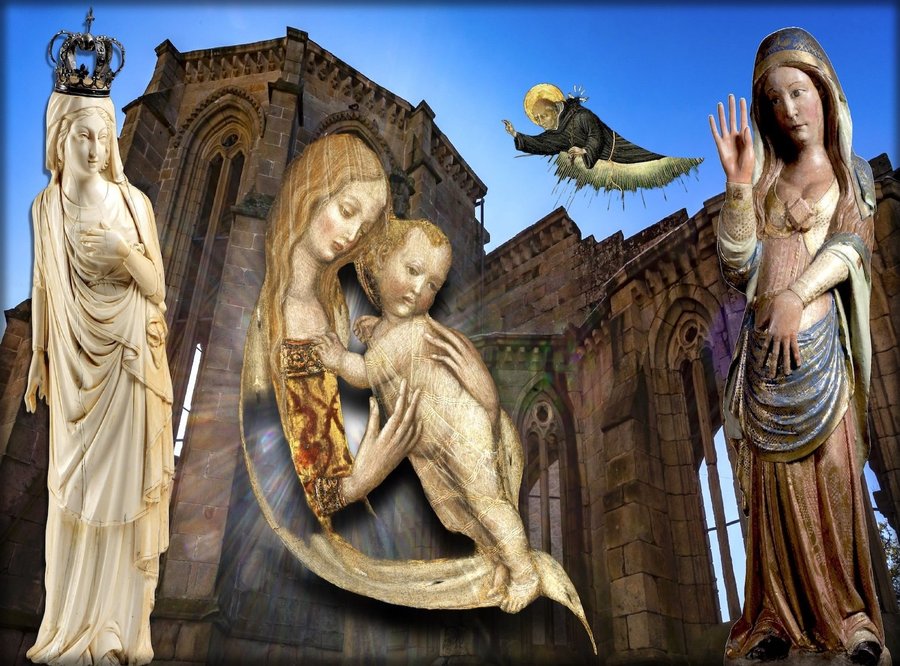
Pope Francis gave a speech on the female figure and lucidly explained their qualities with these words: 'Woman reaches the pinnacle of creation, serving as the summary of all creation. Indeed, she embodies the very purpose of creation itself: the generation and safeguarding of life, communion with all things, and caring for everything. Woman shows that the meaning of living is not to keep producing things, but to take to heart the things that exist.
In occasione della Giornata internazionale della donna, Papa Francesco fece un discorso sulla figura femminile e spiegò lucidamente le prerogative che le donne posseggono: «La donna giunge al culmine della creazione, come il riassunto dell’intero creato. Infatti racchiude in sé il fine del creato stesso: la generazione e la custodia della vita, la comunione con tutto, il prendersi cura di tutto. La donna mostra che il senso del vivere non è continuare a produrre cose, ma prendere a cuore le cose che ci sono. Quante volte il corpo della donna viene sacrificato sugli altari profani della pubblicità, del guadagno, della pornografia, sfruttato come superficie da usare. Il corpo va dunque liberato dal consumismo, va rispettato e onorato.»
Forged Irons
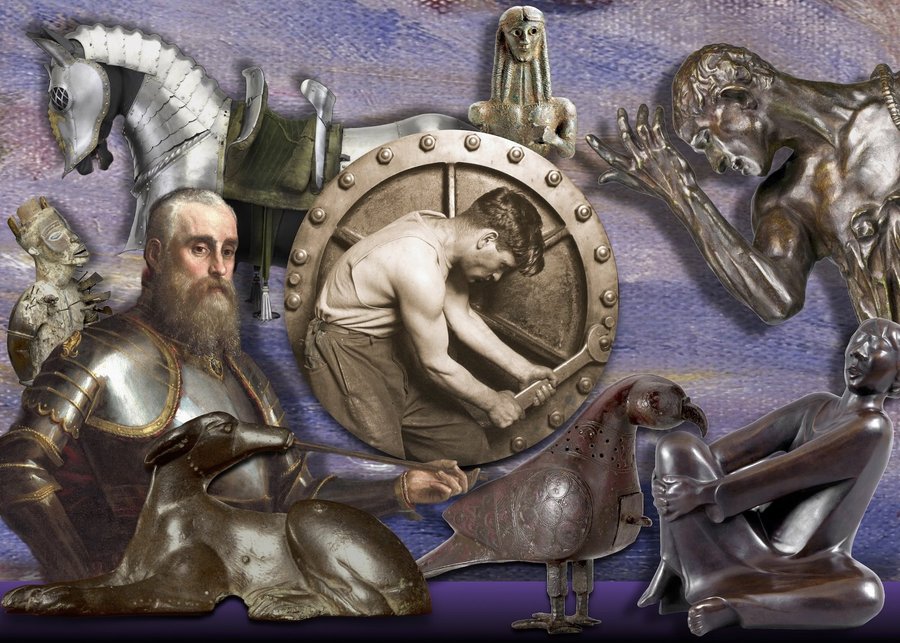
Iron is hard, but fire softens it' is an ancient proverb passed down from generation to generation. This saying clearly refers to the properties of iron: strong and resistant, yet easily forged when exposed to high-temperature fire and subsequently hammered and pressed. It is the oldest method of ironworking, performed manually for centuries in small workshops using a furnace to heat the iron, an anvil, and various tools to shape the metal into diverse objects for many uses, sometimes achieving artistically significant results.
La nostra scelta di collocare la fotografia Powerhouse Mechanic del fotografo americano Lewis Hine, scattata nel 1922, al centro del collage è emblematica, in quanto onora il duro lavoro dei lavoratori che si sono sforzati per contribuire allo sviluppo industriale. Lewis Wickes Hine (1874 - 1940) è stato un sociologo e fotografo americano che ha utilizzato la sua macchina fotografica come strumento per promuovere la riforma sociale, in particolare nell'ambito dello sfruttamento del lavoro minorile. "Il ferro è duro, ma il fuoco lo rende morbido" è un antico proverbio tramandato di generazione in generazione. Questo detto si riferisce chiaramente alle proprietà del ferro: forte, resistente e non facilmente piegabile, ma in grado di essere forgiato con facilità se esposto al fuoco ad alte temperature e poi martellato e pressato. È il metodo più antico di lavorazione del ferro, eseguito manualmente per secoli in piccole officine utilizzando una fornace per riscaldare il ferro, un'incudine e vari utensili per martellare e modellare il metallo in diversi oggetti funzionali.
German Expressionist
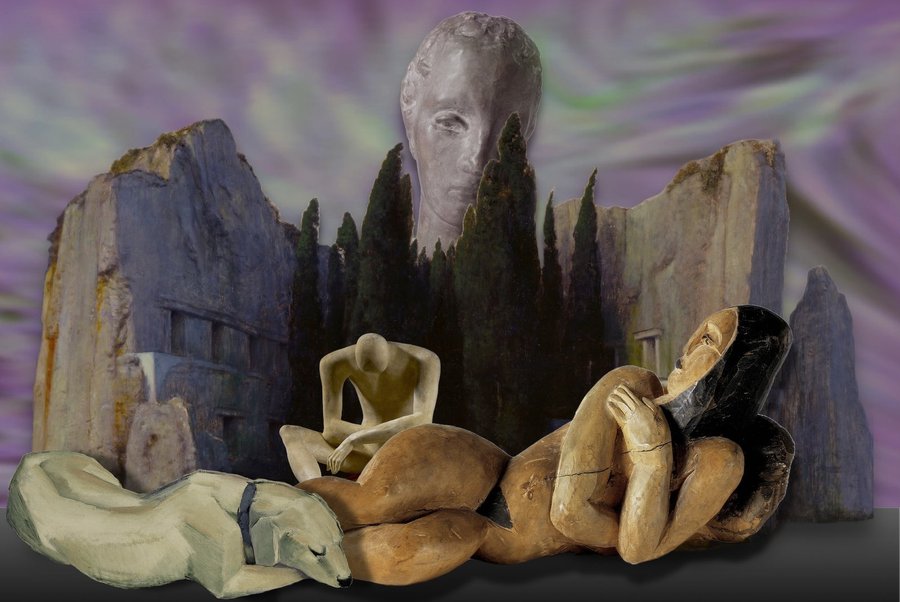
The artists of German Expressionism, one of the most revolutionary art movements of all time, were driven by a desire to rebel against the conventions of the period, inspired by themes related to philosophy, the inner life, primal emotions, and sexuality. The emphasis on disillusionment and the barely hidden restlessness of German society became central to German Expressionism, and its representation— through unusual forms and vivid colors—became its hallmark. For the first time, thanks to this movement, the psyche, spirituality, and mysticism revealed their visual potential through works that have become symbols of the modern era. These artists worked in the immediate aftermath of the First World War, capturing above all the German disillusionment of the era and the deep anxieties of modern society. The innovations inherent in this movement also influenced cinema, theater, and literature, helping to redefine a new artistic and cultural sensibility.
Gli artisti dell'espressionismo tedesco, uno dei movimenti artistici più rivoluzionari di tutti i tempi, erano spinti dal desiderio di ribellarsi alle convenzioni del periodo e ispirati da temi legati alla filosofia, alla vita interiore, alle emozioni primordiali e alla sessualità. L'enfasi sulla disillusione e l'irrequietezza appena nascosta della società tedesca divennero centrali nell'espressionismo tedesco e la sua rappresentazione attraverso forme insolite e colori vividi divenne il suo segno distintivo. Per la prima volta, grazie a questo movimento, psiche, spiritualità e misticismo rivelarono il loro potenziale visivo attraverso opere che sono diventate simboli dell'era moderna. Questi artisti lavorarono subito dopo la prima guerra mondiale e divennero la voce della disillusione dell'epoca e delle profonde ansie dell'umanità moderna. L'innovazione al centro di questo movimento influenzò anche il cinema, il teatro e la letteratura, contribuendo a ridefinire una nuova sensibilità artistica e culturale.
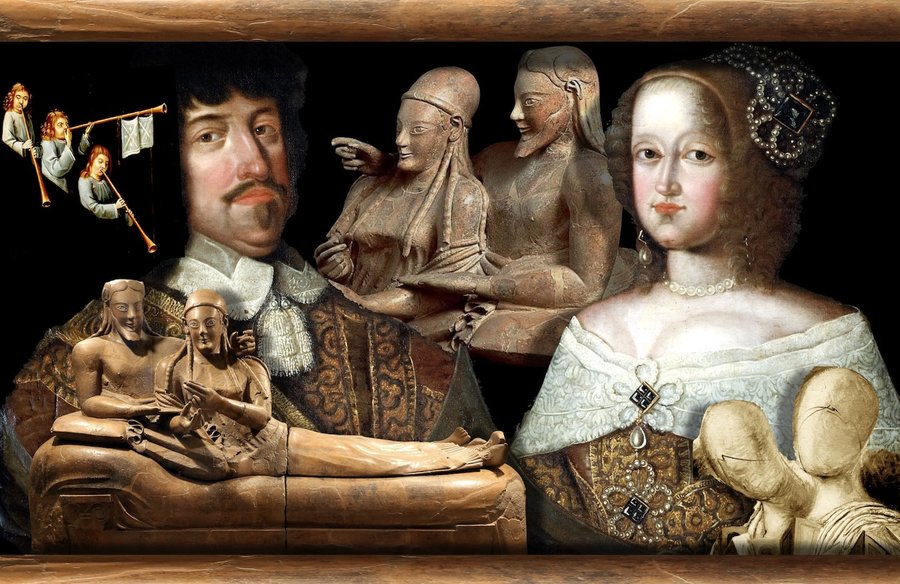
Just Married
Our collage is dedicated to the theme of weddings, featuring three artistic works that differ in era, style, and the artists who created them. Let us begin with the one that seems most classic to us: the Sarcophagus of the Spouses, a masterpiece of Etruscan art dating to 530–520 BC. It was discovered in Cerveteri, a city northwest of Rome, within a necropolis complex that was once part of an ancient Etruscan city. Reassembled from roughly 400 fragments, its lid is surmounted by a painted terracotta couple reclining with their torsos raised in the typical banquet posture, the man placing an arm around the woman's shoulders; the position of their hands and fingers suggests the original presence of objects now lost, perhaps a wine cup or a small flask holding precious perfume. An important innovation compared to Greek custom is the presence of the woman alongside the man in a position of complete equality. With the elegance of her attire and the imperiousness of her gestures, the female figure appears to dominate the scene, capturing all of our attention and admiration.
Il nostro collage è dedicato al tema delle nozze con tre opere artistiche diverse tra loro per epoca, stile e artisti che le hanno realizzate. Parliamo di quella che ci sembra la più classica: il "Sarcofago degli Sposi”; capolavoro dell'arte etrusca risalente al 530-520 a.C. rinvenuto a Cerveteri, città a nord-ovest di Roma, in un complesso di necropoli, un tempo parte di una città etrusca. Ricomposto da circa 400 frammenti, il Sarcofago degli Sposi è un'urna destinata ad accogliere i resti materiali del defunto. L'opera rappresenta una coppia di sposi distesi con il busto sollevato nella tipica posizione del banchetto, con l'uomo che mette un braccio intorno alle spalle della donna; la disposizione delle mani e delle dita suggerisce la presenza originaria di oggetti oggi perduti, forse una coppa per bere il vino o un piccolo vaso da cui attingere prezioso profumo. Un'importante innovazione, rispetto al costume greco, è la presenza della donna accanto all'uomo in una posizione completamente paritaria. Con l'eleganza del suo abbigliamento e l'imperiosità dei suoi gesti, la figura femminile sembra dominare la scena, catturando tutta la nostra attenzione e ammirazione.
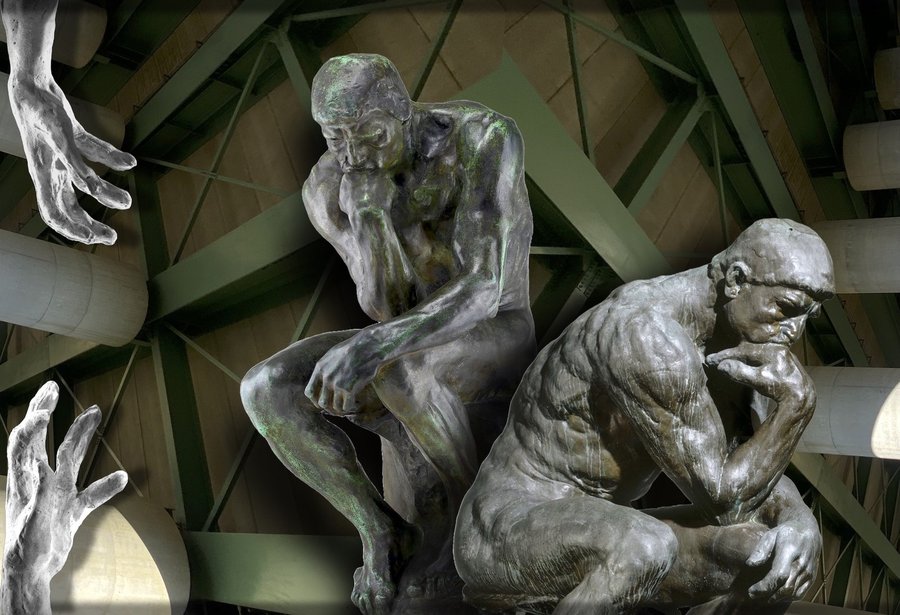
Le Penseur de Rodin
“Le Penseur” (The Thinker) was initially conceived by the French sculptor Auguste Rodin as the portrait of a poet. His nudity, however, has handed him down to us as an artist seeking new stimulation from thought and imagination. Crafted in bronze, at first glance this nude man so absorbed in his ponderings appears as the portrait of a hero, a classical deity, or Dante Alighieri and, likely for this reason, the sculpture has always been considered an icon of the creative activity of all those poets who have confronted the mystery of existence. Rodin's bronze exists today in many casts and sizes. More than fifty variations are known from the original handmade clay model by Rodin. In our collage, the presence of the hands is due to the fact that one thing that particularly fascinated Rodin was hands; gesturing hands, studies of hands pulsating with life. For Rodin hands communicate with the same force as the human face. Auguste Rodin (1840-1917), an artisan who long desired recognition from the academic world but was never accepted by the most important Parisian art schools.
Il Pensatore fu inizialmente concepito dallo scultore francese, Auguste Rodin, come il ritratto di un poeta. La sua nudità, tuttavia, lo ha contrassegnato come l'incarnazione universale di ogni poeta, ogni creatore che trae nuova vita dall'immaginazione. Il Pensatore di Rodin esiste oggi in molti calchi e dimensioni. Se ne conoscono più di cinquanta di queste dimensioni, ovvero le dimensioni del modello originale in argilla fatto a mano di Rodin. Nel nostro collage, la presenza delle mani sono dovute al fatto che una cosa che affascinava particolarmente Rodin erano le mani; mani che gesticolano, studi di mani che pulsavano di vita. Per Rodin, le mani comunicano con la stessa forza del volto umano. Realizzato in bronzo, a primo impatto quest’uomo nudo così preso dalle sue elucubrazioni appare come il ritratto di un eroe o di una divinità classica e, probabilmente per questo motivo, la scultura è da sempre ispirazione per scrittori e artisti. Secondo alcune ipotesi, “Il Pensatore” in realtà raffiguri Dante Alighieri, il sommo tra tutti i poeti, che si sono confrontati con il mistero dell’esistenza.
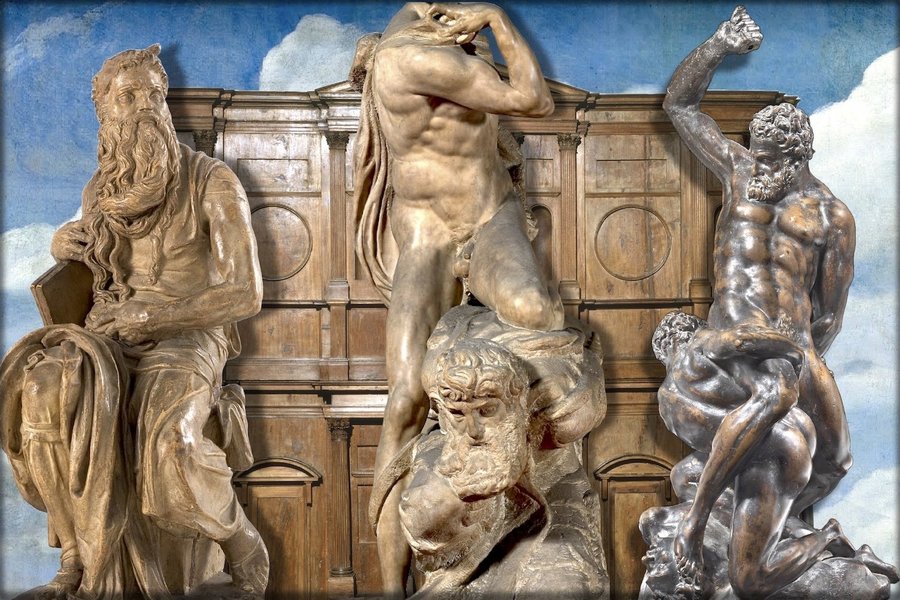
Michelangelo Tribute
The Tuscan Michelangelo Buonarroti (1475 – 1564) is not only one of the most famous sculptors in history, but was also a great painter and architect. After convincing his father that he was destined to be an artist, he began painting in the workshop of Domenico Ghirlandaio and, later, sculpting in the Garden of San Marco, the florentine art academy. The multifaceted Michelangelo was also a poet, and his compositions met with some success in the United States during the nineteenth century, following their translation by the philosopher Ralph Waldo Emerson. A personality as brilliant as it was restless, Michelangelo is linked to some of the most majestic works of Western art, including the David, Moses, the Pietà in the Vatican, the Dome of Saint Peter's, and the fresco cycle in the Sistine Chapel—works considered exceptional milestones of creative genius. For our collage, a tribute to the great Tuscan sculptor, we chose for the background the wooden model prepared by the artist in 1518 for the facade of San Lorenzo. To this, we added the statue of Moses on the left (a faithful terracotta replica of the original). In the center, The Genius of Victory, an allegory from 1534; on the right, the bronze (since the marble original has not survived) of Samson Slaying a Philistine.
Michelangelo Buonarroti (1475 - 1564) non è soltanto uno degli scultori più famosi della storia, è stato anche un grande pittore e architetto. Dopo aver convinto il padre di essere destinato a fare l’artista, ha iniziato a dipingere nella bottega di Domenico Ghirlandaio e, più tardi, a scolpire nel Giardino di San Marco, accademia d’arte voluta da Lorenzo de Medici, detto il Magnifico. Personalità tanto geniale quanto irrequieta, il suo nome è legato ad alcune delle più maestose opere dell'arte occidentale, fra cui si annoverano il David, il Mosè, la Pietà del Vaticano, la Cupola di San Pietro e il ciclo di affreschi nella Cappella Sistina, tutti considerati traguardi eccezionali dell'ingegno creativo. Per il nostro collage, tributo al grande scultore toscano, abbiamo scelto: per il fondo, il modello in legno preparato dall’artista nel 1518 per la facciata di San Lorenzo in Roma. A cui abbiamo posto, in primo piano a sinistra, la statua di Mosé (una fedele replica in terracotta dell’originale). Al centro “The Genie of Victory”, un'allegoria del 1534 della Vittoria; a destra il bronzo (in quanto l’originale in marmo non è sopravvissuto) di Sansone che sconfigge i filistei.
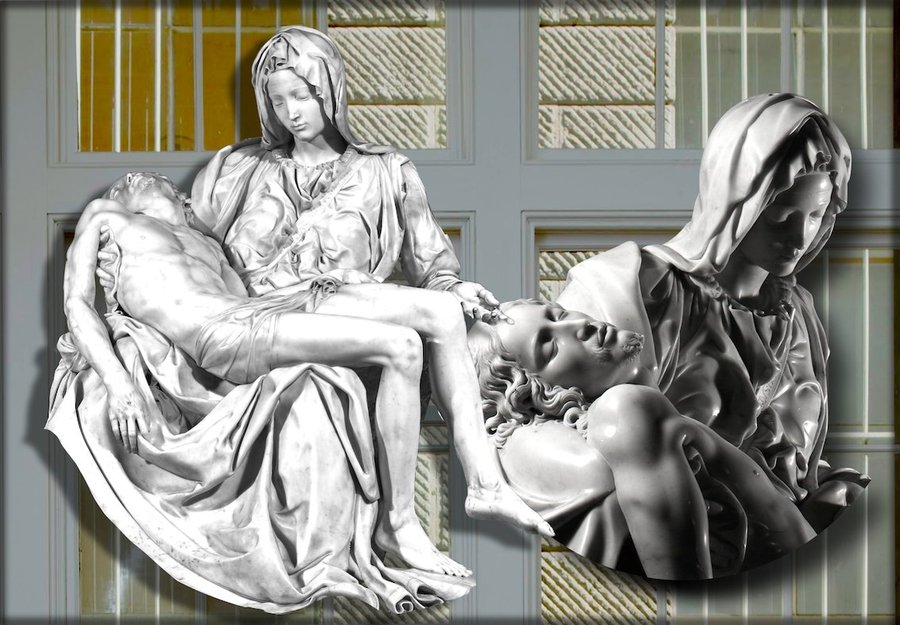
Pietà di Michelangelo
Michelangelo's Pietà is a masterpiece of Renaissance sculpture. Crafted between 1497 and 1499, it is sculpted from a single block of white Carrara marble. The Virgin Mary has a young, almost adolescent face that shows no signs of aging. This symbolizes her purity and perpetual virginity, as well as embodying the symbol of eternal life. Her face expresses a serene and dignified sorrow, not despair. Meanwhile, Jesus's body is sculpted with impeccable, realistic anatomy that highlights his suffering while maintaining composure and grace.
La Pietà di Michelangelo è un capolavoro della scultura rinascimentale. Realizzata tra il 1497 e il 1499, è l'unica opera firmata dall'artista. Attualmente si trova nella Basilica di San Pietro in Vaticano. L'opera è scolpita in un unico blocco di marmo bianco di Carrara, caratterizzato da una levigatura e una finitura eccezionali. La Madonna ha un volto giovane, quasi adolescenziale, che non mostra i segni della vecchiaia. Questo simboleggia la sua purezza e verginità perpetua, oltre a incarnare il simbolo della vita eterna. Il suo volto esprime un dolore assorto e dignitoso, non disperazione. Mentre il corpo di Gesù è scolpito con un'anatomia impeccabile e realistica, che ne evidenzia la sofferenza, pur mantenendo compostezza e grazia. La Pietà è considerata un'espressione dell'ideale di perfezione dell'artista, capace di trasformare il dolore umano in contemplazione spirituale, fatta di silenzio e pace.
Prosit Thorvaldsen
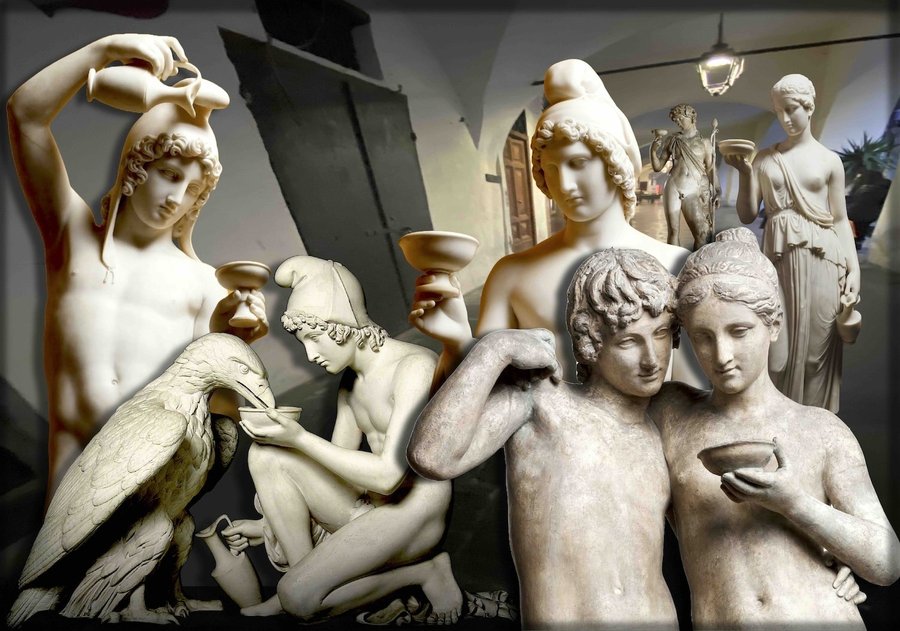
Bertel Thorvaldsen (1770–1844) was a Danish sculptor and a prominent figure in 19th-century European art, a representative of Neoclassicism and Canova's main rival. He worked primarily in Rome, his adopted artistic homeland. His fame among contemporaries was immense, equal to that of Canova. Our collage focuses on works inspired by the Greek myth of Ganymede; Ganymede was a prince whom Zeus, in the form of an eagle, carried off to Mount Olympus to serve as cupbearer to the gods. Thorvaldsen sculpted several versions of Ganymede— distinguishable by his headcovering—which are included in our collage: the one with the eagle dates back to 1817; the one with the pitcher raised above his head was created in 1816; and an earlier version from 1804 depicts Ganymede holding only a cup. One can also admire the pair Cupid and Psyche from 1807, followed by two versions of Hebe (the Greek goddess of youth, daughter of Zeus and Hera); and, in the background, the god of wine, the Roman Bacchus (known as Dionysus to the Greeks), dated 1804. Thorvaldsen was honored with the construction of the first museum ever dedicated to a living artist, located in his hometown of Copenhagen.
Bertel Thorvaldsen (1770–1844) è stato uno scultore danese e una figura di spicco dell'arte europea del XIX secolo, rappresentante del Neoclassicismo e principale rivale di Canova. Lavorò principalmente a Roma, sua patria artistica adottiva. La sua fama tra i contemporanei fu immensa, pari a quella di Canova, Il nostro collage si concentra su questi ultimi, in particolare quelli ispirati al mito greco di Ganimede. Ganimede era un principe che il dio Zeus, sotto forma di aquila, portò sul Monte Olimpo per fungere da coppiere degli dei. Thorvaldsen scolpì diverse versioni di Ganimede, riconoscibili dal suo copricapo, che sono incluse nel nostro collage: quella con l'aquila risale al 1817; Quella con la brocca sollevata sopra la testa fu realizzata nel 1816; e una versione precedente del 1804 raffigura Ganimede con in mano solo una coppa. Per completare la collezione, si possono ammirare anche: la coppia Amore e Psiche del 1807; due versioni di Ebe (la dea greca della giovinezza, figlia di Zeus ed Era); e, sullo sfondo, il dio del vino, il romano Bacco (noto come Dioniso per i Greci), datato 1804. Thorvaldsen fu onorato con la costruzione del primo museo mai dedicato a un artista vivente, situato nella sua città natale, Copenaghen.
Rodin Tribute
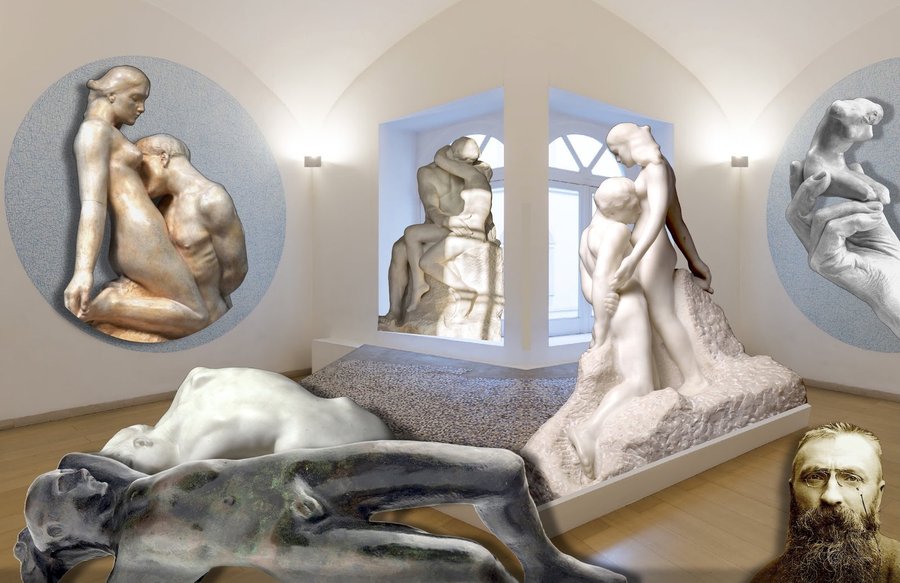
Rodin chose to take inspiration from Michelangelo, who was a revelation for him—a discovery that forever changed his way of conceiving art, shifting from a classical language to one that was more expressive and immediate. Emotion and total adherence to reality would always remain prerequisites of Rodin's work, since, as he wrote: “When the artist softens the grimaces of pain, the scars of old age, the horror of perversity, when he adapts to Nature, when he masks it, disguises it, and mitigates it to please the ignorant public, he produces ugliness; he is afraid of the truth."
Auguste Rodin. Un grande scultore al tempo di un grande pittore, Monet. Entrambi nacquero a Parigi nel 1840. Rodin scelse di ispirarsi a Michelangelo. Buonarroti, infatti, fu per lui una rivelazione, una scoperta che cambiò per sempre il suo modo di concepire l'arte, passando da un linguaggio classico a uno più espressivo e immediato, creando capolavori di innovazione dirompente. Auguste Rodin fu molto più di uno scultore, fu anche appassionato di pittura e fotografia, e un grande collezionista. Senso e piena aderenza alla realtà saranno sempre i prerequisiti dell'opera di Rodin, poiché, come scrisse: "Quando l'artista attenua le smorfie del dolore, lo sfregio della vecchiaia, l'orrore della perversità, quando si adatta alla Natura, quando la maschera, la traveste, la mitiga per compiacere il pubblico ignorante, produce bruttezza, ha paura della verità."
Rosso Tribute
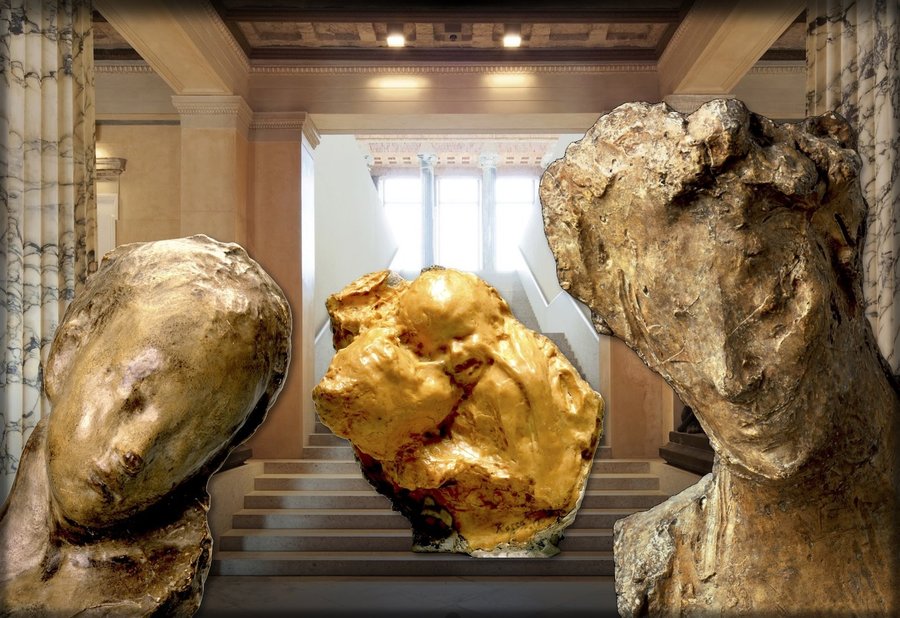
Medardo Rosso (1858–1928) was the greatest Italian sculptor of his time. A complex and rebellious personality, well known in Paris—where he lived for years—he experimented with and anticipated new expressive languages. At the center of the collage is the work The Golden Age from 1887, one of three versions that Medardo Rosso dedicated to the double portrait of his wife Giuditta Pozzi with their son Francesco, in which the artist began shaping his sculptures with wax—a material that had no precedent in Italian art. "In this work, he chooses to model only the front, leaving out the back and focusing on the surface. The resolution of the two faces, which merge into one another, heightens the intensity of the relationship between mother and child." (museivaticani.va) The collage is completed on the left by Sick Child, dated 1893, and the 1895 portrait of Yvette Guilbert, a French singer, actress, and writer. “I am referring to the genius of Medardo Rosso, to an Italian, to the only great modern sculptor who attempted to open a broader field to sculpture." (Umberto Boccioni)
Medardo Rosso (1858-1928), il maggiore scultore italiano del suo tempo. Personalità complessa e ribelle, più noto a Parigi, dove risiede per anni, che in patria, sperimenta e anticipa nuovi linguaggi espressivi. Al centro del nostro collage abbiamo l’opera “The Golden Age” del 1887, una delle tre versioni che Medardo Rosso dedica al doppio ritratto della moglie Giuditta Pozzi col figlio Francesco, in cui l’artista inizia a plasmare le sue sculture con la cera, materiale che in Italia non aveva precedenti. “In quest’opera Medardo Rosso ripropone il tema della madre che bacia il bambino, ma invece di creare una scultura a tuttotondo, sceglie di modellare solo la parte anteriore, tralasciando il retro e concentrandosi sulla superficie. La soluzione dei due volti, che si fondono uno nell’altro, accentua l’intensità della relazione tra la madre e il figlio.” (museivaticani.va) Completano il collage a sinistra “Sick Child”, datato 1893, e il ritratto, datato 1895, di Yvette Guilbert, cantante, attrice e scrittrice francese; di grande successo soprattutto durante la Belle Époque.
The Pietà
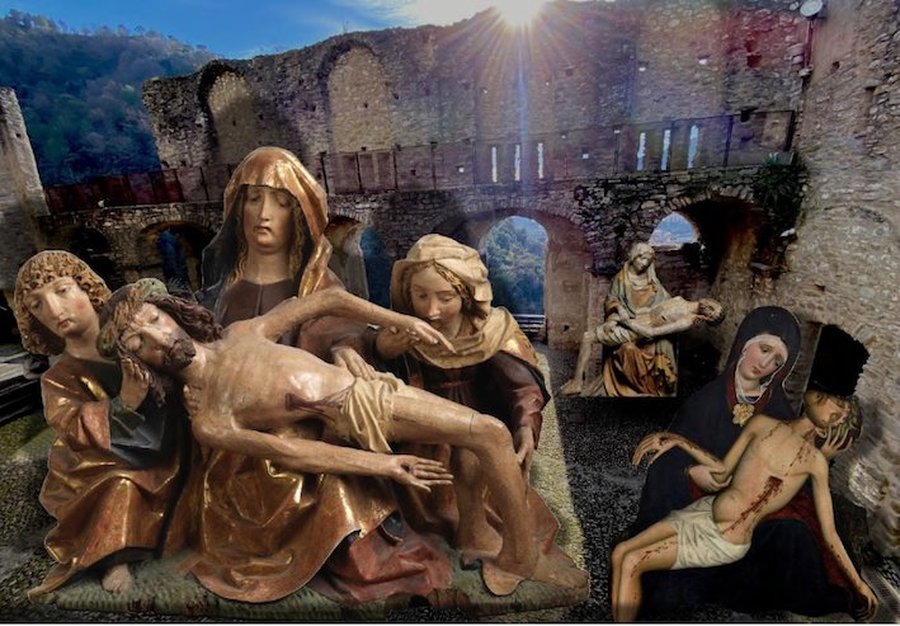
The image of the Pietà, one of the most frequently rendered subjects in art, has inspired many artists to produce works of great intensity. Initially, these were primarily wooden sculptures (the large image on the left in the collage), followed by terracotta works (the image at the bottom right) by an Austrian craftsman from the early 1400s. In 15th-century Europe, these images came to be known as Pietà, such as the painting on the right by the Polish artist Warsztat Krakowski, dated 1450.
L’immagine della Pietà, una delle più riproposte nell’arte, ha ispirato tanti artisti a produrre opere di grande intensità. Quest’immagine nasce in ambito tedesco per ricordare la sera della deposizione di Cristo dalla croce per poi essere sepolto. Inizialmente si trattava soprattutto di sculture realizzate con il legno (nel collage l’immagine grande a sinistra) dove veniva raffigurata la Vergine Maria che sosteneva sulle gambe il corpo esangue e magrissimo del figlio Gesù. Al legno si sostituiranno successivamente altri materiali come la terracotta (l’immagine in fondo a destra) che proviene da un’artigiano austriaco dell’inizio del 1400. Nel XV secolo in Europa queste immagini del Vespro acquisiscono il nome di Pietà e vengono realizzate soprattutto in opere pittoriche anziché scultoree, come il dipinto a destra, dell’artista polacco Warsztat Krakowski, datato 1450.
Zeus and Ganymede
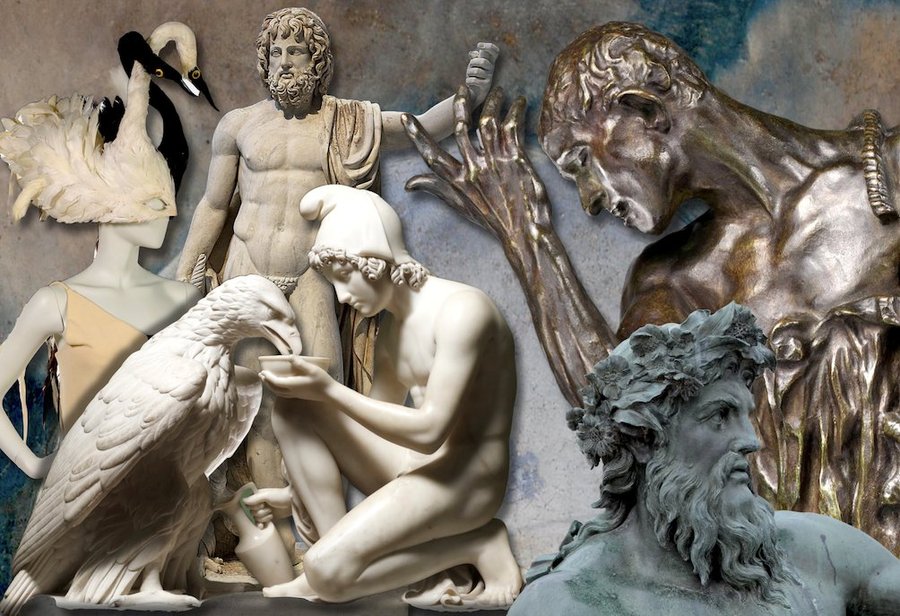
The myth of Ganymede, celebrated not only by Homer but also by Pindar and Ovid, quickly became very popular in Greece and later in Rome, because a romantic relationship between an adult man and a youth caused no scandal. In our collage, Ganymede offers a drink to the eagle in the splendid sculpture by Danish artist Bertel Thorvaldsen, dated 1817. On the right, the man raising his hand to warn Ganymede of impending danger is a late 19th-century work by another great sculptor: the Frenchman Auguste Rodin, considered the progenitor of modern sculpture.
Ganimede era un giovane che il poeta Omero descrive come il più bello tra tutti; così bello che persino Zeus se ne innamorò e lo desiderò; un giorno, mentre Ganimede pascolava con il suo gregge sul monte Ida, Zeus mandò la sua aquila divina a rapirlo o, in altre versioni del mito, assunse lui stesso le sembianze di un'aquila, per portarlo con sé sull’Olimpo. Il mito di Ganimede, cantato oltre che da Omero, da Pindaro e Ovidio, divenne presto molto popolare in Grecia e poi a Roma, perché la relazione amorosa tra un uomo adulto e un ragazzo non suscitava scandalo. Nel nostro collage, Ganimede offre da bere all'aquila nella splendida scultura dell'artista danese Bertel Thorvaldsen datata 1817. A destra, l'uomo che alza la mano per avvertire Ganimede dell'imminente pericolo, è un'opera di fine Ottocento di un altro grande scultore: il francese August Rodin, considerato il progenitore della scultura moderna.
Sculptors and Sculptures is part of Blu Artworks' wider body of work — 577 original SIAE-registered collages in total. Explore the Sculptors and Sculptures fa parte del lavoro più ampio di Blu Artworks — 577 collage originali registrati SIAE in totale. Esplora la Full GalleryGalleria Completa.