Great Artists A-DGrandi Artisti A-D
26 collages, tributes to the masters A–D26 collage, omaggi ai maestri A–D
26 collages in this catalogcollage in questo catalogo
The first wing of our Great Artists series: our tribute to the style of every great artist, with an introductory note for each — 26 collages from Antonello da Messina to Donatello, by way of Botticelli, Caravaggio, Canova and Dalí.La prima ala della nostra serie Grandi Artisti: il nostro omaggio allo stile di ogni grande artista, con una nota introduttiva per ciascuno — 26 collage da Antonello da Messina a Donatello, passando per Botticelli, Caravaggio, Canova e Dalí.
Scarica il Catalogo PDF (bilingue) →Download Catalog PDF (bilingual) → View All Collections →Vedi Tutte le Collezioni →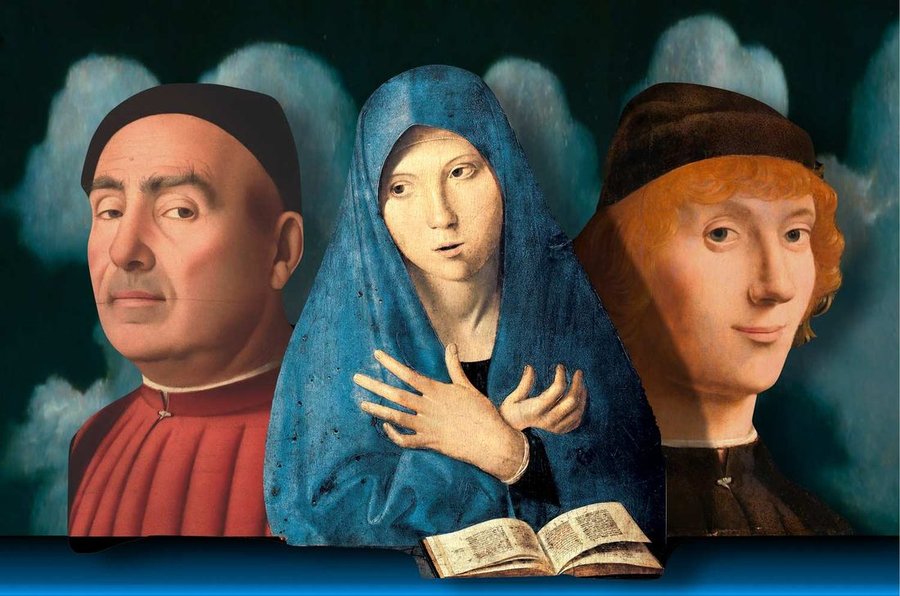
Antonello da Messina
Trained in Naples in the oil painting technique, Antonello set a new standard for portraiture when he arrived in Venice from Sicily in 1475.
Long before Leonardo da Vinci, he introduced the hint of a smile to convey the sitter's inner life, wrapping their features in a soft light, with a direct gaze that still holds viewers captive today.
In doing so, the painting challenged the dominant view of the time—that a portrait should merely be a formal representation of a person's outer appearance rather than their character.
Formatosi a Napoli nella tecnica della pittura a olio olandese, Antonello stabilì il nuovo standard della ritrattistica quando arrivò dalla Sicilia a Venezia nel 1475.
Molto prima di Leonardo da Vinci, introdusse il sorriso accennato come indicazione della vita interiore del soggetto, avvolgendone i lineamenti in una luce soffusa e catturando l'osservatore con il suo sguardo diretto.
In questo modo il dipinto contraddisse l’allora visione negativa dominante, secondo cui la pittura potesse essere solo una mera rappresentazione dell'aspetto esteriore di una persona, non certo del suo carattere.
(Fonte: The Metropolitan Museum of Art)
Arcimboldo — Tribute
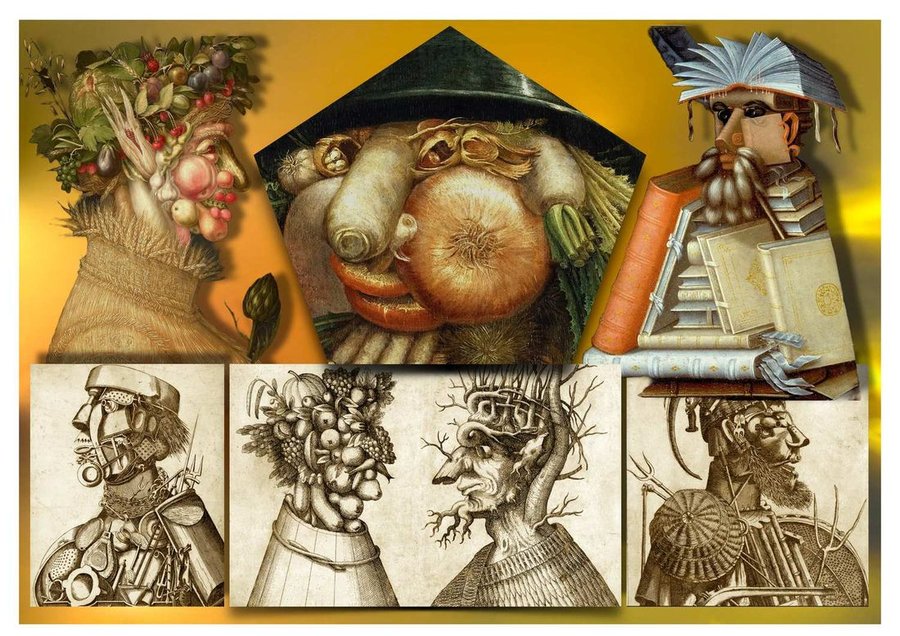
Giuseppe Arcimboldi (or Arcimboldo) was the most eccentric Mannerist painter, famous for his heads composed of intricate arrangements of fruit and vegetables.
The artist trained in a particularly vibrant artistic environment, that of mid-sixteenth-century Milan. Summoned to Vienna in 1562 by Ferdinand I of Habsburg, Arcimboldi immediately devoted himself to portraiture, so much so that he was appointed court portraitist by Maximilian II in 1564.
However, official portraiture was a constraining genre for Arcimboldi, who in 1563 began working on his whimsical heads—the very works that would bring him immense fame and success.
Giuseppe Arcimboldi (o Arcimboldo) fu il più eccentrico pittore manierista, famoso per le sue teste composte.
L'artista, milanese, si era formato in un ambiente artistico particolarmente vitale come quello milanese di metà Cinquecento.
Chiamato a Vienna nel 1562 da Ferdinando I d'Asburgo, Arcimboldi si dedicò subito alla ritrattistica, tanto da essere nominato ritrattista di corte nel 1564 da Massimiliano II.
Ma la ritrattistica ufficiale era un genere circoscritto a Giuseppe Arcimboldi, che a partire dal 1563 iniziò a lavorare alle sue teste composte, che gli avrebbero garantito un grande successo.
Balla — Never Seen
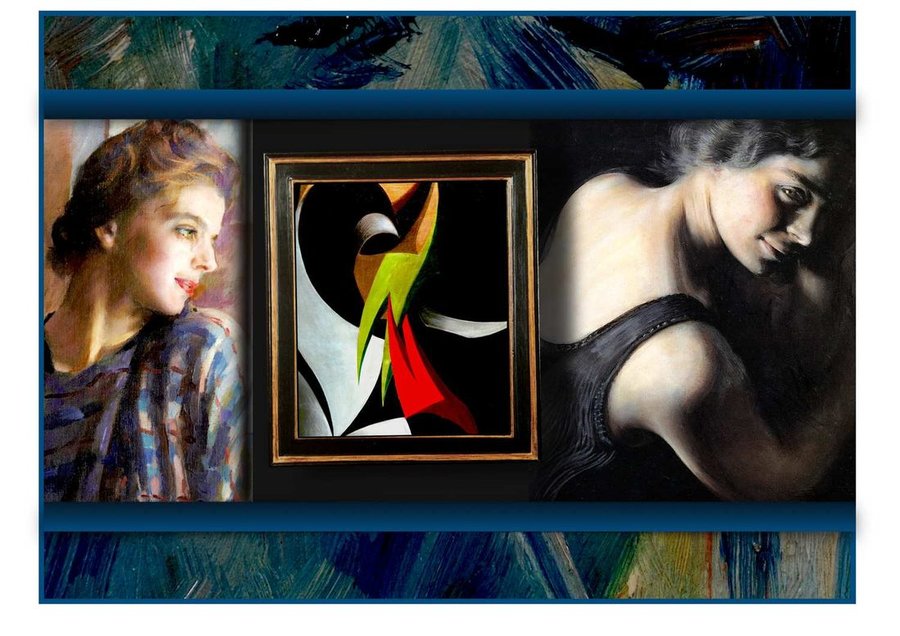
Giacomo Balla (1871–1958) is the Italian artist whose talent is inextricably linked to the Futurist movement, of which he was a promoter and leading figure. However, labeling the artist purely as a Futurist would be both reductive and inaccurate.
In fact, during the 1930s, Giacomo Balla grew increasingly disillusioned with Futurist ideals as well as Fascist ones, ultimately distancing himself from both.
We would like to remember him here with one of his own quotes: "Making light has always been my favorite study."
Giacomo Balla (1871/1958) è l'artista italiano il cui talento è indissolubilmente legato al movimento futurista, di cui fu promotore e uno dei principali esponenti negli anni cruciali per l'evoluzione del movimento. Ma etichettare l'artista originario di Torino esclusivamente come futurista sarebbe riduttivo e scorretto.
Negli anni Trenta del Novecento, tuttavia, Giacomo Balla iniziò a essere sempre meno convinto degli ideali futuristi e, allo stesso tempo, anche di quelli fascisti, allontanandosi sia dai movimenti artistici che da quelli politici.
Vogliamo qui ricordarlo con una sua frase: "Fare luce è sempre stato il mio studio preferito".
Bartolomeo Veneto
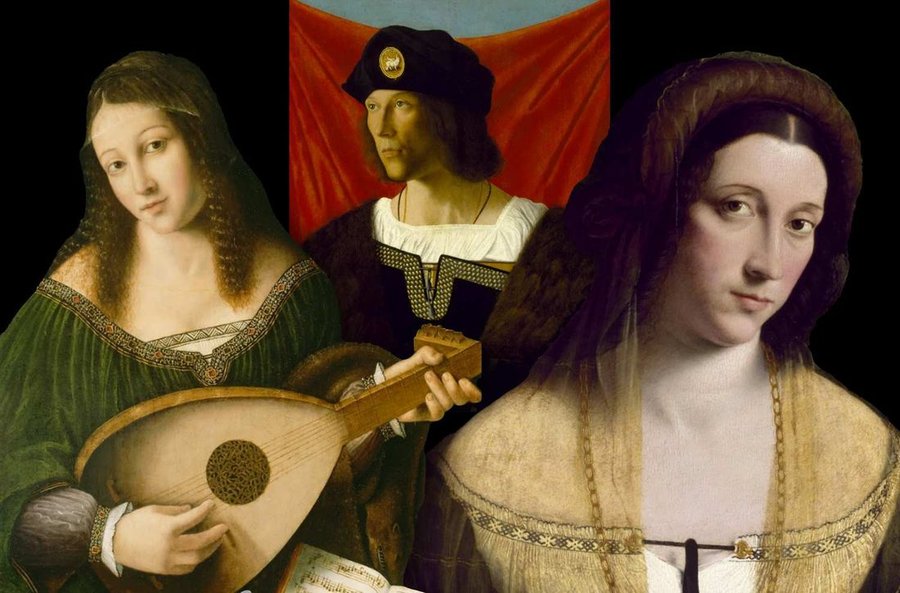
Giacomo Bartolomeo Veneto is one of the most interesting and least studied "minor" artists of the early Italian Cinquecento. Bartolomeo's female portraits recall the models of Leonardo da Vinci, in part due to the presence of a small animal wrapped around the left arm of the lady playing music.
This seems to evoke Leonardo's famous portrait, "Lady with an Ermine," now on display at the Czartoryski Museum in Kraków.
However, the animal in Bartolomeo's painting is not a live ermine as in Leonardo's work, but a dead one. High-ranking women often wore ermine furs in the belief that they kept fleas away.
Giacomo Bartolomeo Veneto è uno degli artisti "minori" più interessanti e meno studiati del primo Cinquecento italiano.
I ritratti femminili di Bartolomeo richiamano i modelli di Leonardo da Vinci, anche per la presenza di un piccolo animale che è avvolto al braccio sinistro della dama che suona, come a ricordare l'ermellino del ritratto di Leonardo, famoso come “la Dama con l'ermellino", ora al Museo Nazionale di Cracovia.
Tuttavia, l'animale nel dipinto di Bartolomeo non è un ermellino vivo come nel dipinto di Leonardo, ma uno morto. Le donne di alto rango indossavano spesso una pelliccia di ermellino o zibellino perché si credeva tenesse lontane le pulci.
Bellini — Tribute
Giovanni Bellini (1430–1516), known as "Giambellino," was one of the most celebrated Venetian painters of his time. He worked continuously for sixty years, bridging the gap between Byzantine tradition and the modernity of the Renaissance.
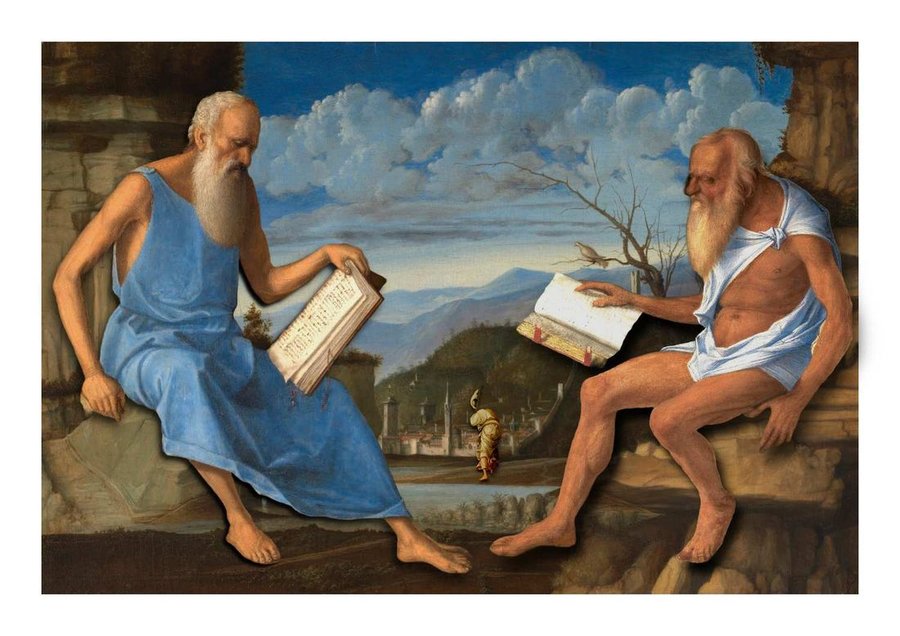
In our collage, Saint Jerome is depicted in both of the men intent on reading. The background landscape cannot truly be described as Oriental; it is far more reminiscent of the Venetian hills familiar to the artist.
The small figure in the distance between the saints, walking stooped toward the city walls, is Jesus Christ about to descend into Limbo after the crucifixion and before the resurrection.
Giovanni Bellini (1430/1516), detto "Giambellino", fu un pittore di Venezia, tra i più celebri artisti del suo tempo.
Lavorò ininterrottamente per sessant'anni, traghettando la pittura dalla tradizione bizantina alla modernità del Rinascimento.
Nel nostro collage, San Girolamo è raffigurato nei due uomini intenti a leggere. Il panorama sullo sfondo non può essere definito orientale, ma è più simile alle colline venete ben note al pittore.
La piccola figura in lontananza tra i santi, che cammina curvo verso le mura della città, è Gesù Cristo che idealmente scende al Limbo (come dipinto in un'altra opera di Bellini), dopo la sua crocifissione e prima della resurrezione.
Bernini’s Popes
If Michelangelo is considered one of the leading representatives of the Renaissance, the Neapolitan Gian Lorenzo Bernini (1598–1680) is the principal exponent of the Baroque. One of his greatest gifts was the ability to capture vital movement in his sculptures.
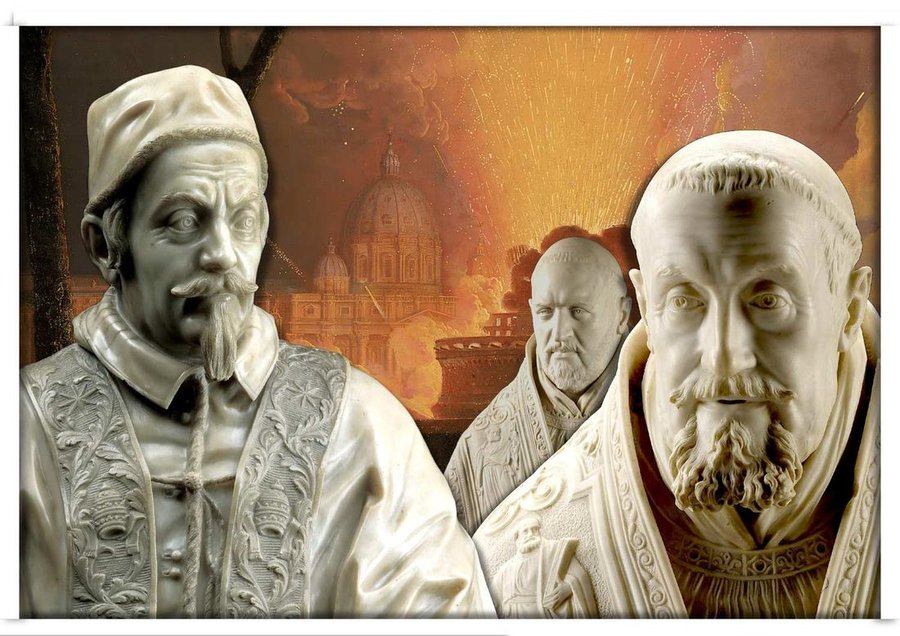
The background image of the collage, painted by the English artist Joseph Wright of Derby in 1775, depicts the fireworks display staged in Rome to mark the inauguration of a new pope. This motif prompted us to select, from Bernini's vast body of work, only the sculptures dedicated to the three popes the artist knew: the first on the left is the austere Pope Clement X; the marble bust in the center is Pope Paul V, and the third is Pope Gregory XV.
Se Michelangelo è considerato uno dei maggiori rappresentanti del Rinascimento, il napoletano Gian Lorenzo Bernini (1598/1680) è l’esponente del Barocco. Una delle sue doti era l’abilità nel catturare il movimento e la vita nelle sue sculture.
L’immagine, dipinta dall’inglese Joseph Wright of Derby nel 1775, che fa da sfondo al collage, era uno spettacolo pirotecnico allestito a Roma in occasione dell'insediamento di un nuovo Papa.
Questo motivo ci ha indotto a scegliere, tra la vasta produzione di Bernini, solo le sculture dedicate ai tre pontefici, che ha conosciuto l’artista: il primo a sinistra è l’austero Papa Clemente X; il secondo busto marmoreo al centro è Papa Paolo V e il terzo è Papa Gregorio XV.
Blake — Tribute
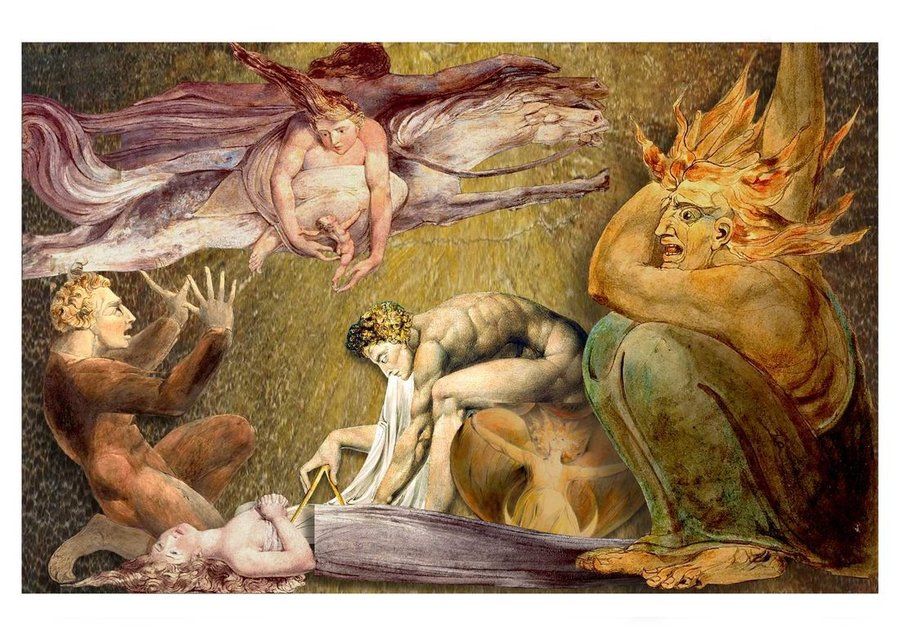
William Blake, a visionary poet famous for his poems marked by a strong spirituality, died in London on August 12, 1827. Passionate about medieval art, he was also an artist himself, as seen in the central figure bending down with a pair of compasses in hand: the physicist Isaac Newton. Newton, a nude man who seems to be carving a path through chaos, is on the verge of discovering the physical laws of motion.
“Man has tasted the fruit of the Tree of Knowledge, and now his intellect reveals the abstract reality of creation to his astonished gaze. Blake sought to exemplify the deeper meaning of his philosophical thought through the tension between the immediate realism of his image and fantastic symbolism." (Emil Krén)
Il 12 agosto 1827 morì a Londra William Blake, visionario poeta inglese. Appassionato di arte medievale, fu anche pittore e grande miniaturista, ed è famoso per le sue poesie caratterizzate da una forte spiritualità. La figura rappresentata china, al centro dell'immagine, con il compasso in mano è riconoscibile come il fisico Isaac Newton.
"Newton, uomo nudo e creato dal caos, sembra aprirsi un varco nel caos. Sta scoprendo la legge insita nella sua stessa natura fisica. L'uomo ha gustato il frutto dell'albero della conoscenza, e ora il suo intelletto rivela al suo sguardo stupito la realtà astratta della creazione. Blake cercò di esemplificare il significato più profondo del suo pensiero filosofico nella tensione tra il realismo immediato della sua immagine e il simbolismo fantastico". (Emil Krén)
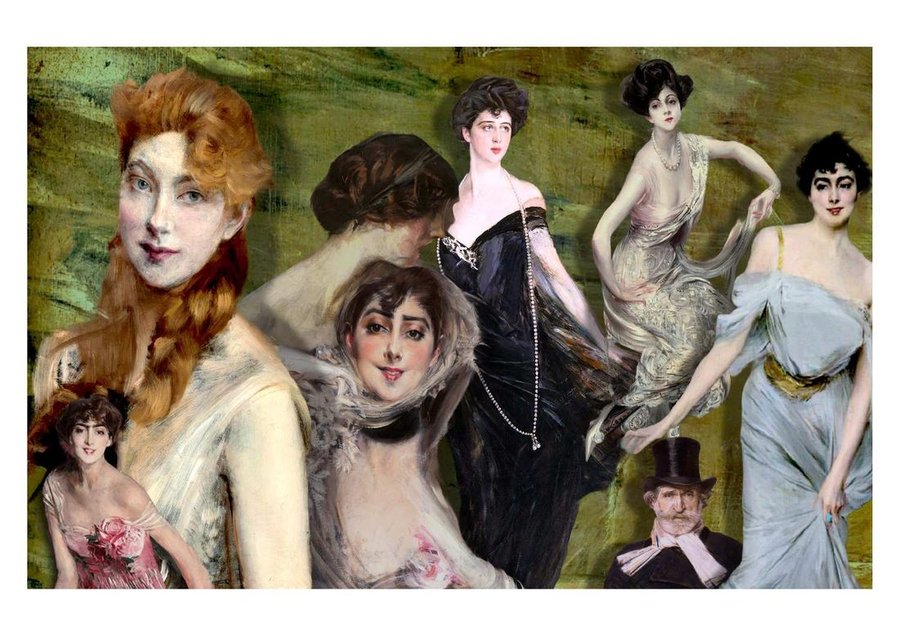
Boldini — Never Seen
After numerous travels, the Italian artist Giovanni Boldini (1842–1931) moved permanently to Paris in 1871, where he remained until his death. A lover of high society, Boldini chose to settle in the Montmartre neighborhood and began frequenting the Café de la Nouvelle Athènes, a popular gathering spot for artists situated right across from his home.
In the French capital, the Italian painter quickly established himself. His signature style lay in his ability to capture the sensuality of high-society ladies through glossy colors and dynamic, nervous brushstrokes.
He would come to be remembered as one of the defining painters of the Belle Époque. Boldini featured prominently in numerous exhibitions, most notably during the Universal Expositions of 1889 and 1900.
Dopo numerosi viaggi, l’artista italiano Giovanni Boldini (1842/1931) si trasferì definitivamente a Parigi nel 1871, dove rimase fino alla morte. Amante della vita mondana, Boldini volle stabilirsi nel quartiere di Montmartre e iniziò a frequentare il Café de la Nouvelle Athènes, ritrovo degli artisti, situato proprio di fronte a casa sua.
Nella capitale francese, la carriera del pittore italiano continuò a decollare rapidamente: ritrasse la femminilità e la sensualità delle dame dell'alta società con colori smaltati e un tratto pittorico fatto di pennellate guizzante e nervose, tanto da essere ricordato come un pittore della Belle Époque.
Tenne numerose mostre, soprattutto a Parigi, anche in occasione delle Esposizioni Universali del 1889 e del 1900.
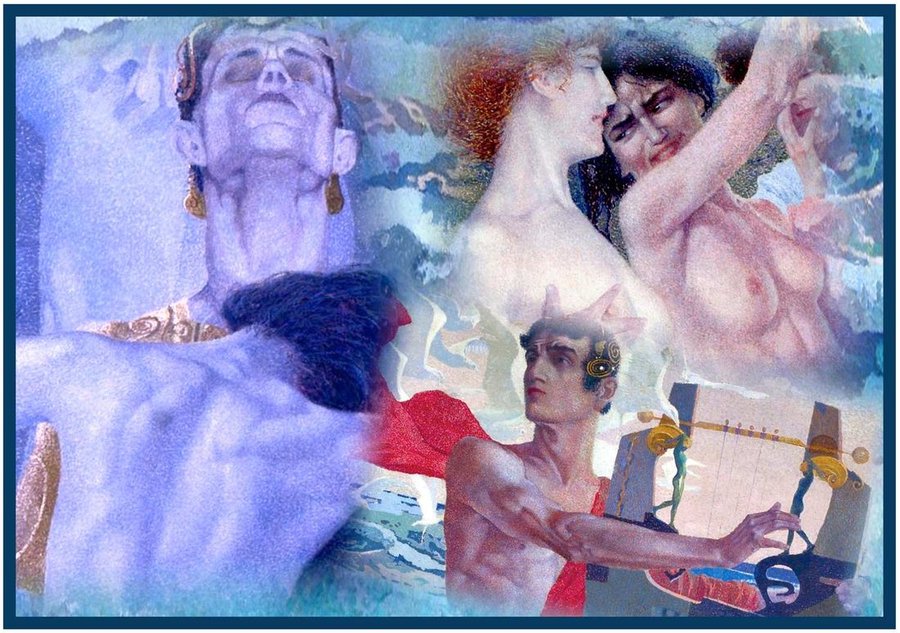
Bonazza — Never Seen
The Italian artist Luigi Bonazza was active during the first half of the twentieth century. He moved to Vienna in 1897 and enrolled at the Kunstgewerbeschule. Drawing on what he learned there, Bonazza was inspired by the iconographic repertoire of the Vienna Secession, captivated by the sensual imagery of Klimt. Every artist has their sanctuary, whether large or small: Pablo Neruda wrote from his boat overlooking the Pacific; Frida Kahlo had her vibrant blue house in Mexico, and Monet could not live without his gardens, where ponds and water lilies found their way onto his canvases.
In Trento, too, we find a house transformed into a work of art: that of Luigi Bonazza, who turned it into a museum filled with works— paintings, sgraffito works, decorations, and handcrafted furnishings designed by his own hand.
L'artista italiano Luigi Bonazza operò nella prima metà del Novecento. Dopo la laurea, nel 1897 si trasferì a Vienna e si iscrisse alla Kunstgewerbeschule. Grazie agli insegnamenti appresi, Bonazza si ispirò al repertorio iconografico della Secessione Viennese, subendo il fascino delle raffigurazioni sensuali di Gustav Klimt.
Ogni artista ha il suo piccolo o grande rifugio: Pablo Neruda scriveva dalla sua barca affacciata sul Pacifico; Frida Khalo aveva una casa tutta blu in Messico, mentre Monet non poteva fare a meno dei suoi giardini, dove stagni e ninfee finivano nei suoi dipinti. Anche a Trento, troviamo una casa diventata un'opera d'arte: quella di Luigi Bonazza, che, nel corso del tempo, trasformò in un museo, il suo, denso di opere tra dipinti, graffiti e decorazioni e arredi disegnati di sua mano.
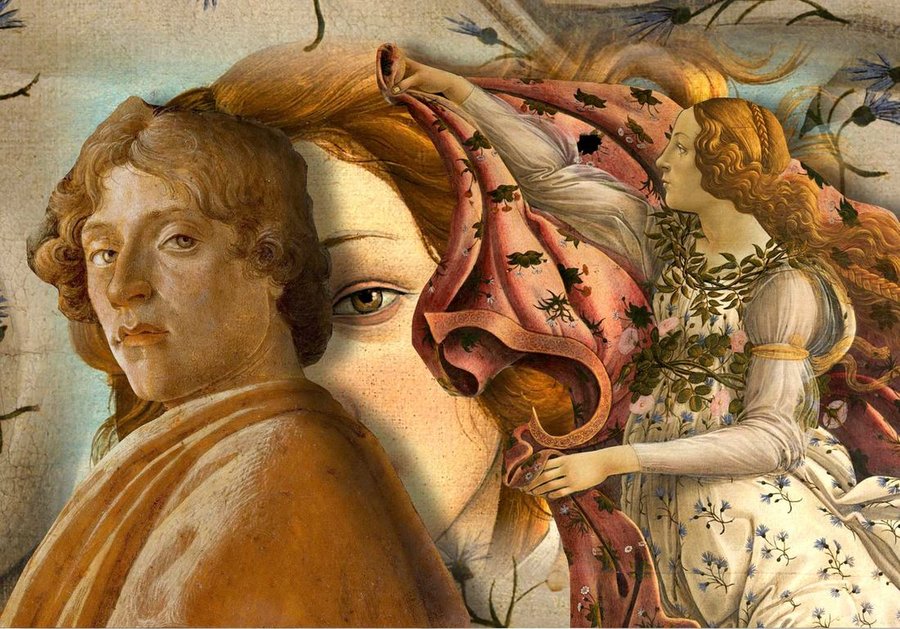
Botticelli — Never Seen
Sandro Botticelli (1445–1510) is one of the defining figures of the Renaissance, particularly the Tuscan Renaissance, renowned not only for the legendary beauty of his goddesses and Madonnas, but also as a man of profound culture and one of its most refined painters.
Not everyone knows that Sandro Botticelli also painted frescoes in the Sistine Chapel, where visitors usually go to admire Michelangelo.
On the side walls, you can see three scenes painted by Botticelli himself. In our collage, the Florentine master appears on the left in a self-portrait from 1475.
Sandro Botticelli (1445/1510) è uno degli artisti simbolo del Rinascimento, e in particolare di quello toscano, non solo per la proverbiale bellezza delle sue dee e delle sue Madonne, ma anche per essere uomo di grande cultura e uno dei pittori più raffinati.
All'apice della sua fama, il pittore fiorentino fu uno degli artisti più stimati d’Italia; l'artista simbolo del Rinascimento.
Non tutti sanno che Sandro Botticelli affrescò anche la Cappella Sistina, dove solitamente si va a ammirare Michelangelo, si possono vedere, sulle pareti laterali, anche tre scene dipinte da Botticelli, maestro fiorentino che appare a sinistra nel suo autoritratto del 1475.
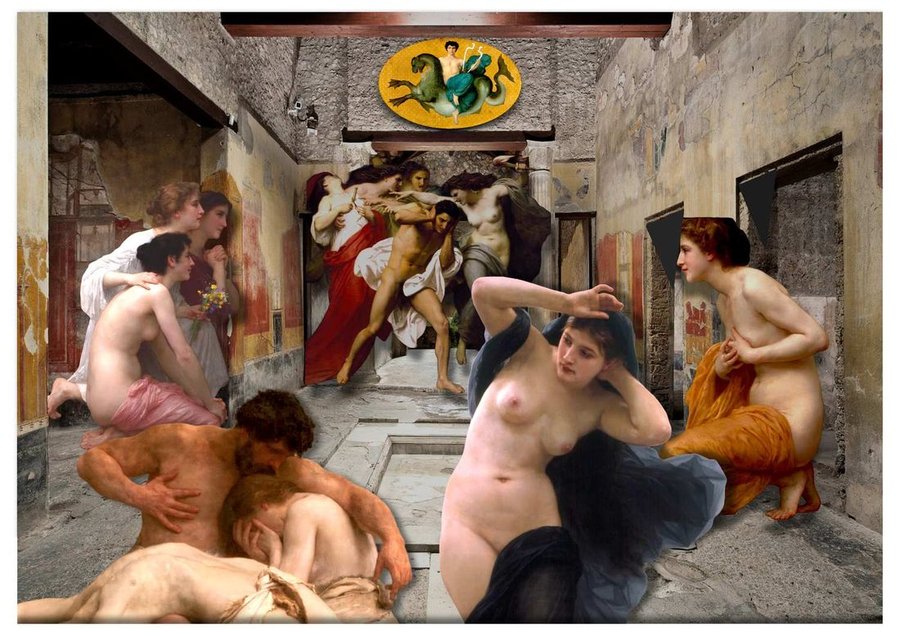
Bouguereau at Pompeii
In 1850, the French artist Bouguereau was awarded the Grand Prix de Rome, which included a scholarship to the French Academy in Rome, where he began his studies the following year. Bouguereau devoted himself to studying Italian Renaissance painting (Raphael was his favorite artist) as well as the works of ancient Rome.
He was deeply moved by his visit to the ruins of Pompeii, which inspired our collage. He remained faithful to the Neoclassical style throughout his life, as he expressed in these words: "In painting, I am an idealist. In art, I know and want to see only beauty, and for me, art corresponds to the feeling of Beauty."
Nel 1850 all'artista francese Bouguereau fu conferito il Grand Prix de Rome, che includeva una borsa di studio per l'Accademia di Francia a Roma, dove iniziò a studiare l'anno successivo. Bouguereau si dedicò allo studio della pittura rinascimentale italiana (il suo artista preferito era Raffaello) e delle opere dell'antica Roma, profondamente colpito dalla sua visita alle rovine di Pompei, a cui è ispirato il nostro collage.
Dopo il lungo soggiorno romano, tornò nella sua città natale, La Rochelle, dove la sua carriera fiorì. Rimase fedele allo stile neoclassico per tutta la vita, come dichiarò con queste parole: "Nella pittura, sono un idealista. Nell'arte, conosco e voglio vedere solo la bellezza, e per me l'arte corrisponde al sentimento della Bellezza".
Bruegel — Never Seen
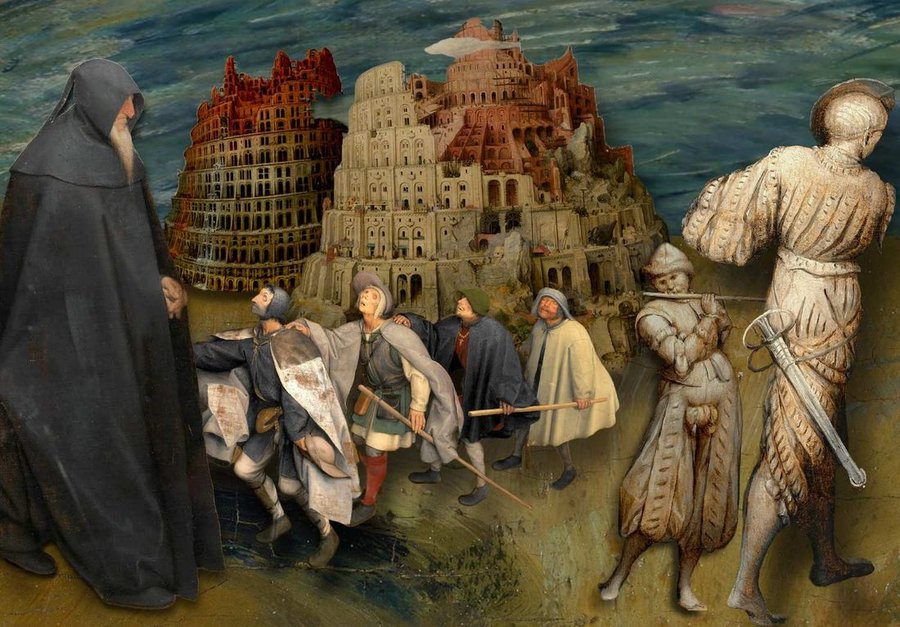
The art of Pieter Bruegel the Elder is rich in meticulous details and hidden symbols, almost imperceptible at first glance. Let's look at a few drawn from the 16th-century Dutch artist's works that we included in the collage: Looking closely at the Tower of Babel, we can see that it is depicted using various architectural styles—an allusion to the chaos and confusion that, according to legend, arose after God made the builders speak different languages, leaving them unable to complete the tower that was meant to reach toward the heavens. Bruegel shows us the signs of its inevitable downfall.
Beneath the tower, a line of blind men walk single file, holding on to one another's shoulders and gripping walking sticks to keep from falling. It is the visual depiction of the parable told by Jesus: "Leave them; they are blind guides. If the blind lead the blind, both will fall into a pit." A warning for those who blindly follow the ideas of others. On the left side, a man wrapped in a black cloak is depicted: his long beard, folded hands, and bowed head reveal his stern nature. He is a misanthrope, likely Timon of Athens—a hermit described by Cicero, Seneca, and many other ancient writers. His appearance lends a macabre atmosphere to our collage. The figures on the right are two "Landsknechts"—mercenary soldiers with picturesque costumes and a swaggering air, just as they were repeatedly depicted by 16th-century engravers. Pieter Bruegel the Elder was the greatest satirical artist of Netherlandish art. His paintings are rich in allusive imagery that ranges from the sacred to the profane, all the way to the ridiculous.
L'arte di Pieter Bruegel il Vecchio è ricca di dettagli minuziosi e simboli nascosti, quasi impercettibili a prima vista. Vediamo alcuni nelle opere dell'artista olandese del XVI secolo che abbiamo raccolto nel nostro collage:
La Torre di Babele. Il trattamento di Bruegel di questo episodio biblico è ricco di dettagli meticolosi. Osservando attentamente la Torre, possiamo notare che raffigurava vari stili architettonici, un'allusione al caos e alla confusione che, secondo la leggenda, si generarono dopo che Dio fece parlare lingue diverse ai costruttori per impedire di comunicare tra loro, e così non riuscirono a completare la torre che si sarebbe innalzata verso il cielo.
Bruegel ci mostra i segni dell'inevitabile rovina. Ovunque mattoni si sgretolano, cadono e gli operai penzolano pericolosamente dai cornicioni.
Sotto la torre, alcuni ciechi camminano in fila indiana. Si tengono tutti per le spalle e impugnano dei bastoni per non perdersi; sono dipinti con il volto rivolto verso l'alto, poiché si affidano al senso dell'udito. Ognuno di loro è poi accuratamente raffigurato come affetto da una distinta forma di cecità. È l'immagine della parabola narrata da Gesù: "Lasciateli stare: sono ciechi che guidano altri ciechi. E se un cieco guida un altro cieco, entrambi cadranno nella fossa!" L'approccio sbagliato di coloro che seguivano ciecamente le idee degli altri.
Sul lato sinistro è raffigurato un uomo coperto da un mantello nero: la lunga barba, le mani giunte e la testa rivolta verso il basso indicano il suo carattere severo. E’ il Misantropo, che dà il titolo all'opera, probabilmente Timone di Atene, un eremita descritto da Cicerone, Seneca e molti altri scrittori antichi. Il suo aspetto conferisce al nostro collage un'atmosfera macabra.
Le figure sul lato destro sono due "Lanzichenecchi", i fanti mercenari i cui costumi pittoreschi e l'aria spavalda fornirono immagini popolari agli incisori del XVI secolo. Pieter Bruegel il Vecchio è stato il più grande artista satirico dell'arte olandese. I suoi dipinti sono ricchi di immagini allusive, che spaziano dal sacro al profano, fino al ridicolo.
Burne-Jones — Tribute
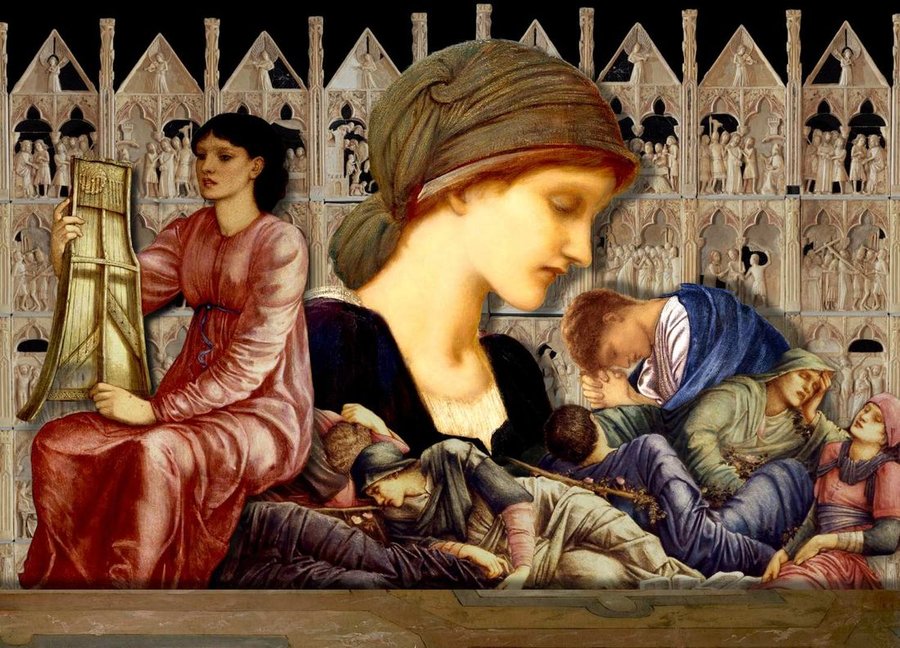
Sir Edward Coley Burne-Jones (1833–1898) was an important late-nineteenth-century English painter, illustrator, and designer whose romantic paintings were among the last expressions of the Pre-Raphaelite style.
After his death, Burne-Jones's paintings fell into oblivion, and the artist was largely unappreciated as both the public and artists favored modern art. He was re-evaluated only in the 1960s and 1970s.
In 1998, to mark the centenary of his death, several highly acclaimed exhibitions were held at both the Metropolitan Museum of Art in New York and the Musée d'Orsay in Paris.
Sir Edward Coley Burne-Jones (1833/1898) fu un importante pittore, illustratore e designer inglese di fine Ottocento, i cui dipinti, tra romantici e medievali, furono tra le ultime espressioni dello stile preraffaellita.
Dopo la sua morte, le opere pittoriche di Burne-Jones caddero nell'oblio, l'artista fu poco apprezzato, dato che pubblico e artisti prediligevano l'arte moderna.
Fu rivalutato solo negli anni '60 e '70 del Novecento e nel 1998, per celebrare il centenario della sua morte, furono organizzate diverse mostre molto apprezzate al Metropolitan Museum of Art di New York e al Musée d'Orsay di Parigi.
Canova — Never Seen
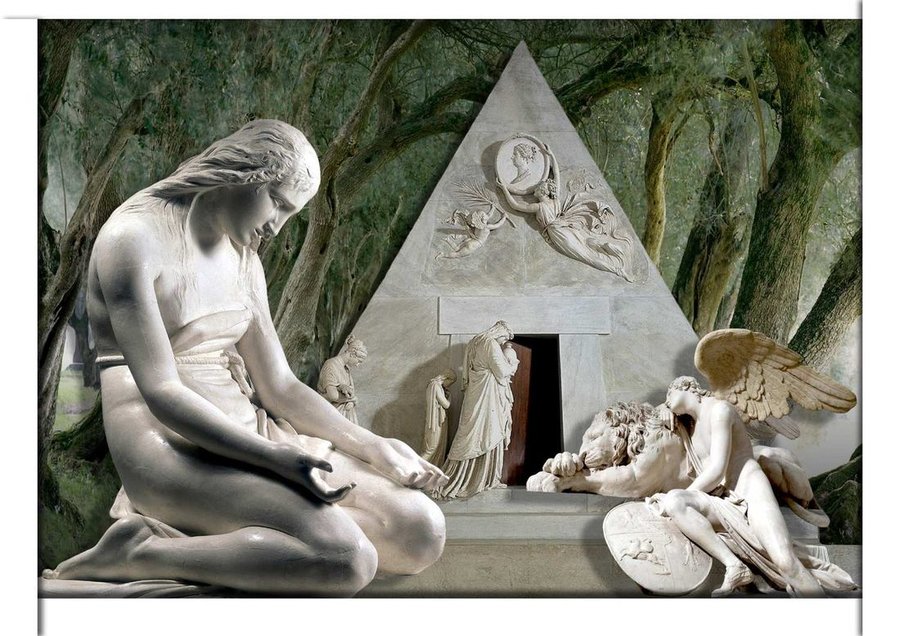
Antonio Canova (1757–1822), a Venetian painter and sculptor, is one of the leading figures of Neoclassical sculpture, eventually coming to be considered the greatest sculptor in Europe since the time of Bernini—a "new Phidias," as his contemporaries called him. Canova's marble sculptures, inspired by classical antiquity, are distinguished by their flawless finishes and shaped by an ideal of unattainable beauty. At the center of our collage is one of the artist's most monumental works: the pyramid tomb of Archduchess Maria Christina of Austria. Located in the Augustinian Church in Vienna, it was created by Canova over the course of two stays in Austria, in 1798 and 1805.
“A large funerary pyramid, then, where Maria Christina is portrayed at the top within a frame shaped like a snake biting its tail, a symbol of eternity. On the right, a winged genius leans on a lion, the symbol of the House of Saxony. They stand guard over the tomb so that no one may disturb its peace.” (Sonia Cappellini) On the left, in the foreground, we have placed the figure of Mary Magdalene, which Canova sculpted in 1796. The marble was exhibited in Paris and described as "miraculous" for its incredible beauty. The woman appears in a state of contrition, perfectly in keeping with the mood of the funerary composition.
Antonio Canova (1757 - 1822), pittore e scultore veneziano, è uno dei principali rappresentanti della scultura neoclassica. Incoraggiato dal nonno, ha iniziato la sua formazione artistica molto giovane, fino ad arrivare a essere considerato il miglior scultore d’Europa dall’epoca di Bernini; “novello Fidia” come lo definivano i suoi contemporanei. Le sculture in marmo di Canova, ispirate all’antichità classica, sono caratterizzate dalle finiture perfette, ispirate da un’ideale di bellezza irraggiungibile.
Il nostro collage pone al centro una delle opere più monumentali dell’artista: la piramide, monumento funebre di Maria Cristina d’Austria, che si trova nella chiesa degli Agostiniani di Vienna, viene realizzato da Canova durante due soggiorni in Austria, nel 1798 e nel 1805.
“Una grande piramide sepolcrale dunque, dove in alto è ritratta Maria Cristina, in una cornice a forma di serpente che si morde la coda simbolo di eternità. A destra un genio alato si appoggia ad un leone, simbolo di casa Sassonia, e fanno la guardia del sepolcro, di cui nessuno deve turbare la pace”. (Sonia Cappellini)
A sinistra abbiamo posto in primo piano la figura di Maddalena che Canova scolpì nel 1796; il marmo fu esposto a Parigi e venne definito "miracoloso" per la sua grande bellezza.
La donna appare in atto di contrizione, in sintonia quindi con il contesto della composizione funebre.
Caravaggio — Tribute
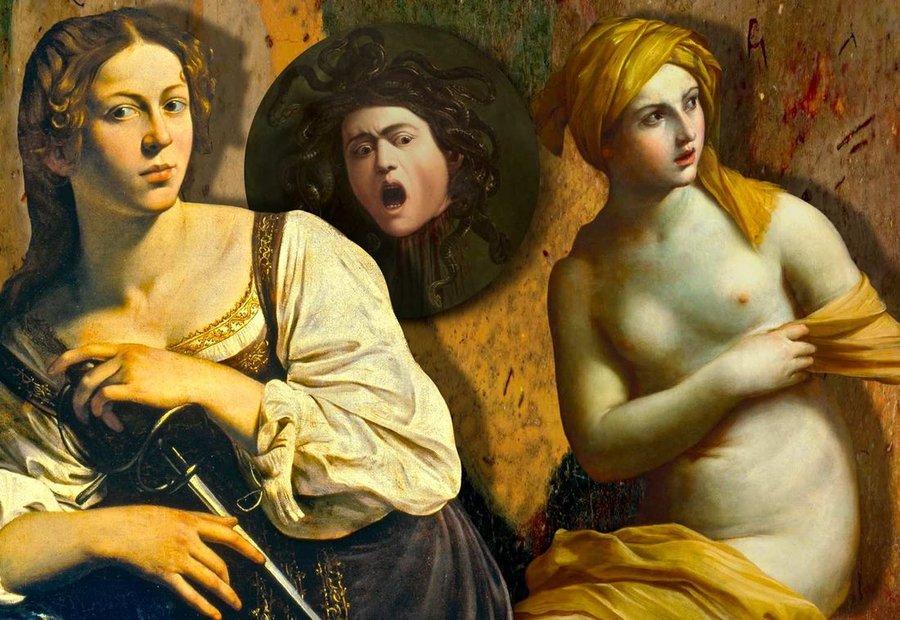
The head with snakes in place of hair, created by the Italian painter Michelangelo Merisi, known as Caravaggio (1571–1610), is preserved in the Uffizi Gallery in Florence. It represents Medusa (a figure from Greek mythology) at the moment of her decapitation: her screaming face, her eyes and mouth wide open with fear and surprise, and her head dripping with blood. It is likely that Caravaggio used his own features in a mirror to paint the terrified face. Due to the ferocity and rawness of the subject, it represents a break from the sensibility that had characterized his earlier paintings.
The impact of this innovation would extend far beyond Caravaggio, sending ripples through the entire history of art, as violence—combined with an intense realism—shattered the prevailing rules on decorum and the balance of traditional pictorial composition.
This shift in taste would take shape later, during the late Baroque period, and was destined to transform the very concept of painting: no longer aimed solely at representing beauty as in the Renaissance, but seeking instead to astonish, striking both the eye and the soul of the viewer.
La testa con serpenti al posto dei capelli, realizzata dal pittore italiano Michelangelo Merisi detto il Caravaggio (1571-1610) è conservata nella Galleria degli Uffizi di Firenze. Rappresenta Medusa (figura mitologica greca) nel momento in cui viene uccisa, con il volto urlante, gli occhi e la bocca spalancati dalla paura e dalla sorpresa e la testa decapitata grondante di sangue.
È probabile che Caravaggio abbia ripreso i propri lineamenti allo specchio per dipingere il volto terrorizzato; tuttavia non si tratta di un vero e proprio autoritratto, bensì di uno studio espressivo basato sul modello più facile che aveva a disposizione: sé stesso. Per la ferocia e la crudezza del soggetto, rappresenta un momento di rottura rispetto alla sensibilità che aveva caratterizzato i suoi dipinti precedenti.
La portata di questa innovazione non riguarderà solo la sua opera, ma avrà ripercussioni sull'intera storia dell'estetica, dato che la sua violenza, unita al suo intenso realismo, infrangeva le regole vigenti sul decoro e l'equilibrio della composizione pittorica.
“Questo cambiamento di gusto prenderà forma più tardi, durante l'epoca barocca, e sarà destinato a trasformare il concetto di pittura, che non avrà più il solo scopo di rappresentare la bellezza come avvenne nel Rinascimento: l'arte mirerà a stupire, a colpire lo sguardo e l'anima dello spettatore con ogni mezzo possibile.” (recensioni.wordpress.com)
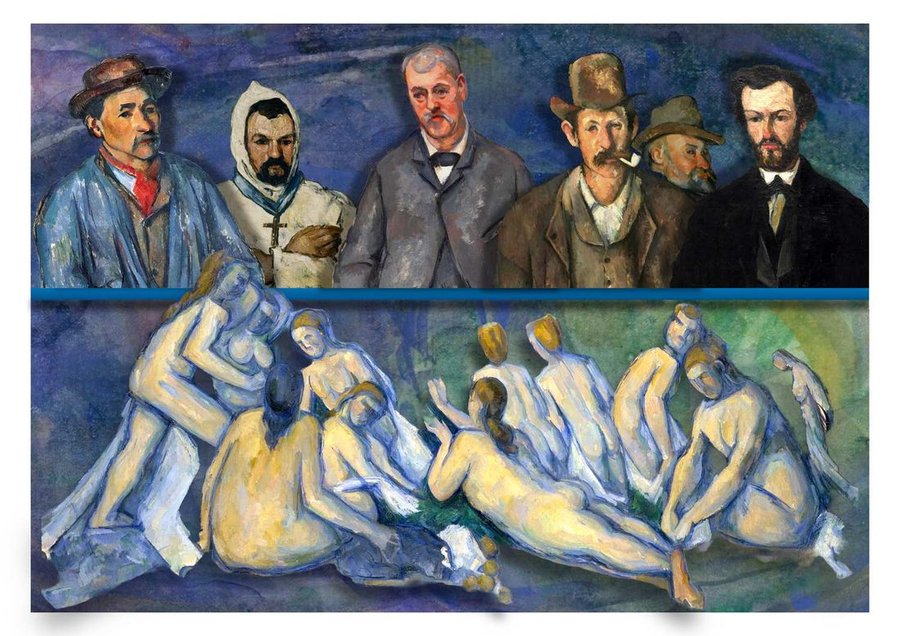
Cézanne — Tribute
Initially close to the Impressionists, with whom he frequented the Café Guerbois in Paris, Cézanne eventually distanced himself from them to develop a more scientific and reflective painting technique that could grant art its own legitimate autonomy.
For most of his life, the French painter remained at his country home in Provence, even though in his youth he had been strongly drawn to the Parisian boulevards and the cafés of Montmartre and Montparnasse. Meanwhile, the artist's reputation as a solitary genius began to spread throughout Europe, bringing a flood of invitations to participate in exhibitions.
Nevertheless, Cézanne withdrew completely into voluntary isolation, continuing his relentless pursuit of new artistic directions.
Inizialmente vicino agli impressionisti con cui frequentava il Café Guerbois a Parigi, Cézanne se ne allontanò presto per sviluppare uno stile personale, una tecnica pittorica più scientifica e riflessiva che potesse conferire all'arte una sua legittima autonomia.
Per quasi tutta la vita il pittore francese rimase nella sua casa di campagna in Provenza, sebbene in gioventù fosse molto attratto dai boulevard parigini e dai caffè di Montmartre e Montparnasse.
Nel frattempo, la fama dell'artista solitario e geniale iniziò a circolare in tutta Europa, e numerosi furono gli inviti a partecipare alle mostre: ciononostante, l'artista, in un isolamento quasi volontario, si chiuse definitivamente in se stesso alla ricerca di nuove esperienze artistiche.
Chagall — Never Seen
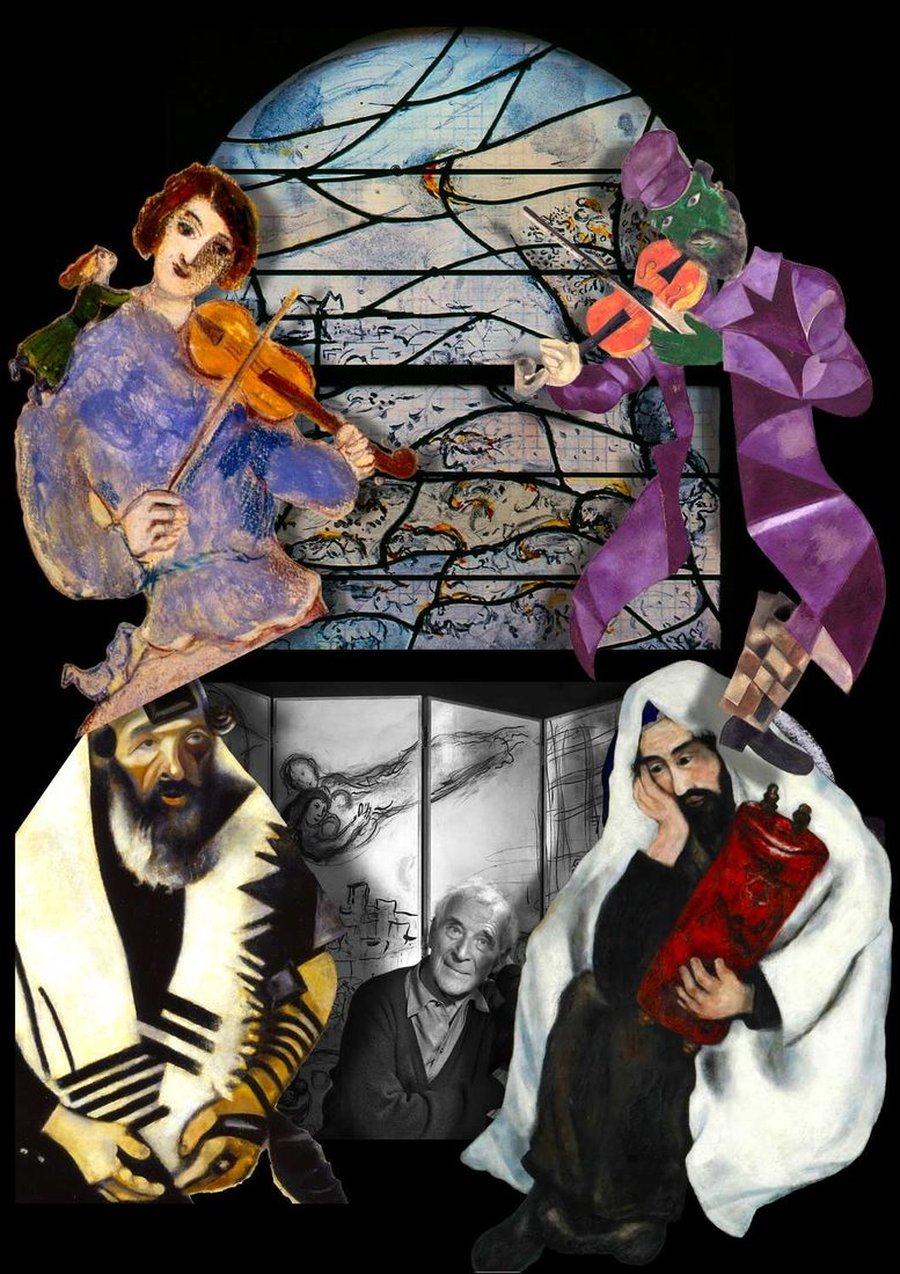
The Russian-born Marc Chagall (1887–1985) traveled to Paris in 1910, where he met avant-garde poets like Max Jacob and Guillaume Apollinaire, as well as several promising painters who were destined for fame, including Chaïm Soutine, Robert Delaunay, and Amedeo Modigliani.
The violinists portrayed by the Russian-French artist date back to this Parisian period.
As for our collage, let us consider "The Green Violinist" (1924), a painting that exhibits all the avant-garde influences Chagall embraced and learned in Paris: the disregard for perspective, the angular details of the clothing, and the movements of the violinist. A recurring figure in Hasidic culture, the violinist was a constant presence at festivals and celebrations, as music and dance were believed to be a means of connecting with God.
Il russo Marc Chagall (1887/1985) si recò a Parigi nel 1910 e qui incontrò i poeti d’avanguardia: Max Jacob e Apollinaire, e alcuni promettenti pittori destinati a diventare famosi: Chaim Soutine, Robert Delaunay, Amedeo Modigliani.
Di questo periodo parigino sono i personaggi che danzano nel cielo, il bizzarro violinista che si dondola sopra le case, gli amanti in blu, le scene di volo, e poi i suoi animali indefinibili.
Un'enorme sequenza di simboli che avrebbe poi costituito la base ispiratrice del Surrealismo. Per quanto riguarda il nostro collage, prendiamo in considerazione "Il Violinista Verde", del 1924, un dipinto che mostra tutte le influenze d'avanguardia accolte da Chagall e apprese a Parigi: il disinteresse per la prospettiva, i dettagli spigolosi degli abiti, i movimenti bidimensionali del violinista.
Il Violinista, una figura ricorrente nella cultura chassidica, era una presenza fissa durante feste e celebrazioni, poiché si pensava che la musica e la danza fossero un mezzo per entrare in contatto con Dio.
Chardin — Never Seen
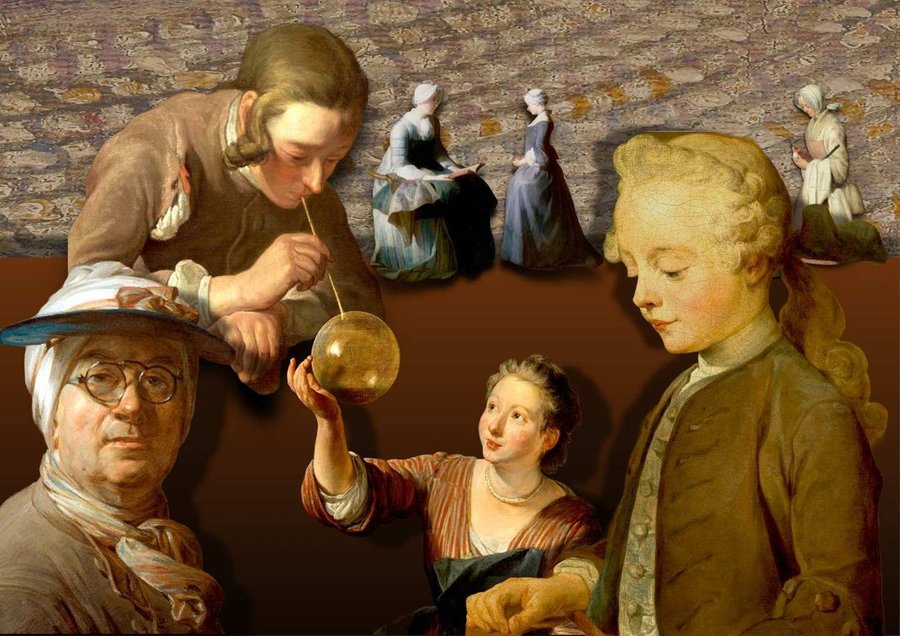
An 18th-century artist, Jean-Baptiste-Siméon Chardin built a reputation for his distinctive personal style, transitioning from simple still lifes to detailed depictions of French daily life. His acclaim earned him lucrative commissions and even a pension granted by King Louis XV. As the novelist Marcel Proust wrote: "We have learned from Chardin that a pear is as alive as a woman, that a common piece of pottery is as beautiful as a precious stone. Having understood the vitality of his paintings, you will have discovered the beauty of life."
Pittore francese del XVIII secolo, Jean Baptiste Siméon Chardin era noto per le sue nature morte e le sue opere di genere. Chardin sviluppò ulteriormente la sua abilità nella riproduzione di nature morte e iniziò a coltivare una passione per le scene di genere. La sua reputazione gli valse commissioni redditizie e persino una pensione da Re Luigi XV. Il suo stile si evolse continuamente, passando da semplici nature morte a dettagliate raffigurazioni della vita quotidiana della società francese. Come scrisse il romanziere Marcel Proust: "Abbiamo imparato da Chardin che una pera è viva quanto una donna, che un comune pezzo di ceramica è bello quanto una pietra preziosa. Avendo compreso la vitalità dei suoi dipinti, avrete scoperto la bellezza della vita".
Claudel — Forgotten
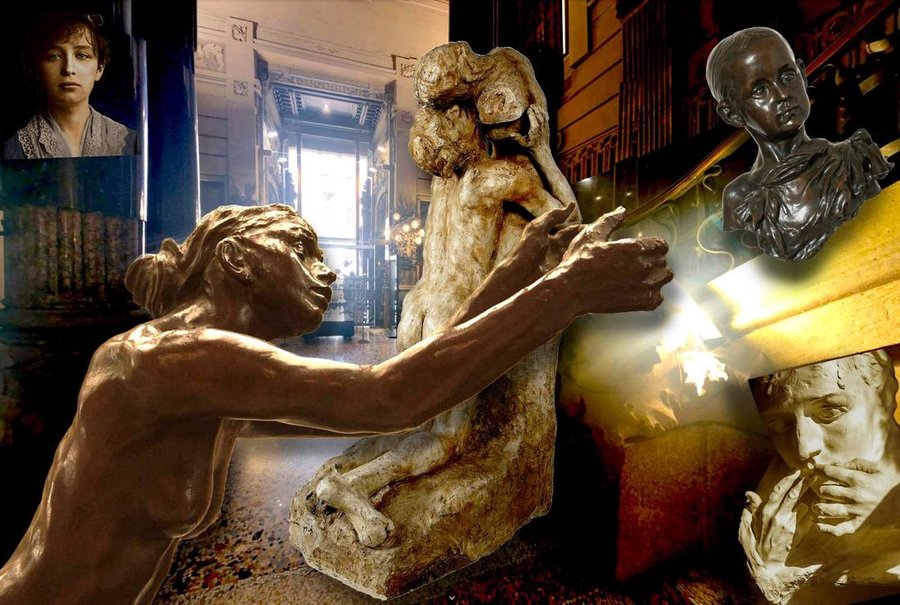
Sister of the famous French writer Paul Claudel, Camille Claudel (1863–1943) is one of those female figures in art history who fell victim to an era incapable of accepting her talent. After a brief and promising start, her career was brutally cut short by those who should have loved and supported her.
First her mother, who was always opposed to her passion for sculpture, and then her master, Auguste Rodin, who seduced and loved her, but also exploited her to the point of draining her artistic and vital energy.
“It is a story that remained buried in oblivion for years. Until, by chance, a literary scholar looking to learn more about the life of her brother Paul discovered the tragic and passionate existence of his sculptor sister.” (Emma Sedini)
Sorella del celebre scrittore francese Paul Claudel, Camille Claudel (1863/1943) è uno di quei nomi femminili della storia dell'arte vittime di un'epoca incapace di accettare il suo talento.
Dopo un esordio brevissimo e promettente, la sua carriera fu brutalmente stroncata da coloro che avrebbero dovuto amarla e sostenerla. Prima sua madre, sempre contraria alla sua passione per la scultura, poi il suo maestro: Auguste Rodin, che la sedusse e l'amò, ma anche la sfruttò, fino a esaurirne la linfa artistica e vitale.
“È una storia rimasta sepolta nell'oblio per anni. Finché, per caso, uno studioso di letteratura interessato a saperne di più sulla vita del fratello Paul scoprì la tragica e appassionata esistenza della sorella scultrice". (Emma Sedini)
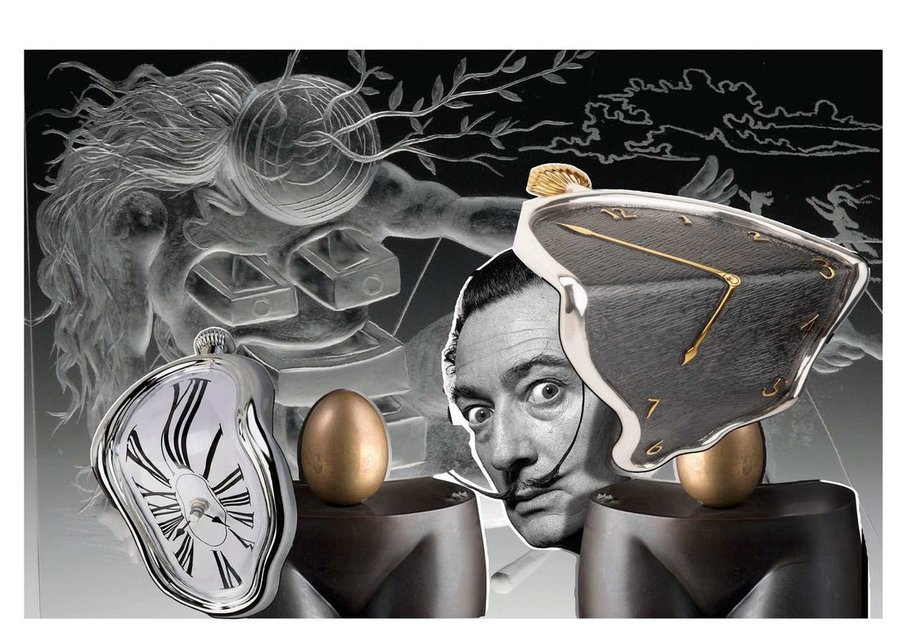
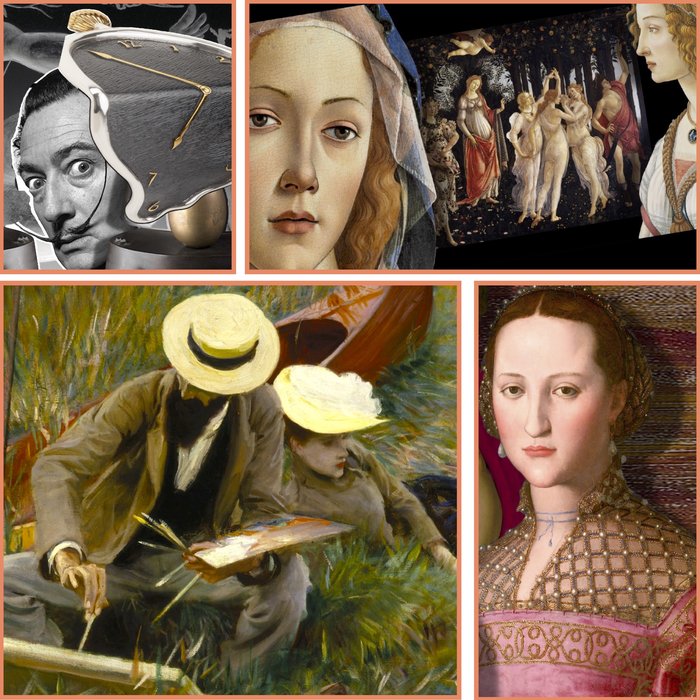
Dalì — Time
Salvador Dalí (1904–1989) was a versatile Spanish artist and a globally renowned figure, famous as much for his creations as for his eccentric mustache. An artist and an icon of Surrealism, he sought to dismantle reality in order to 'systematize confusion and contribute to the total discredit of the world of reality.' Dalí was endowed with an innate talent, a rebellious spirit, and a life of excess lived within his own surreal parallel world.
Despite his desire to be admired, surrounded, and adored by others, over the years he developed a deep sense of solitude— a side he kept hidden during public appearances and his numerous international accolades.
Salvador Dalí (1904/1989) è stato un pittore, scultore, scrittore, fotografo, regista, designer, sceneggiatore spagnolo; un personaggio conosciuto in tutto il mondo, sia per le sue creazioni che per i suoi eccentrici baffi.
Secondo l’eccentrico artista, icona del surrealismo, la realtà viene distrutta per "sistematizzare la confusione e contribuire a screditare completamente il mondo della realtà”.
"Dalí era dotato di un talento innato, uno spirito ribelle che trasformava il suo mondo in un surreale universo parallelo. Nonostante il suo precoce desiderio di essere ammirato e adorato dagli altri, sviluppò una forma di solitudine. Una caratteristica che tenne nascosta, nonostante il riconoscimento internazionale e una vita di eccessi”.
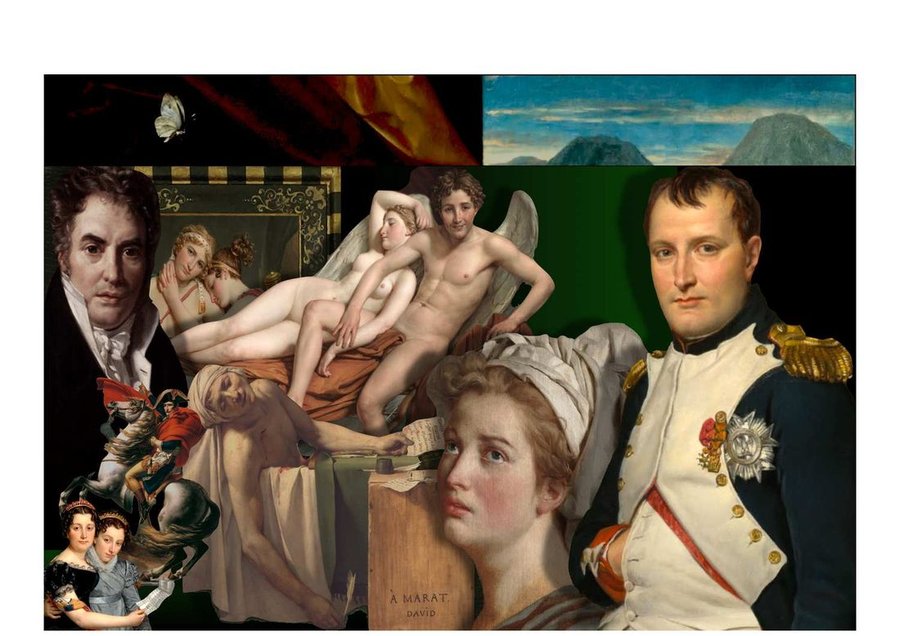
David — Never Seen
To view the paintings of David created between the end of the 18th century and 1825, the year of his death, is to witness a chapter of modern European history. His works bring back to life before our eyes the historical figures and events of that era.
In our collage, who are the two young lovers? David used the story of Cupid and Psyche to explore the conflict between romantic sentiment and the reality of physical passion. While Cupid was usually depicted as an adolescent, here David portrays him as an awkward youth, grinning with pleasure at his sexual conquest.
Perhaps David drew inspiration from an ancient Greek poem that described Cupid as a mischievous brat with sparkling eyes and curly hair.
Osservare i dipinti realizzati da David tra la fine del Settecento e il 1825, anno della sua morte, significa assistere a un pezzo di storia europea moderna. Le sue opere ci riportano vividamente davanti agli occhi i personaggi storici e gli eventi di quel periodo.
Curiosità: tra i dettagli del nostro collage, chi sono i due giovani amanti? David ha usato la storia di Amore e Psiche per esplorare il conflitto tra amore idealizzato e realtà fisica. Amore, amante della bella mortale Psiche, le faceva visita di notte a condizione che lei non conoscesse la sua identità.
Amore era solitamente raffigurato come un adolescente ideale, ma qui David lo presenta come un adolescente impacciato che sorride di piacere alla sua conquista sessuale. David si è ispirato a diversi testi antichi, tra cui un oscuro poema greco che descriveva Amore come un monello meschino, dagli occhi scintillanti e i capelli ricci.
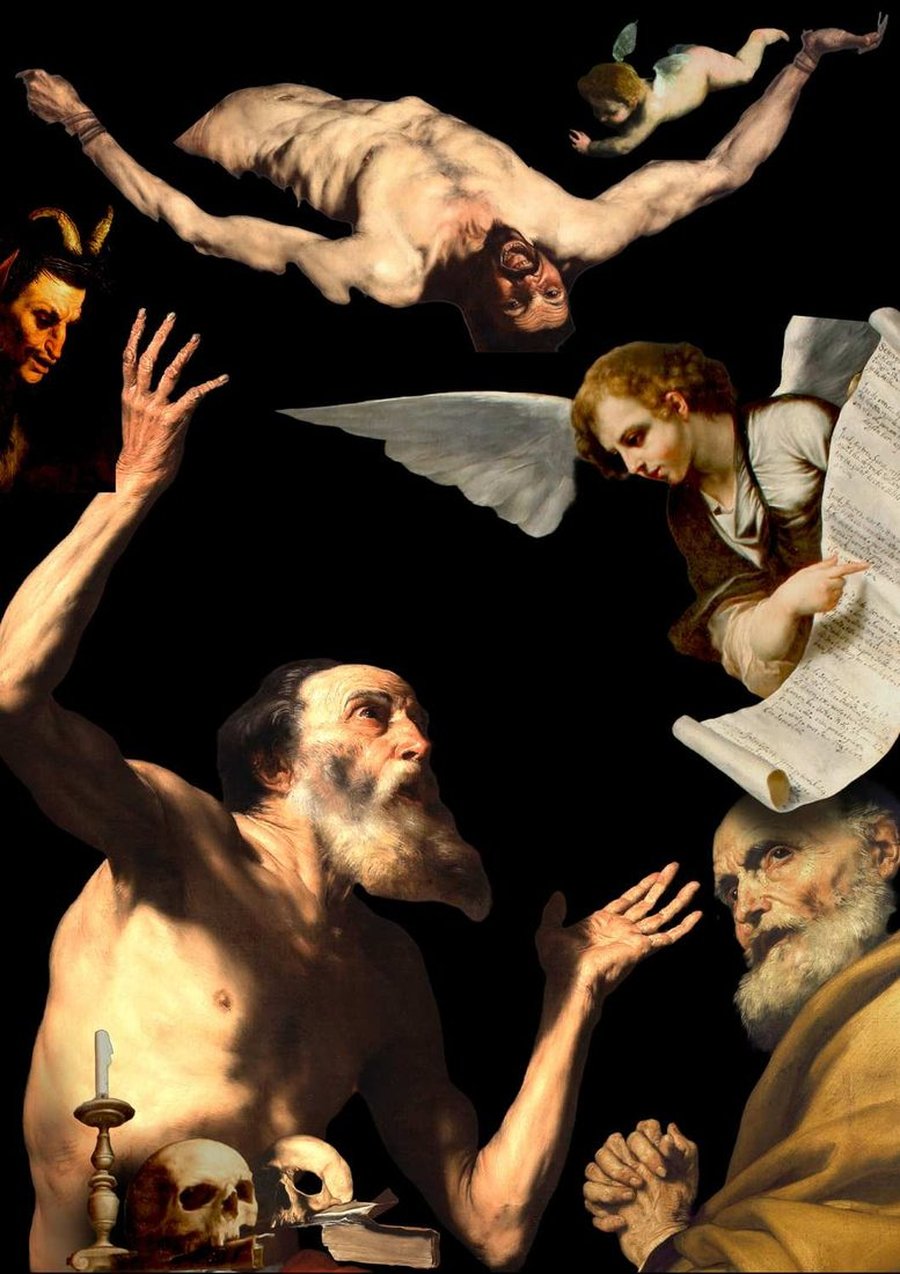
De Ribera — Tribute
While still a teenager, Spanish painter Jusepe de Ribera (1591–1652) traveled to nearby Valencia to attend university. However, after seeing the works of Francisco Ribalta—a master of Valencian painting—he was so captivated that he abandoned his studies to join the artist’s workshop.
A few years later, drawn by the fame of the great Italian masters, Ribera arrived in Italy, where he would remain for the rest of his life. He first settled in Rome, where he was given the nickname 'Lo Spagnoletto' ('The Little Spaniard'); then moved to Parma, captivated by Correggio; and finally to Naples around 1616, where he spent the entirety of his glorious mature career.
Il pittore spagnolo Jusepe de Ribera (1591/1652), ancora adolescente, si recò nella vicina Valencia per studiare all'università; ma, dopo aver visto le opere di Francisco Ribalta, maestro della pittura valenciana dell'epoca, ne fu così attratto che abbandonò gli studi per entrare nella bottega del maestro.
Qualche anno dopo, attratto dalla fama dei grandi artisti italiani, Ribera giunse in Italia, dove sarebbe rimasto per tutta la vita. Fu prima a Roma, dove gli fu dato il soprannome di "Spagnoletto"; poi a Parma, affascinato dalla grazia del Correggio; quindi di nuovo a Roma; infine a Napoli, intorno al 1616, dove trascorse tutta la sua gloriosa maturità.
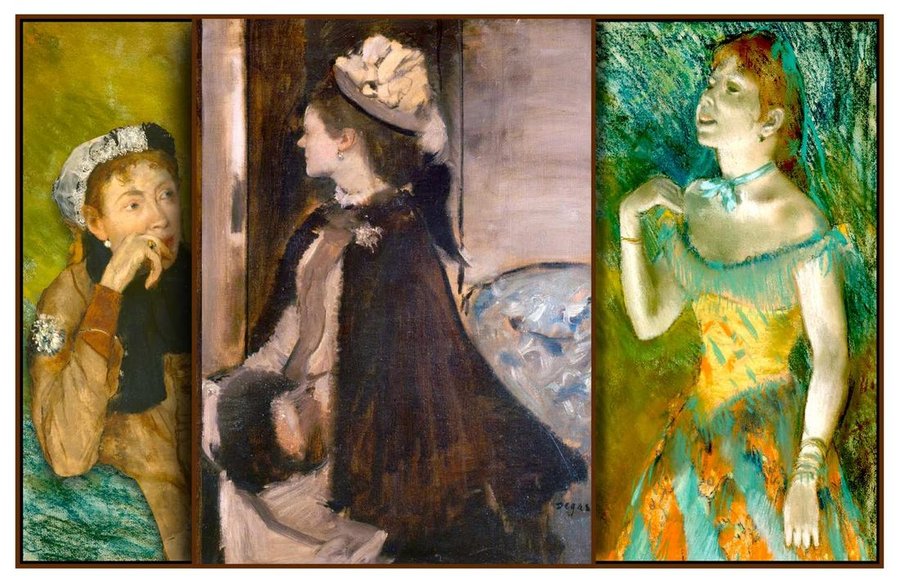
Degas’ Women
The works of French painter Edgar Degas (1834–1917) demonstrate immense technical skill, while his personality was defined by a relentless pursuit of beauty. These qualities converged in a man with a truly unique approach to making art—always remarkably original, to the extent that he cannot be understood purely through the lens of pre-existing styles, currents, or movements.
When art critic Edmond de Goncourt visited Degas in his studio in the late 1800s, he wrote of him: “After many trials, experiments, and attempts in every direction, he fell in love with modern life, and among all the subjects of modern life, he chose to portray women in every expression of beauty throughout their lives.”
Le opere del pittore francese Edgar Degas (1834/1917) sono di grande qualità tecnica e la personalità dell'autore è caratterizzata dalla sua incessante ricerca della bellezza.
Questi aspetti convergono in quest'uomo unico nel suo modo di fare arte, sempre molto originale, tanto che non è possibile analizzarlo tenendo conto solo di stili, correnti e movimenti preesistenti.
Quando il critico d'arte Edmond de Goncourt visitò Degas nel suo studio alla fine del 1800, disse di lui: "Dopo grandi prove, esperimenti e tentativi in tutte le direzioni, si innamorò della vita moderna e, tra tutti i temi della vita moderna, scelse di ritrarre le donne in tutte le espressioni di bellezza della loro vita".
Delacroix — Tribute
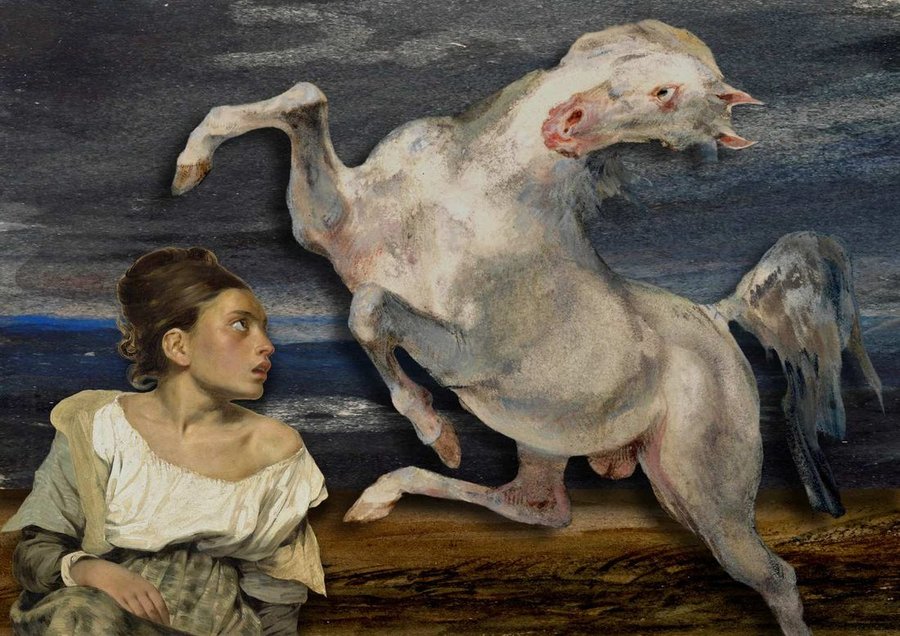
“A painting must first of all be a feast for the eyes.” These were the words of the painter Eugène Delacroix (1798–1863), one of the greatest exponents of French Romantic painting. “Brown eyes, leonine hair. A man of the world, yet at the same time a solitary hermit entirely dedicated to his art!” With these words, the poet Charles Baudelaire described Delacroix, an artist who was always drawn to intellectual circles. “He was a man of great culture and maintained friendships with the brightest minds of his time, such as the writer George Sand and her partner, the musician Frédéric Chopin.” (Alessandra Pagano)
Our collage highlights the magnificent white horse painted by Delacroix in 1829 in his famous work Horse Frightened by Lightning. The work embodies everything this proud animal represented in the eyes of the Romantics: strength, nobility, freedom, and wild passion. Yet the horse, depicted by humanity through every evolutionary stage—from cave paintings to the 20th-century avant-gardes—seems no longer to interest us. “After millennia, we are witnessing its decline even within the art world. Following the avant-gardes, after Picasso, after the many deeply Expressionist works of Franz Marc, after Kandinsky, after Boccioni, contemporary art oscillated between classical and mythological inspiration and transfiguration, until ultimately denying it altogether.” (Doina Ene) Perhaps this is a sign that an entire civilization has come to an end through its detachment from Nature and its simultaneous fascination with, and submission to, technology.
"La prima qualità di un dipinto è di essere una gioia per gli occhi". Queste le parole del pittore francese Eugène Delacroix (1798/1863) uno dei massimi esponenti della pittura romantica francese. Si iscrisse all'École des Beaux-Arts e si dedicò allo studio dei capolavori del Louvre.
«Occhi castani, capelli leonini. Uomo di mondo, ma allo stesso tempo "orso", fiero e interamente dedito alla sua arte": con queste parole il poeta Charles Baudelaire descrisse Eugène Delacroix.
Il pittore fu sempre attratto dagli ambienti intellettuali. "Era un uomo di grande cultura e mantenne amicizie con le menti più brillanti del suo tempo, come la scrittrice George Sand e il suo compagno, il musicista Frédéric Chopin." (Alessandra Pagano)
Depero — Tribute
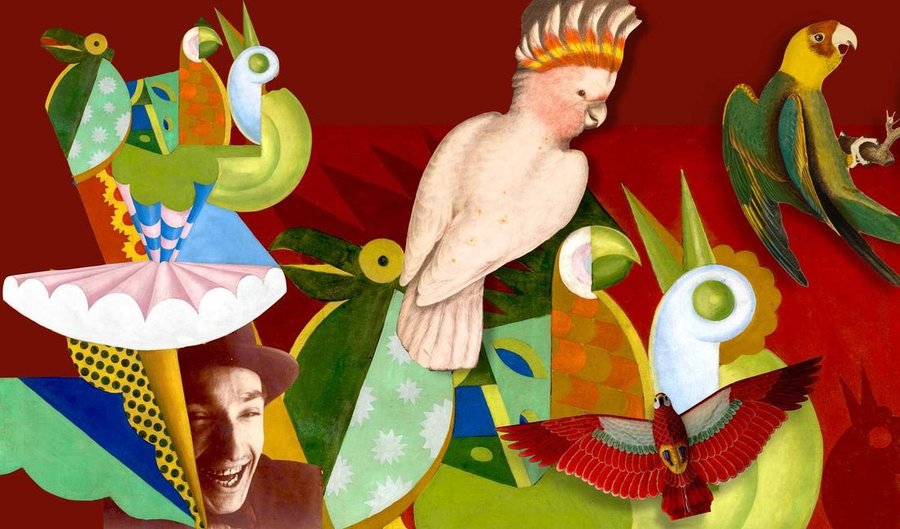
The Italian artist Fortunato Depero (1892–1960), a pupil of Giacomo Balla, co-authored with him a famous manifesto: Futurist Reconstruction of the Universe, published on March 11, 1915. In its pages, they envisioned a world filled with joy, vibrant colors, and light, featuring brightly colored materials as well as mechanical and musical devices.
In a sense, it can be said that the two artists anticipated by several decades the developments typical of Pop Art and Arte Povera.
“We want to achieve this total fusion,' they wrote, 'to reconstruct the universe by brightening it up—that is, by recreating it entirely.”
L'artista trentino Fortunato Depero (1892-1960), allievo di Giacomo Balla, scrisse con lui un celebre manifesto, “Ricostruzione futurista dell'universo", pubblicato l'11 marzo 1915, nelle cui pagine elogia un mondo pieno di gioia, coloratissimo e luminosissimo, con materiali dai colori vivaci, dispositivi meccanici e musicali e liquidi luminosi.
“In un certo senso si può dire che i due artisti anticiparono di qualche decennio le esperienze tipiche della Pop-Art e dell'Arte Povera. Noi - scrivono - vogliamo raggiungere questa fusione totale per ricostruire l'universo rallegrandolo, cioè ricreandolo integralmente.
Molta attenzione è data anche ai giocattoli futuristici (grazie ai quali anche gli adulti potranno rimanere giovani, agili, allegri e disinvolti), così come alla moda, all'architettura, alla pubblicità e alla musica. (Roberto Roberti)
Donatello — Tribute
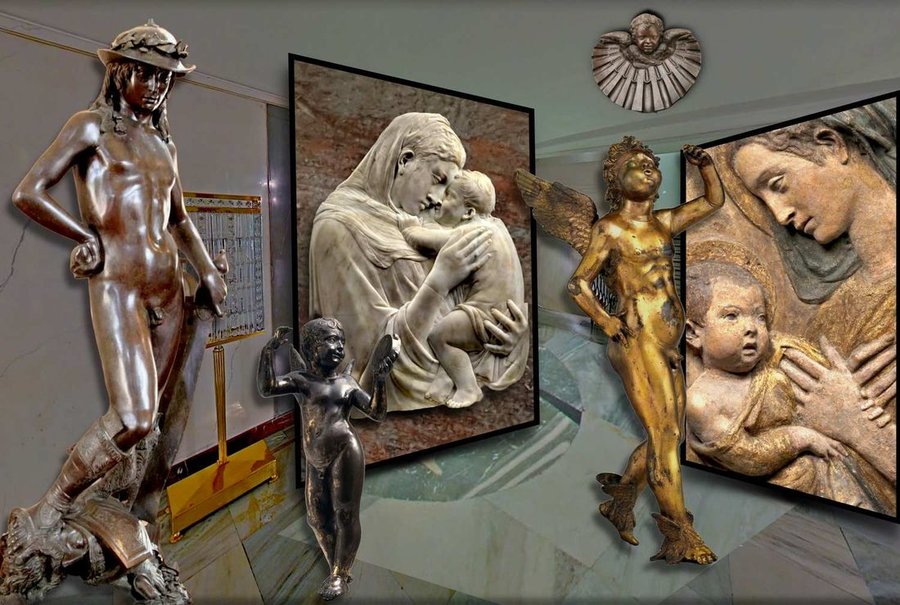
Donatello (1386–1466) was the greatest Italian sculptor of the Early Renaissance and one of the most celebrated sculptors of all time. The Tuscan artist drew inspiration from classical antiquity, combining it with his own inventive capacity and supreme technical skill. Dated to 1420, the white marble Madonna at the center, with her gentle expression beside the Child, is known as the Pazzi Madonna. The name is believed to derive from the fact that this exquisite bas-relief was discovered in Palazzo Pazzi in Florence. The Pazzi family was one of the most powerful and noble families of Florentine bankers—and fierce rivals of the Medici. The second Madonna and Child, crafted in painted terracotta, was commissioned from the sculptor in 1450 by another family of bankers and merchants operating between Milan, Padua, and Venice: the Borromeo family.
To the left stands the famous biblical hero David, portrayed by Donatello immediately after slaying Goliath— nude, wearing boots and a hat. His left hand rests on his hip holding a stone, while his right arm extends down his side, his hand grasping the hilt of a sword. This bronze sculpture, preserved at the Bargello Museum in Florence , is a true masterpiece of the Italian Renaissance. The bronze putto with a tambourine and the winged sprite complete the collage—a tribute we chose to set in a hypothetical contemporary museum to emphasize the modernity and artistic value of Donatello's works created 600 years ago.
Donatello (1386 - 1466), vero nome Donato di Niccolò di Betto Bardi, il più grande scultore italiano del primo Rinascimento, e uno dei più celebri scultori di tutti i tempi. Donatello si ispirava all’antichità classica, a cui aggiungeva la sua capacità di invenzione, di espressioni e di grande abilità tecnica.
La Madonna di marmo bianco con la dolce espressione accanto al Bambino, è conosciuta come Madonna Pazzi, datata 1420. Sembra che il nome sia dovuto al fatto che questo bellissimo bassorilievo sia stato rinvenuto nel Palazzo Pazzi a Firenze. La famiglia Pazzi era una delle più potenti e nobili famiglie di banchieri fiorentini, nemici acerrimi dei Medici.
La seconda Madonna con Bambino, realizzata in terracotta dipinta, fu commissionata nel 1450 allo scultore da un’altra famiglia di banchieri e mercanti che operavano tra Milano, Padova e Venezia, i Borromeo.
A sinistra c’è il celebre eroe David, rappresentato da Donatello subito dopo l’uccisione di Golia; in piedi, totalmente nudo, a parte i calzari ed un cappello a falda larga. La mano sinistra poggia sul fianco tenendo un sasso, mentre il braccio destro è lungo il corpo e la mano stringe l’elsa di una spada. La scultura bronzea conservata al Museo Nazionale del Bargello a Firenze, è un vero capolavoro del Rinascimento italiano.
Il putto col tamburello di bronzo e il folletto alato, in lega di rame dorato, completano il nostro collage; un tributo che abbiamo voluto ambientare in un ipotetico museo moderno per sottolineare la modernità e il valore artistico delle opere di Donatello realizzate 600 anni fa.
Great Artists A-D is part of Blu Artworks' wider body of work — 577 original SIAE-registered collages in total. Explore the Grandi Artisti A-D fa parte del lavoro più ampio di Blu Artworks — 577 collage originali registrati SIAE in totale. Esplora la Full GalleryGalleria Completa.