Artistic Nudes
20 collages, sensuality through art history20 collage, la sensualità attraverso la storia dell'arte
20 collages in this catalogcollage in questo catalogo
Sexuality in art is embedded in the social, cultural and political changes that have marked the different historical periods. From the erotic frescoes of ancient Pompeii to contemporary art, the concepts of sensuality, eroticism and desire have been interpreted by a vast array of artists through countless styles and creative forms. We present twenty original collages exploring the theme; the tools we used were artificial intelligence, augmented reality and a touch of natural mischief. Each piece below is available as a high-resolution, 300dpi, royalty-free download for €39, ready for print at any size.La sessualità nell'arte è insita nei cambiamenti sociali, culturali e politici che hanno caratterizzato i diversi periodi storici. Dagli affreschi erotici dell'antica Pompei all'arte contemporanea, i concetti di sensualità, erotismo e desiderio sono stati interpretati da una vasta platea di artisti attraverso molteplici stili e forme creative. Vi proponiamo venti collage inediti che trattano l'argomento; gli strumenti che abbiamo usato sono: l'intelligenza artificiale, la realtà aumentata e un po' di malizia naturale. Ogni opera qui sotto è disponibile in download ad alta risoluzione, 300dpi, royalty-free, a €39, pronta per la stampa in qualsiasi formato.
Download Catalog PDF →Scarica il Catalogo PDF → View All Collections →Vedi Tutte le Collezioni →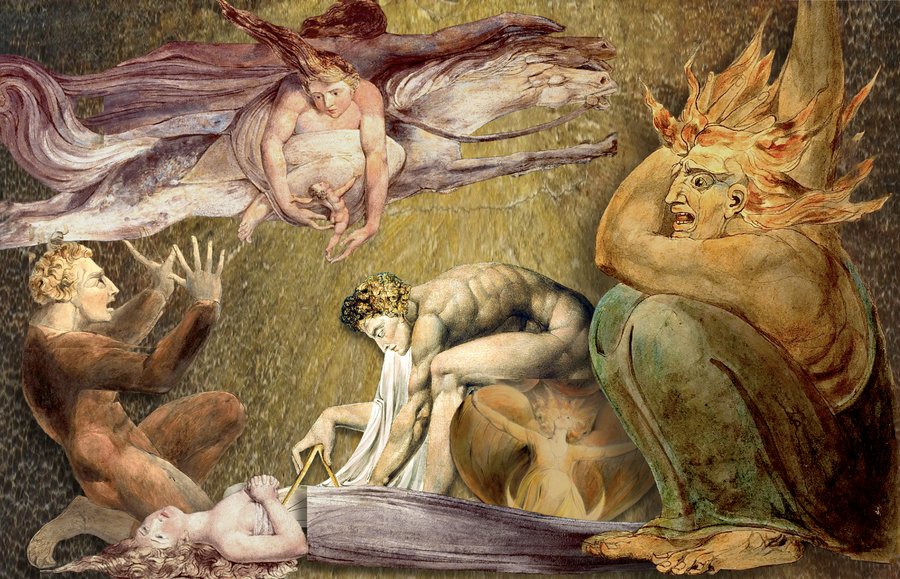
Blake Tribute
On August 12, 1827, the poet William Blake died in London, a visionary English artist. Passionate about medieval art, he was also a painter and a great miniaturist, famous for poems marked by a powerful spirituality. ‘Stay still, Kate! I will make a portrait of you, because to me you have always been like an angel,’ were reportedly William Blake's last words, spoken to his wife Catherine Boucher, whom he married at just twenty against her father's wishes. It is said that even on his final day Blake worked without allowing himself a moment's rest; he died around six in the evening, having just finished Kate's portrait and sworn he would remain by her side forever.
‘William Blake died on August 12, 1827, slowly fading into the shadow of an age that never gave him the honors he deserved. Only many years later, at the start of the twentieth century, did his prodigious and visionary work begin to be appreciated by the wider public, championed by scholars and academic critics.’ (Alice Figini) The bent figure at the center of the collage, holding a compass, is Isaac Newton — drawn from Blake's own 1795 masterpiece. ‘Newton, naked man born from chaos, seems to break through chaos itself. He is uncovering the law inherent in his own physical nature… Blake sought to distill the deepest meaning of his philosophy in the tension between the immediate realism of the image and its fantastical symbolism.’ (Emil Krén)
Il 12 agosto 1827 moriva a Londra il poeta William Blake, visionario artista inglese. Appassionato di arte medievale, fu anche pittore e grande miniaturista, famoso per le sue poesie caratterizzate da una forte spiritualità. ‘Stai ferma Kate! Ti farò un ritratto, perché per me sei sempre stata come un angelo’: furono queste, si racconta, le ultime parole di William Blake, rivolte alla moglie Catherine Boucher, sposata a soli vent'anni contro la volontà del padre. Si narra che anche nell'ultimo giorno di vita Blake lavorò senza concedersi un attimo di riposo; morì verso le sei di sera, dopo aver completato il ritratto di Kate e averle giurato che le sarebbe rimasto per sempre accanto.
‘William Blake morì il 12 agosto 1827, svanendo lentamente nell'ombra di un'epoca che non gli aveva mai reso gli onori che meritava. Solo molti anni dopo, agli inizi del Novecento, l'opera prodigiosa e visionaria di William Blake cominciò ad essere apprezzata dal grande pubblico, venendo valorizzata da studiosi e critici accademici.’ (Alice Figini) La figura piegata al centro del collage, che tiene in mano il compasso, è Isaac Newton, tratta dal celebre capolavoro dipinto da Blake nel 1795. ‘Newton, uomo nudo creato dal caos, sembra sfondare il caos. Sta scoprendo la legge che è insita nella sua stessa natura fisica… Blake cercò di esemplificare il significato più profondo del suo pensiero filosofico nella tensione tra il realismo immediato della sua immagine e il simbolismo fantastico.’ (Emil Krén)
Bonazza never seen
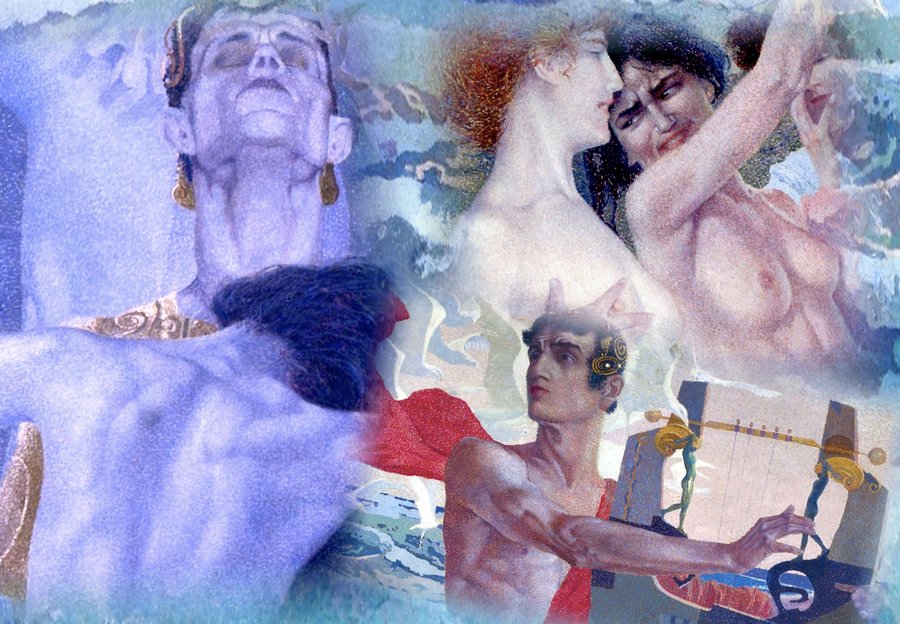
The Italian artist Luigi Bonazza worked in the first half of the twentieth century. After graduating, in 1897 he moved to Vienna and enrolled at the Kunstgewerbeschule, where he studied painting under Franz von Matsch, an artist who had worked alongside the Klimt brothers. In the Austrian capital, where he rented a studio, he collaborated with several magazines and received his first commissions.
‘Bonazza always kept up his ties with the Italian cultural world, entering competitions for decoration and illustration work, such as the one held by the Milanese magazine La Lettura, which he won in 1904. That same year he began the great canvas The Legend of Orpheus, shown at the 1906 International Exposition in Milan.’ (Vittorio Sgarbi) Bonazza drew on the iconography of the Vienna Secession, falling under the spell of Gustav Klimt's imagery; his works were shown in Vienna at the 37th Secession exhibition in 1911 and, the following year, at the 10th Venice Biennale. In 1913 the Berlin magazine Die Kunstwelt published plates of the cycle that made him famous, the ‘Loves of Jove,’ later acquired by Vienna's Albertina, Moscow's Lemercier Gallery, and collectors in Paris, London and Saint Petersburg. Every artist has had a refuge of their own — Pablo Neruda wrote from a boat adrift in the Pacific, Frida Kahlo had her blue house in Mexico, Monet had his garden at Giverny. In Italy, in the city of Trento, stands a house that itself became a work of art: Luigi Bonazza's, built on the proceeds of his considerable sales to European collectors.
L'artista italiano Luigi Bonazza operò nella prima metà del Novecento. Dopo la laurea, nel 1897 si trasferì a Vienna e si iscrisse alla Kunstgewerbeschule, dove seguì il corso di pittura di Franz von Matsch, artista che aveva lavorato con i fratelli Klimt. Nella capitale austriaca, dove affittò un atelier, collaborò con alcune riviste e ricevette le prime commissioni.
‘Bonazza mantenne sempre i contatti con l'ambiente culturale italiano, partecipando ad alcuni concorsi per decorazioni e illustrazioni, come quello promosso dalla rivista milanese La Lettura, che vinse nel 1904. Nello stesso anno iniziò la grande tela La leggenda di Orfeo, presentata all'Esposizione Internazionale di Milano del 1906.’ (Vittorio Sgarbi) Bonazza si ispirò al repertorio iconografico della Secessione viennese, subendo il fascino delle raffigurazioni di Gustav Klimt: le sue opere vennero esposte a Vienna alla XXXVII mostra della Secessione nel 1911 e, l'anno successivo, alla X Biennale di Venezia. Nel 1913 la rivista berlinese Die Kunstwelt pubblicò le tavole del ciclo che lo rese celebre, gli ‘Amori di Giove’, poi acquisite dalle collezioni viennesi dell'Albertina, dalla Galleria Lemercier di Mosca e da collezionisti di Parigi, Londra e San Pietroburgo. Ogni artista ha avuto il suo piccolo o grande rifugio: Pablo Neruda scriveva dalla sua barca nel Pacifico, Frida Kahlo aveva la sua casa blu in Messico, Monet il suo giardino a Giverny. In Italia, nella città di Trento, troviamo una casa diventata essa stessa un'opera d'arte: quella di Luigi Bonazza, frutto delle cospicue vendite dei suoi quadri a numerosi collezionisti europei.
Bouguereau at Pompeii
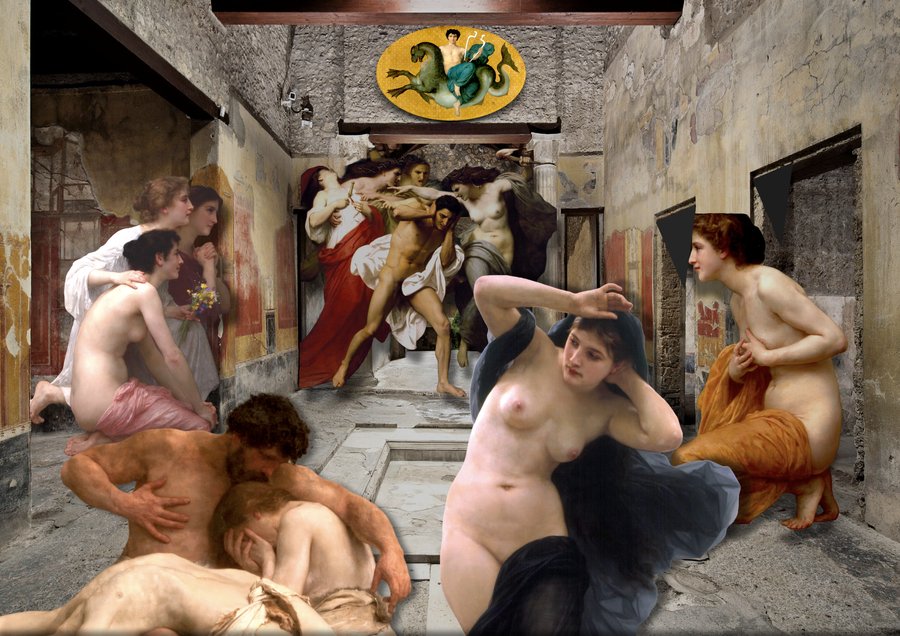
William-Adolphe Bouguereau (1825–1905) was one of the leading French painters of the late 19th century. His work is marked by a perfect mastery of both form and technique, with a high-quality finish achieving remarkable effects of realism.
After moving to Paris at twenty, he studied under the painter François-Édouard Picot. Admitted to the École Royale des Beaux-Arts, he won the Grand Prix de Rome in 1850, which included a generous scholarship to the Académie de France in Rome, where he began studying the following year. There he devoted himself to Italian Renaissance painting — his favorite artist was Raphael — and to Roman antiquities, and was deeply struck by his visit to the ruins of Pompeii. After his stay in Rome, Bouguereau returned to his hometown of La Rochelle, where his career flourished. He remained faithful to the neoclassical style for his entire life, declaring: ‘In painting, I am an idealist. In art, I know and want to see only beauty; to me, art corresponds to the feeling of pure beauty.’
William-Adolphe Bouguereau (1825–1905) fu uno dei principali pittori francesi della fine del XIX secolo. La sua pittura è caratterizzata da una perfetta padronanza sia della forma che della tecnica, con una finitura di alta qualità che raggiunge grandi effetti di realismo.
Dopo essersi trasferito a Parigi all'età di vent'anni, studiò con il pittore François-Édouard Picot. Ammesso all'École Royale des Beaux-Arts, gli fu conferito il Grand Prix de Rome nel 1850, che includeva una generosa borsa di studio per l'Accademia di Francia a Roma, dove iniziò a studiare l'anno successivo. Lì si dedicò allo studio della pittura rinascimentale italiana — il suo artista preferito era Raffaello — e delle antichità romane, rimanendo profondamente colpito dalla visita alle rovine di Pompei. Dopo il soggiorno a Roma, Bouguereau tornò nella sua città natale di La Rochelle, dove la sua carriera fiorì. Rimase fedele allo stile neoclassico per tutta la vita, dichiarando: ‘Nella pittura, sono un idealista. Nell'arte, conosco e voglio vedere solo la bellezza; per me, l'arte corrisponde al sentimento della bellezza pura.’
Bronzino Tribute
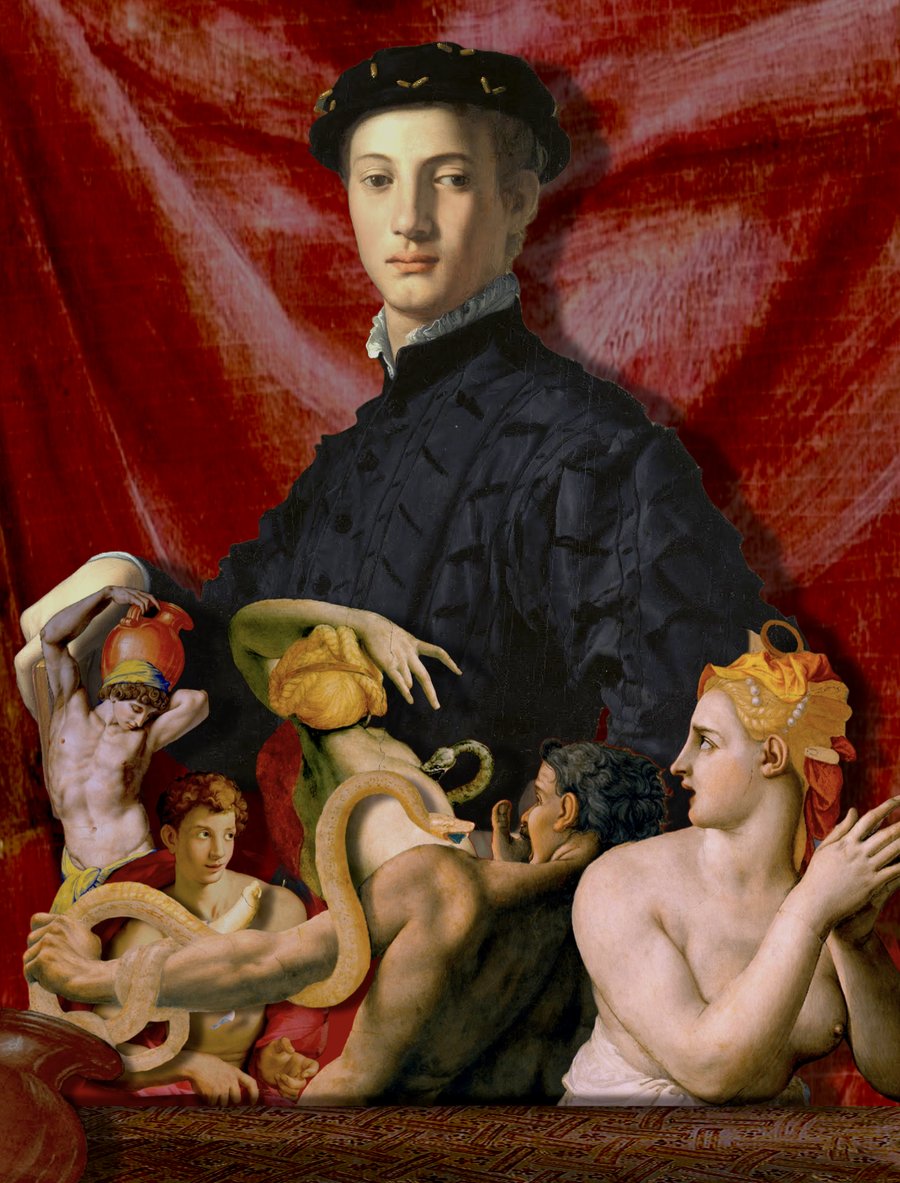
Agnolo di Cosimo, known as Bronzino, was a Florentine painter. His works are rare on the market: the last to appear, ‘Portrait of a Young Man with a Book,’ sold at auction for over 9 million dollars in 2015. We placed this portrait, large, at the center of our collage, with details from his other paintings at the base, as a tribute to the great artist.
‘This incredible portrait is one of the most interesting recent discoveries; it is extraordinary, a true masterpiece of 16th-century portraiture.’ (Carlo Falciani) The portrait was shown at an exhibition at the Met in New York in 2022, revealing how the patronage of Florentine bankers in the Medici era used art to consolidate their own power, reputation and lasting renown. ‘Portraits and Politics’ was the exhibition's title, set in an age when the Medici fought for dominion over Florence, and Bronzino was the go-to painter for noble portraiture. The exhibition closed with a line from Leonardo da Vinci on the immortality of great artists: ‘How many emperors and princes have lived and died, and no trace of them remains?’ — a fitting tribute to the lasting power of great art, and to the powerful who commission it.
Agnolo di Cosimo, detto il Bronzino, è stato un pittore fiorentino. Le sue opere sono rare sul mercato: l'ultima apparsa, ‘Ritratto di giovane con libro’, è stata battuta all'asta per oltre 9 milioni di dollari nel 2015. Questo ritratto lo abbiamo posto al centro, in grande, nel nostro collage, dove alla base sono presenti alcuni dettagli dei suoi quadri, per rendere omaggio al grande artista.
‘Questo incredibile ritratto è una delle più interessanti scoperte recenti; è straordinario, un vero capolavoro della ritrattistica del XVI secolo.’ (Carlo Falciani) Il ritratto è stato esposto in una mostra al Met di New York nel 2022, rivelando come il mecenatismo dei banchieri fiorentini, al tempo dei Medici, si servisse dell'arte per consolidare il proprio potere, la propria reputazione e la notorietà futura. ‘Ritratti e politica’ era il titolo della mostra, ambientata in un'epoca in cui la famiglia Medici combatteva per il dominio di Firenze, e Bronzino era l'artista di riferimento per i ritratti nobiliari. La mostra si concludeva con una citazione di Leonardo da Vinci sull'immortalità dei grandi artisti: ‘Quanti imperatori e principi sono vissuti e morti, e di loro non rimane traccia?’ — un omaggio al potere duraturo della grande arte, e ai meriti dei potenti che la commissionano.
Casting
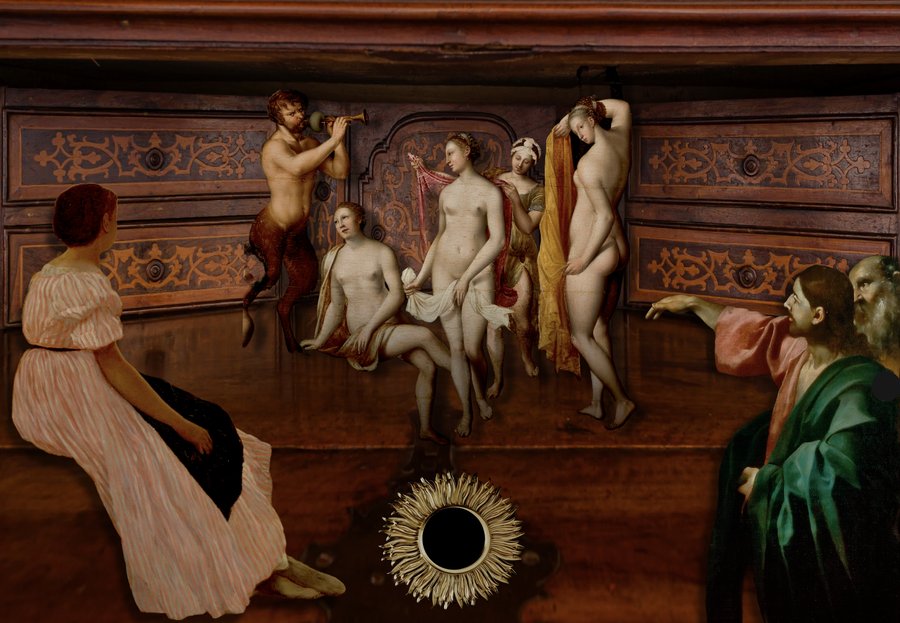
The casting director is the professional who coordinates casting: researching and selecting the actors best suited to the characters of a film, television program, commercial or stage production. Hired by the production, after reading the script and consulting with the director and producer, they hold auditions to shortlist names for every role.
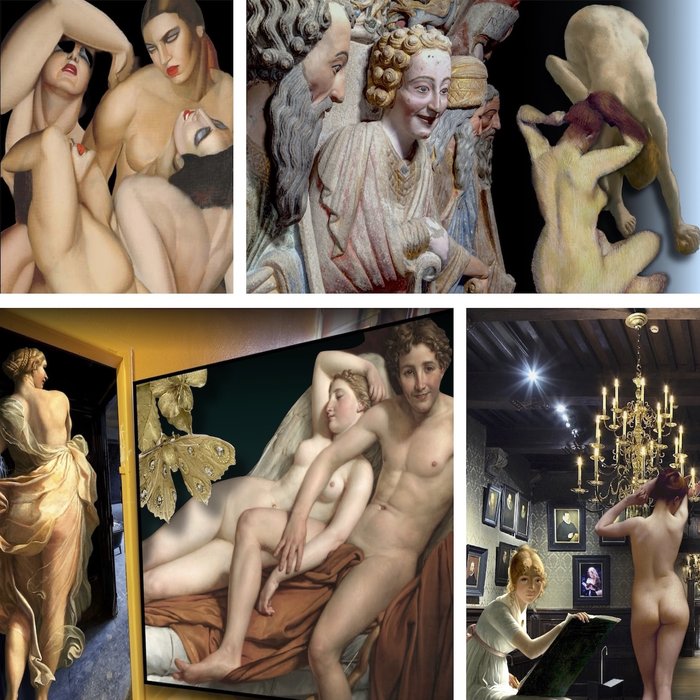
This is the theme we chose for our collage, illustrated with figures drawn from art history. Starting with the woman in pink on the left: Thérèse des Hours, cousin of the French painter Jean-Frédéric Bazille, who painted her portrait in 1864. At the center, the group of audition hopefuls who, judging by their nudity, seem destined for a rather different kind of production — drawn from a 1560 painting by the Frenchman François Clouet titled ‘The Bath of Diana,’ a mythological subject that, for centuries, gave artists a respectable alibi for painting and displaying classical nudes, always appreciated by their patrons, secular and religious alike. Closing the scene on the right is our own casting director, painted in 1625 by the Italian Giovanni Lanfranco, one of the great figures of Roman Baroque, whose original painting depicted Jesus in a Gospel episode, made for the church of San Marcello al Corso in Rome.
Il casting director è il professionista che coordina il casting, ovvero il lavoro di ricerca e selezione degli attori più adatti a interpretare i personaggi di un film, di un programma televisivo, di una pubblicità o di uno spettacolo teatrale. Assunto dalla produzione, dopo aver letto la sceneggiatura e confrontato le proprie opinioni con il regista e il produttore, tiene delle audizioni per fornire una selezione di nomi per ogni ruolo.
Questo è il tema che abbiamo scelto per il nostro collage, illustrato con figure tratte dalla storia dell'arte. Iniziando dalla donna in rosa a sinistra: Thérèse des Hours, cugina del pittore francese Jean-Frédéric Bazille, che la ritrasse nel 1864. Al centro, il gruppo dei partecipanti all'audizione che, a giudicare dalla loro nudità, sembrano destinati a una produzione di tutt'altro genere — tratto da un dipinto del 1560 del francese François Clouet, intitolato ‘Bagno di Diana’, soggetto mitologico che per secoli offrì agli artisti un rispettabile alibi per dipingere ed esporre nudi in stile classico, sempre apprezzati dai committenti, laici e religiosi. Chiude la scena a destra il nostro direttore del casting, dipinto nel 1625 dall'italiano Giovanni Lanfranco, una delle grandi figure del Barocco romano, la cui opera originale raffigurava Gesù in un episodio del Vangelo, destinata alla chiesa di San Marcello al Corso di Roma.
Confession and Repentance
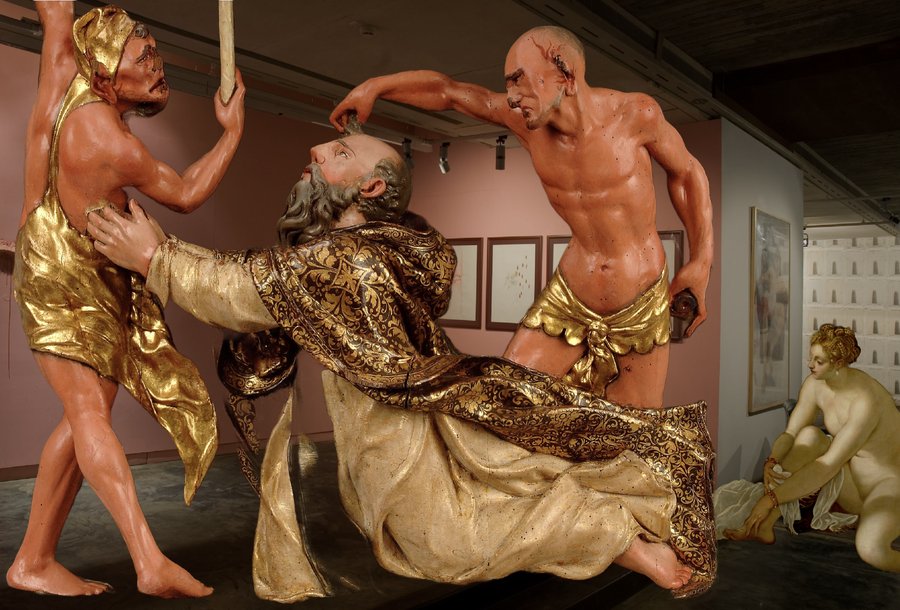
To illustrate our collage, we included the bas-relief carved by the Spanish sculptor Diego Rodríguez in 1555: The Temptations of Saint Anthony Abbot. The saint seems to implore his tormentors over the sexual temptation he was on the verge of yielding to. We chose to represent that temptation through a female nude, a detail from a painting by the Italian Tintoretto, also from 1555: Susanna and the Elders, now held at the Kunsthistorisches Museum in Vienna.
In recent decades, sexual-abuse scandals within the Catholic Church have not in the least shaken the obligation of clerical celibacy. A priest is required to be celibate, meaning he must live in total chastity, abstaining from any sexual relationship and keeping a heart free even emotionally, since it is consecrated to the Lord. In his encyclical, Pope Paul VI (Montini) reaffirmed the necessity of ecclesiastical celibacy, while acknowledging: ‘The New Testament, in which the doctrine of Christ and the Apostles is preserved, does not require celibacy of sacred ministers… Jesus himself did not impose this condition in choosing the Twelve, nor did the Apostles for those destined for the first Christian communities.’ (Encyclical Letter Sacerdotalis Caelibatus, 1967, p.5)
Per illustrare il nostro collage, abbiamo inserito il bassorilievo scolpito dallo spagnolo Diego Rodríguez nel 1555: Le tentazioni di Sant'Antonio Abate. Il santo sembra implorare i suoi carnefici per la tentazione sessuale alla quale stava per cedere. Abbiamo voluto rappresentare la tentazione con il nudo femminile, un particolare di un dipinto dell'italiano Tintoretto dello stesso 1555: Susanna e i vecchioni, oggi conservato al Kunsthistorisches Museum di Vienna.
Negli ultimi decenni, gli scandali sessuali all'interno della Chiesa cattolica non hanno scalfito minimamente l'obbligo del celibato. Il sacerdote deve essere celibe, ovvero deve vivere in totale castità, astenendosi da qualsiasi rapporto sessuale, mantenendo un cuore libero anche emotivamente, perché consacrato al Signore. Nella sua enciclica, papa Paolo VI (Montini) ribadì la necessità del celibato ecclesiastico, pur ammettendo che: ‘Il Nuovo Testamento, in cui è custodita la dottrina di Cristo e degli Apostoli, non esige il celibato per i sacri ministri… Gesù stesso non impose questa condizione nella scelta dei Dodici, né lo fecero gli Apostoli riguardo a coloro che furono destinati alle prime comunità cristiane.’ (Lettera enciclica Sacerdotalis Caelibatus, 1967, p.5)
Cupid and Psyche
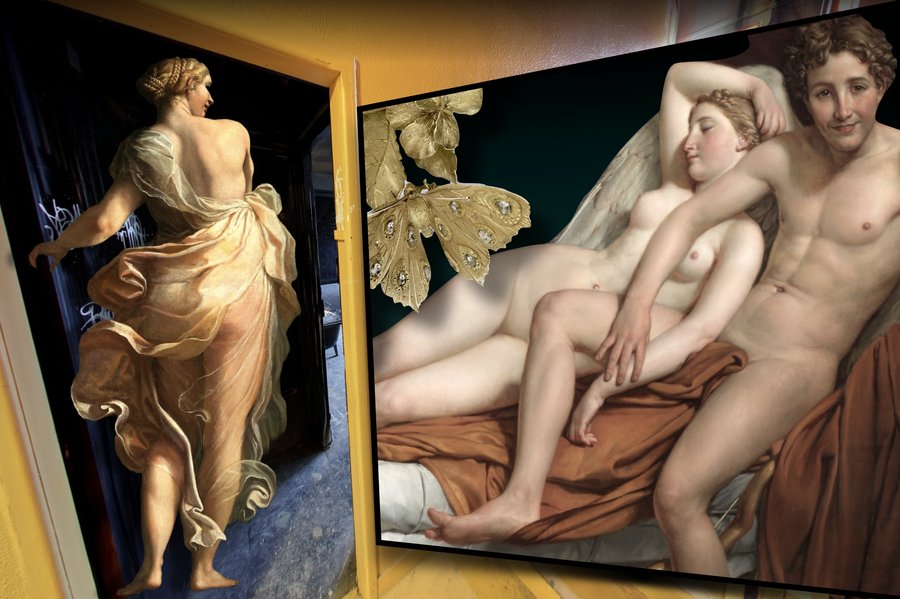
The legend, told by the Roman writer Apuleius, recounts that Psyche was the most beautiful of three sisters — so rare a beauty that people in nearby villages called her Aphrodite or Venus. This provoked the wrath of the goddess Venus, who asked Cupid to make Psyche fall in love with an ugly, insignificant man. But when Cupid sees Psyche, he is struck by her beauty and decides to protect rather than harm her, loving her without ever revealing his face or identity.
The French painter Jacques-Louis David masterfully depicted this story in 1817, painting Cupid rising with caution so as not to wake the sleeping Psyche. The public did not warm to this work, whose romantic realism sat oddly against the icy classicism the myth was expected to demand. In the collage, we added on the left a female figure from a 1596 painting by the Italian Annibale Carracci, depicting Venus discovering the deception and preparing to punish young, beautiful Psyche. In Freud's reading, Cupid and Psyche symbolize reason and instinct — two forces present in all of us, in search of the balance that alone lets us live in harmony with ourselves and the world.
La leggenda, narrata dallo scrittore romano Apuleio, racconta che Psiche era la più bella di tre sorelle, una bellezza così rara che le persone dei villaggi vicini la chiamavano Afrodite o Venere. Ciò provocò l'ira della dea Venere, che chiese a Cupido di farla innamorare di un uomo brutto e insignificante. Ma quando Cupido vede Psiche, ne rimane colpito dalla bellezza e decide di proteggerla invece di farle del male, amandola senza mai rivelarle il proprio aspetto o la propria identità.
Il pittore francese Jacques-Louis David rappresentò magistralmente questa storia nel 1817, dipingendo Cupido che si alza con cautela per non svegliare Psiche addormentata. Il pubblico non apprezzò quest'opera, il cui realismo romantico stonava con la classicità algida che il mito avrebbe richiesto. Nel collage, abbiamo incluso a sinistra una figura femminile da un quadro di Annibale Carracci del 1596, che raffigura Venere mentre scopre l'inganno e si prepara a punire la giovane e bella Psiche. Secondo l'interpretazione di Freud, Cupido e Psiche simboleggiano la ragione e l'istinto, due forze presenti in ognuno di noi, alla ricerca di quell'equilibrio che solo permette di vivere in armonia con se stessi e con il mondo.
Deceptive Persuasion
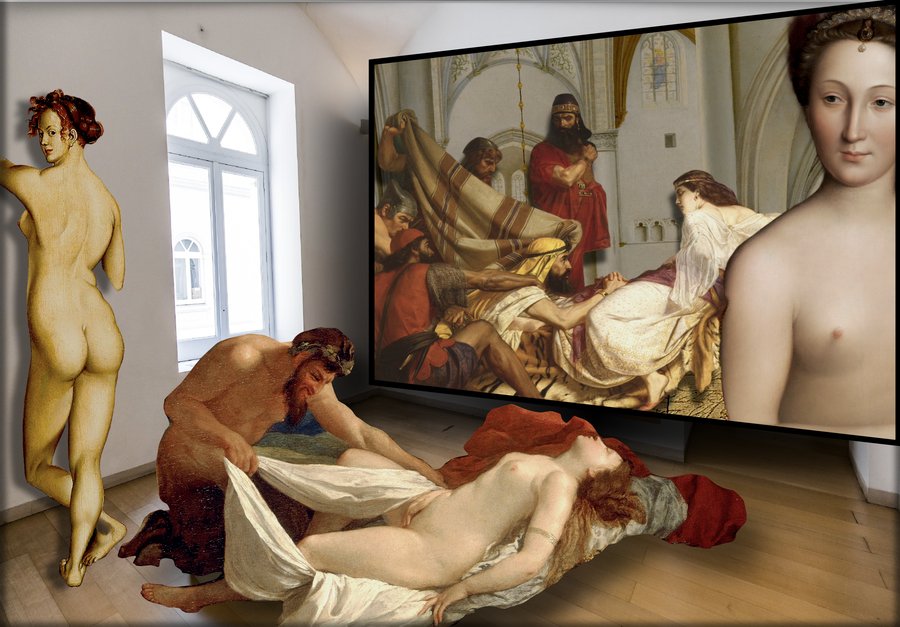
Any act of violence or coercion directed at a woman to induce her to offer her body to an indeterminate number of people is a reprehensible act and, in many countries, a crime — even when the inducement involves no force, threats or deception. In our digital society, another form of inducement runs through platforms and social media, often used to target potential victims, particularly young people, lured with promises of easy money into posting soft-core images and videos.
In our collage, the framed image is taken from an 1865 painting by the English artist Edward Armitage, depicting the biblical story of Queen Esther: King Xerxes, drunk during a celebration marking the third year of his reign, orders his queen to display her beauty before him and his guests; when she refuses, he banishes her and seeks a new queen. The figures' posture suggests an attempt at friendly persuasion; yet to the queen's right stands a woman already undressed, hinting at Esther's possible fate, a detail drawn from an 1571 work by the French painter François Clouet. More dramatic still is the satyr attempting to take advantage of a sleeping Venus on the floor, painted by the Frenchman Nicolas Poussin in 1626; standing before a wall, a nude woman stares back at us, portrayed by the German Hans Baldung in 1523 — each image, across the centuries, a variation on the same coercive pressure this collage sets out to condemn.
Qualsiasi atto di violenza o di coercizione rivolto a una donna per indurla a offrire il proprio corpo a un numero indeterminato di persone è un'azione riprovevole e, in molti stati, è considerato un crimine, anche quando l'induzione avviene senza l'uso della forza, minacce o inganno. Nella nostra società digitale, un'altra forma di induzione passa attraverso piattaforme e social media, spesso utilizzati per prendere di mira potenziali vittime, in particolare giovani, allettate con promesse di soldi facili a pubblicare immagini e video soft-core.
Nel nostro collage, l'immagine in cornice è tratta dal dipinto del 1865 dell'artista inglese Edward Armitage, dedicato alla vicenda biblica della regina Ester: il re Serse, ubriaco durante una celebrazione del terzo anno del suo regno, ordina alla regina di mostrare la propria bellezza davanti a lui e ai suoi ospiti; quando lei rifiuta, la fa bandire e cerca una nuova regina. La postura dei personaggi suggerisce un tentativo di persuasione amichevole; tuttavia, alla destra della regina c'è una donna già svestita, che allude al potenziale destino di Ester, dettaglio tratto da un'opera del 1571 del pittore francese François Clouet. Più drammatico è il satiro che tenta di approfittare di una Venere addormentata sul pavimento, dipinto dal francese Nicolas Poussin nel 1626; in piedi davanti a un muro, una donna nuda ci fissa, ritratta dal tedesco Hans Baldung nel 1523 — ogni immagine, nei secoli, una variazione sulla stessa pressione coercitiva che questo collage intende denunciare.
Egon's Torments
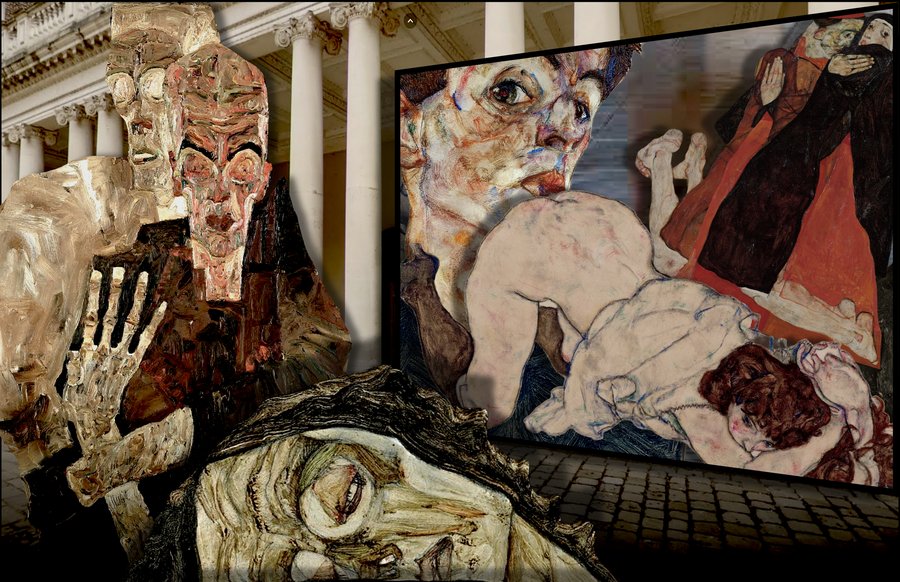
Egon Schiele (1890–1918) lived a short but intense life as an artist, becoming one of the most controversial figures of the Expressionist movement, alongside his fellow Austrian Gustav Klimt, who mentored him and shared his interest in depicting nudity as an exploration of sexuality itself.
A tormented personality, Schiele used sharp, incisive lines that betray his existential anguish; his art, composed mainly of portraits and self-portraits, constantly depicted the human body in an aggressive, distorted way. His preferred models were women with whom he had strong personal ties, fascinated as he was by the eroticism their nude bodies radiated. Because of this, in 1910 the painter was briefly imprisoned, accused of corrupting a minor; though acquitted of the crime, he spent 24 days in jail for exhibiting works the authorities deemed pornographic. In 1918 the influenza epidemic known as the ‘Spanish flu’ reached Vienna too, claiming some 50 million lives across Europe — among them Egon Schiele's, who died prematurely at just 28.
Egon Schiele (1890–1918) visse una vita breve ma intensa come artista, diventando una delle figure più controverse del movimento espressionista, assieme al conterraneo Gustav Klimt, che fu il suo mentore e condivise con lui l'interesse per la rappresentazione della nudità come esplorazione della sessualità stessa.
Personalità tormentata, Schiele usò linee nette e incisive che tradiscono la sua angoscia esistenziale; la sua arte, composta principalmente da ritratti e autoritratti, raffigurava costantemente il corpo umano in modo aggressivo e distorto. Le sue modelle preferite erano donne con cui l'artista aveva forti legami personali, affascinato com'era dall'erotismo che emanavano i corpi nudi. A causa di ciò, nel 1910 il pittore fu brevemente incarcerato, accusato di aver corrotto una minorenne; sebbene assolto dal reato, trascorse 24 giorni in prigione per aver esposto opere che le autorità ritenevano comunque pornografiche. Nel 1918 l'epidemia di influenza chiamata ‘spagnola’ raggiunse anche Vienna, mietendo circa 50 milioni di vittime in tutta Europa: tra queste, anche la vita di Egon Schiele, che morì prematuramente a soli 28 anni.
Emotional Shock
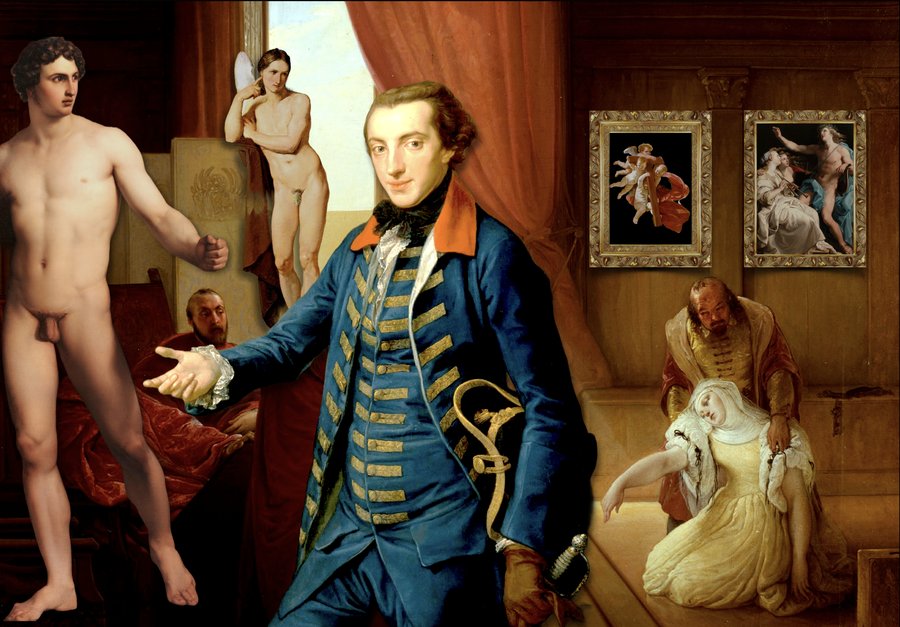
‘No exhibition, until Nackte Männer (Naked Men) in 2011 at Vienna's Leopold Museum, had ever been dedicated to the male nude’ — so wrote the Musée d'Orsay in Paris on its website in September 2013, presenting its exhibition ‘The Male Nude in Art from 1800 to the Present Day.’ To fill this gap, the museum compared works of different eras and techniques, all inspired by the male body.
We must first distinguish what the sight of an undressed man actually evokes: his absence of modesty causes embarrassment, whereas a nude body reshaped and idealized by the uninhibited imagination of artists since classical antiquity is accepted without hesitation. With our own collage, we wanted to imagine a poster for a hypothetical future exhibition on the male nude. At its center we placed the portrait, painted by the Italian Pompeo Batoni, of William Weddell, a British politician who sat in the House of Commons in the late 1700s and was himself a notable art collector — hence, we felt, entitled to the company beside him: on the left, ‘The Triumphant Athlete,’ painted in 1813 by another Italian, Francesco Hayez, who is also responsible for the surrounding figures, including the angel indifferently watching a woman fainted on the ground — a thin covering over his groin and only one wing on his back, perhaps signaling that what he witnesses will cost him his angelic purity.
‘Nessuna mostra, fino a Nackte Männer (Uomini nudi) nel 2011 al Leopold Museum di Vienna, era mai stata dedicata al nudo maschile’: così scriveva il Musée d'Orsay di Parigi sul proprio sito nel settembre 2013, presentando la mostra ‘Il nudo maschile nell'arte dal 1800 ai nostri giorni’. Per colmare questa lacuna, il museo metteva a confronto opere di epoche e tecniche diverse, tutte ispirate al corpo maschile.
Occorre innanzitutto distinguere cosa suscita nella realtà la vista di un uomo senza vestiti: per l'assenza di pudore suscita imbarazzo, mentre un corpo nudo rimodellato e idealizzato dalla fantasia disinibita degli artisti fin dall'antichità classica viene accettato senza problemi. Con il nostro collage abbiamo voluto immaginare un manifesto per un'ipotetica futura mostra sul nudo maschile. Al centro abbiamo posto il ritratto, dipinto dall'italiano Pompeo Batoni, di William Weddell, politico britannico che sedette alla Camera dei Comuni alla fine del Settecento e fu anche un notevole collezionista d'arte — quindi, riteniamo, titolato alla compagnia che gli abbiamo riservato: a sinistra, ‘L'Atleta trionfante’, dipinto nel 1813 da un altro italiano, Francesco Hayez, autore anche delle altre figure di contorno, tra cui l'angelo che osserva indifferente la donna svenuta a terra — una sottile copertura sulle parti intime e una sola ala sulla schiena, forse a significare che ciò a cui sta assistendo gli formerà perdere la sua purezza angelica.
Eros and Thanatos
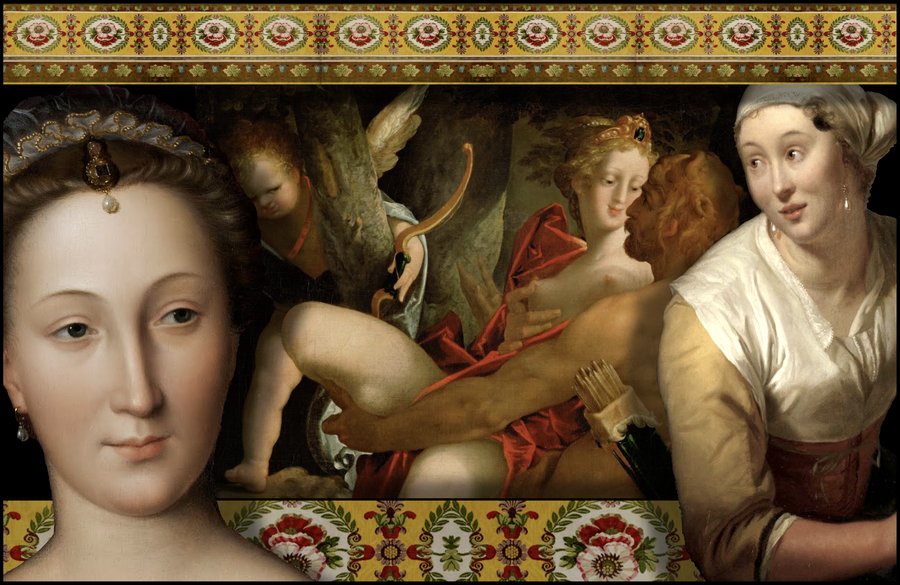
Sigmund Freud introduced, in his essay ‘Beyond the Pleasure Principle’ (1920), a duality inherent to the human psyche between two drives: Eros and Thanatos. Eros coincides with libido — a sexual energy that follows the pleasure principle and tends exclusively toward satisfaction; humanity's eternal dissatisfaction drives a continuous, never fully fulfilled search for pleasure. Thanatos, named for the Greek deity of death, compensates for this dissatisfaction: the tendency to return to an inorganic state where tension ceases, the destructive and self-destructive drive that accompanies sexuality.
Gustav Klimt, and especially Egon Schiele, are the artists who most fully express these two conflicting drives: in Klimt sexuality is joy and satisfaction, in Schiele it becomes torture and punishment — though the line between the two is never quite so clean, and can seem ambiguous depending on the sensibility of whoever views the work. ‘No erotic work of art is trash when it is artistically significant; it only becomes trash through the eyes of the viewer, if he is a pig.’ (Egon Schiele)
Sigmund Freud introduce, nel saggio ‘Al di là del principio di piacere’ (1920), la dualità insita nella psiche umana tra due pulsioni: Eros e Thanatos. Eros coincide con la libido, un'energia sessuale che segue il principio di piacere e tende esclusivamente alla soddisfazione; l'eterna insoddisfazione umana induce l'individuo a una ricerca continua e mai completamente appagata del piacere. Thanatos, dal nome della divinità greca della morte, compensa questa insoddisfazione: è la tendenza a tornare a uno stato inorganico in cui cessano le tensioni, la pulsione distruttiva e autodistruttiva che accompagna la sessualità.
Gustav Klimt, e in particolare Egon Schiele, sono gli artisti che più esprimono nelle loro opere queste due pulsioni contrastanti: in Klimt la sessualità è gioia e soddisfazione, in Schiele diventa tortura e punizione — ma la separazione non è mai così netta, e può apparire ambigua a seconda della sensibilità di chi osserva. ‘Nessuna opera d'arte erotica è spazzatura quando è artisticamente rilevante; diventa spazzatura solo attraverso l'osservatore, se questi è un maiale.’ (Egon Schiele)
Gentileschi never seen
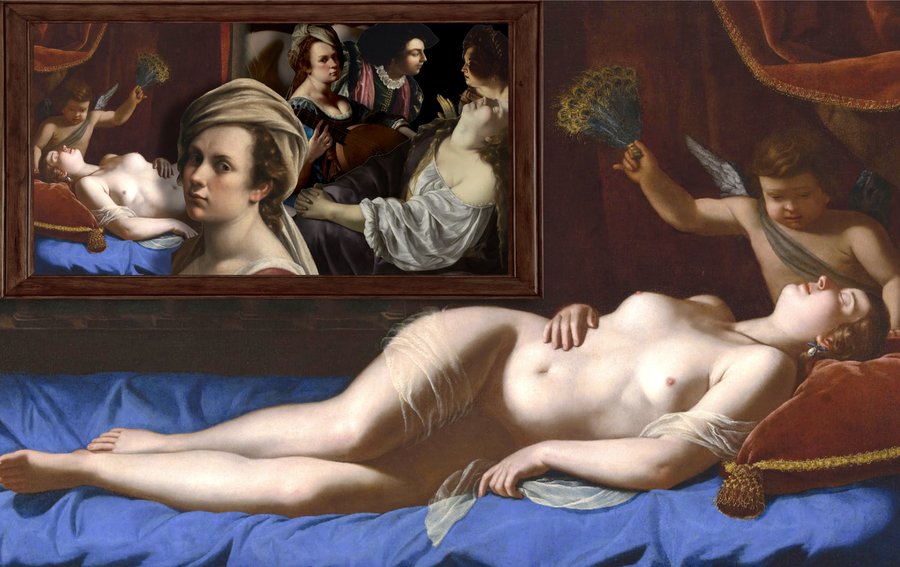
‘In the seventeenth century, her style and personal experiences made her famous throughout Europe, in a field almost always dominated by men; Artemisia Gentileschi was the only woman in Italy who thoroughly knew painting.’ (Roberto Longhi) Artemisia, born in Rome in 1593 and orphaned of her mother, alternated an apprenticeship in her father Orazio Gentileschi's workshop with caring for her younger brothers. Her fate was marked by two men: one illuminating and formative, the other dramatically violent.
The first was the unruly Caravaggio, much talked-about for his often scandalous work, who visited his friend Orazio for company and solidarity. The second was Agostino Tassi, an occasional collaborator of her father's who, feared for his violent conduct, raped Artemisia after repeated advances she had forcefully rejected. The violence she suffered, and the further humiliation of a trial that failed to bring her justice, marked her deeply; her father hastily arranged her marriage and move to Florence with the minor painter Pierantonio Stiattesi, who owes his modest fame chiefly to that union. In the years that followed, Gentileschi established herself as a painter in her own right; ‘Artemisia transposes the psychological consequences she suffered into paintings devoted to the edifying theme of biblical heroines — determined women, heedless of danger and driven by a desire for justice, who triumph over the cruel enemy and assert their place in society.’ (Roberto Longhi)
‘Nel Seicento, il suo stile e le sue vicende personali la resero famosa in tutta Europa, in un campo quasi sempre dominato dagli uomini; Artemisia Gentileschi fu l'unica donna in Italia che conoscesse a fondo la pittura.’ (Roberto Longhi) Artemisia, nata a Roma nel 1593 e rimasta orfana di madre, alternò l'apprendistato nella bottega del padre, il pittore Orazio Gentileschi, con la cura dei fratelli minori. Il suo destino fu segnato da due uomini: uno illuminante e proficuo, l'altro drammaticamente violento.
Il primo fu lo scapestrato Caravaggio, molto chiacchierato per le sue opere spesso considerate scandalose, che veniva a trovare l'amico Orazio in cerca di compagnia e solidarietà. Il secondo fu Agostino Tassi, collaboratore occasionale del padre, temuto per le sue azioni violente, che la violentò dopo vari approcci respinti con forza da Artemisia. La violenza subita, e le successive umiliazioni di un processo che non le rese giustizia, la segnarono profondamente; il padre combinò in fretta il suo matrimonio e il trasferimento a Firenze con il modesto pittore Pierantonio Stiattesi, che deve la sua scarsa fama soprattutto a quell'unione. Negli anni seguenti Gentileschi si affermò come pittrice a pieno titolo; ‘Artemisia traspone le conseguenze psicologiche subite nei quadri dedicati all'edificante tema delle eroine bibliche — donne decise, incuranti del pericolo e animate da un desiderio di giustizia, che trionfano sul nemico crudele e affermano il loro posto nella società.’ (Roberto Longhi)
German Expressionist
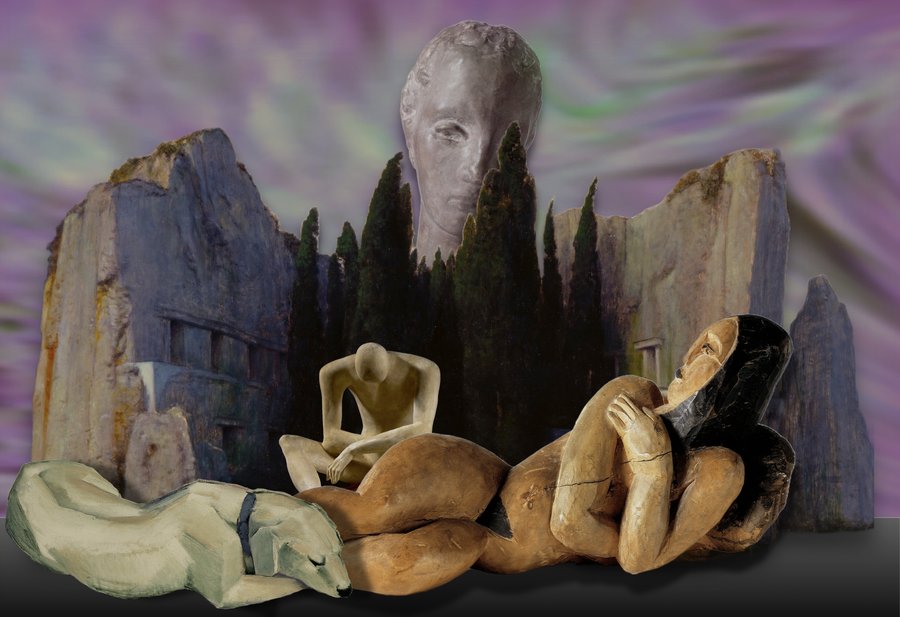
German Expressionism: one of the most revolutionary artistic movements of all time. ‘Man is a rope stretched between the beast and the new man — a rope over an abyss… what is great in man is that he is a bridge and not a goal.’ (Friedrich Nietzsche) Driven by a desire to rebel against the conventions of their time, and inspired by philosophy, inner life, primal emotion and sexuality, the painters of German Expressionism were the first to use color in a spontaneous, instinctive, deeply emotional way.
The restlessness of German society in the early twentieth century became central to the movement; unusual forms and vivid colors became its recognizable signature, meant to bridge classical neo-Romantic painting and the new style that would come to be called ‘Expressionism.’ For the first time, psyche, spirituality and mysticism found visual expression in works that became symbols of the modern era — compositions dominated by the human figure, including many nude portraits, alongside landscapes, city scenes and bourgeois interiors. These artists worked through the height of the First World War and became the voice of an era's disillusionment and deep anxiety.
Espressionismo tedesco: uno dei movimenti artistici più rivoluzionari di tutti i tempi. ‘L'uomo è una corda tesa tra la bestia e l'uomo nuovo, una corda che attraversa un abisso… la grandezza dell'uomo sta nel suo essere un ponte, non un fine.’ (Friedrich Nietzsche) Spinti dal desiderio di ribellarsi alle convenzioni del periodo e ispirati da temi legati alla filosofia, alla vita interiore, alle emozioni primordiali e alla sessualità, i pittori dell'espressionismo tedesco furono i primi a usare il colore in modo spontaneo, istintivo, fortemente emozionale.
L'irrequietezza della società tedesca dei primi anni del Novecento divenne centrale nel movimento; forme insolite e colori vividi ne divennero i segni distintivi, pensati per gettare un ponte tra la pittura classica neo-romantica e il nuovo stile che si sarebbe poi definito ‘espressionismo’. Per la prima volta, psiche, spiritualità e misticismo trovarono espressione visiva in opere divenute simboli dell'era moderna — composizioni dominate dalla figura umana, con molti ritratti di nudo, accanto a paesaggi, scene cittadine e interni borghesi. Questi artisti lavorarono durante il culmine della Prima guerra mondiale e divennero la voce della disillusione e delle profonde ansie dell'epoca.
Gravity Lost
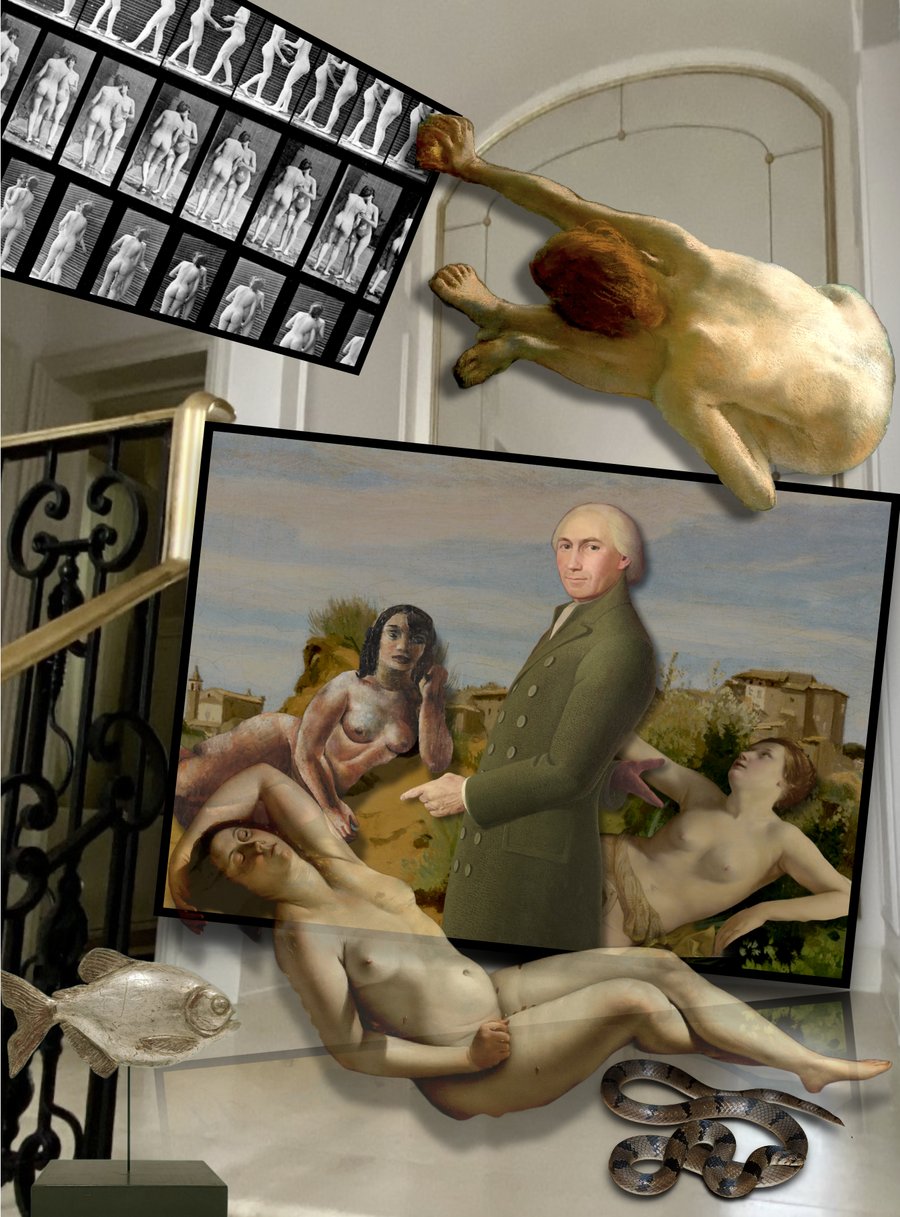
Losing one's center of gravity is that unsettling feeling many of us know from life — the point at which a person keeps their inner balance without being overwhelmed by confusion. That balance lets us not only stand upright but navigate the chaos of life with clarity and detachment. Illustrating so profound a subject in a collage wasn't simple: we imagined it as a moment of chaos, where the absence of gravity strips people of their certainties as they search for a new equilibrium.
The man at the center, painted by the American Grant Wood in 1939, seems the only one who has kept his balance — though this may be an illusion, born of the conceit often found in displays of ostentatious virility. The woman below, painted by Artemisia Gentileschi and indifferent to the serpent beside her, steps outside the rigid frame of her own painting, pointing toward the man who looks back at us, unmoved. Other figures from art history join the scene: inside the black frame on the left, a woman painted by Emiliano Di Cavalcanti in 1930; to the man's right, a figure by the Italian Orazio Gentileschi (Artemisia's father) from 1621; and floating weightlessly above, a nude model by the Frenchman Edgar Degas (1886), at whose feet rests the famous 1887 motion study by Eadweard Muybridge, the English pioneer of photography known as ‘the photographer of movement.’
Perdere il proprio baricentro è quella sensazione inquietante che molti di noi conoscono nella vita: il punto in cui una persona mantiene l'equilibrio interiore senza esserne sopraffatta. Quell'equilibrio ci consente non solo di stare in piedi, ma di navigare nel caos della vita con chiarezza e distacco. Illustrare un tema così profondo in un collage non è stato semplice: lo abbiamo immaginato come un momento di caos, in cui l'assenza di gravità spoglia le persone delle loro certezze mentre cercano un nuovo equilibrio.
L'uomo al centro, dipinto dall'americano Grant Wood nel 1939, sembra l'unico rimasto in equilibrio; potrebbe però essere un'illusione, dettata dalla presunzione spesso riscontrabile nelle rappresentazioni di una virilità ostentata. La donna in basso, dipinta da Artemisia Gentileschi e incurante del serpente accanto a lei, esce dalla rigida cornice del proprio dipinto, indicando con la mano l'uomo che la guarda indifferente. Altre figure della storia dell'arte prendono parte al collage: nella cornice nera a sinistra, una donna dipinta da Emiliano Di Cavalcanti nel 1930; alla destra dell'uomo, una figura dell'italiano Orazio Gentileschi (padre di Artemisia) del 1621; e, fluttuante in alto senza peso, una modella nuda del francese Edgar Degas (1886), ai cui piedi si trova il celebre studio del movimento del 1887 di Eadweard Muybridge, il pioniere inglese della fotografia noto come ‘il fotografo del movimento’.
I am Just my Mind
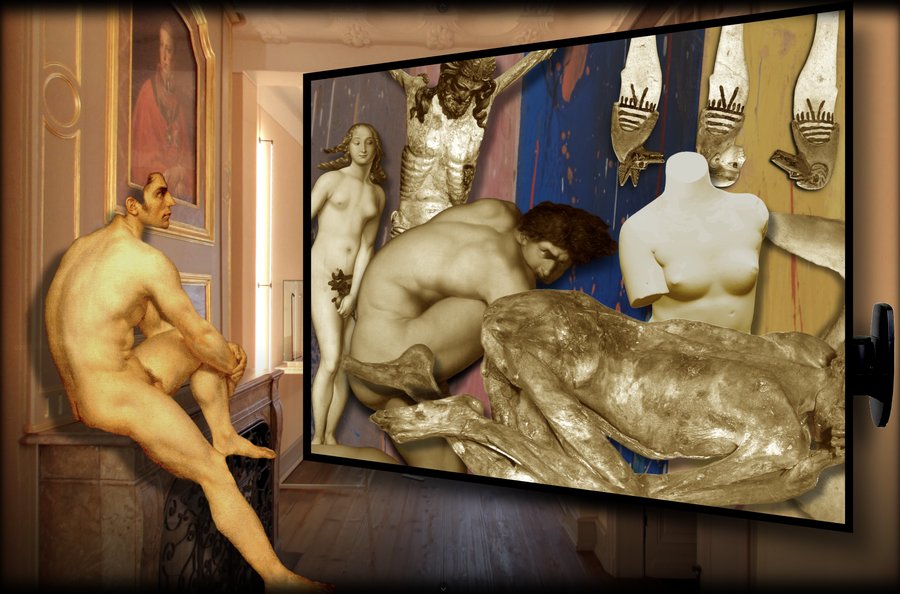
The collage's title quotes the Italian scientist and 1986 Nobel laureate in Medicine, Rita Levi-Montalcini, who in a 2009 interview on her 100th birthday declared: ‘Let the body do what it wants. I am not the body: I am the mind.’ The collage shows a nude man, visibly without a brain, staring emotionlessly at other bodies in various stages of life, all sharing the same fate: bodily decay.
‘And when the body dies?’ the interviewer asked her. ‘What survives is what you have done — the message you have passed on,’ the unforgettable Montalcini replied. In her own case, what survives her, beyond the Nobel Prize itself, is her discovery of the protein NGF (Nerve Growth Factor): administered to laboratory mice, it halts the progression of Alzheimer's disease, and could prove useful against other neurodegenerative conditions too. Producing NGF artificially, however, still carries enormous costs, and pharmaceutical companies are unlikely to invest until economies of scale make the new drug commercially viable.
Il titolo del collage riporta una citazione della scienziata italiana, premio Nobel per la Medicina 1986, Rita Levi-Montalcini, che in un'intervista del 2009, in occasione del suo centesimo compleanno, dichiarò: ‘Lascia che il corpo faccia ciò che vuole. Io non sono il corpo: io sono la mente.’ Il collage mostra un uomo nudo, visibilmente privo di cervello, che fissa senza emozioni altri corpi in varie fasi della vita, tutti accomunati dallo stesso destino: il decadimento del corpo.
‘E quando il corpo muore?’ le chiese di nuovo l'intervistatore. ‘Ciò che sopravvive è ciò che hai fatto, il messaggio che hai trasmesso,’ rispose l'indimenticabile Montalcini. Nel suo caso, ciò che le sopravvive, oltre al Nobel stesso, è la scoperta della proteina NGF (Nerve Growth Factor): somministrata nei topi di laboratorio, arresta la progressione della malattia di Alzheimer, e potrebbe rivelarsi utile anche contro altre malattie neurodegenerative. Produrre NGF artificialmente, però, comporta ancora costi enormi, e le case farmaceutiche difficilmente investiranno finché le economie di scala non renderanno il nuovo farmaco economicamente sostenibile.
In Schiele's Alcove
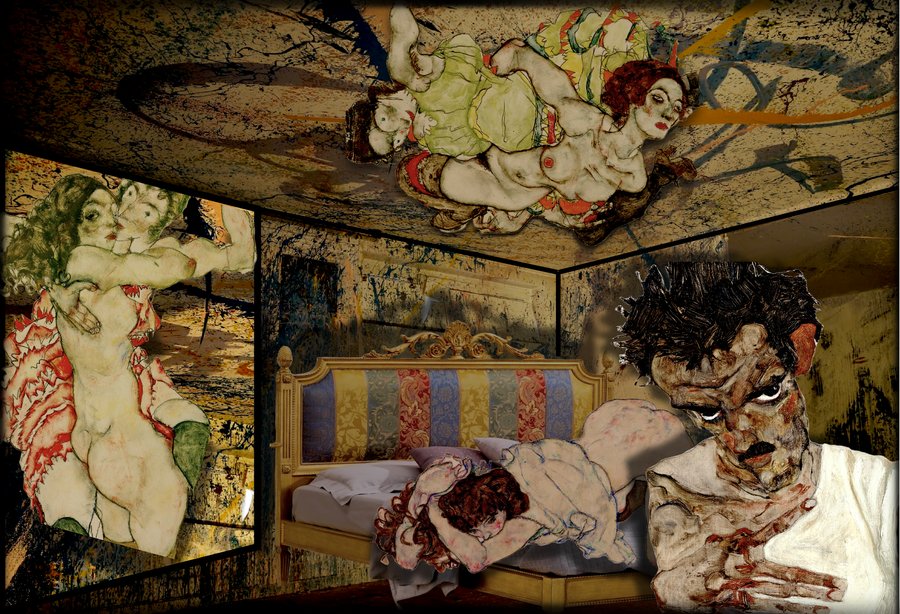
The Austrian painter Egon Schiele is famous — some would say infamous — for the disturbing intensity of his contorted nude bodies and the raw sexuality of his paintings, many of them self-portraits. An important figurative painter of the 20th century, he produced over 3,000 works on paper and some 300 paintings, often considered shocking for an eroticism entirely without romantic disguise.
His jagged lines and heightened color combinations mark him as one of the first champions of Austrian Expressionism, which rejected conventional standards of beauty in favor of ugliness and raw, sometimes exaggerated emotion. Gustav Klimt, an established artist and a generous mentor to emerging talent, took a particular interest in the young Schiele after meeting him in 1907. We close with Schiele's own words, which sum up his entire poetics: ‘Even erotic works of art possess sacredness.’ Like other ‘cursed’ artists, Schiele too died young, felled by the influenza known as the ‘Spanish flu,’ which between 1918 and 1920 caused some fifty million deaths worldwide — more than all the casualties of the First World War that had just ended.
Il pittore austriaco Egon Schiele è famoso, per alcuni famigerato, per l'intensità disturbante dei suoi corpi nudi contorti e per la cruda sessualità dei suoi dipinti, molti dei quali autoritratti. Importante pittore figurativo del Novecento, creò oltre 3.000 opere su carta e circa 300 dipinti, spesso considerati scioccanti per un erotismo del tutto privo di travestimenti romantici.
Le sue linee frastagliate e gli accostamenti cromatici accentuati lo identificano come uno dei primi campioni dell'espressionismo austriaco, che rifiutava gli standard convenzionali di bellezza in favore della bruttezza e di emozioni crude, talvolta esagerate. Gustav Klimt, artista affermato e generoso mentore di nuovi talenti, si interessò particolarmente al giovane Schiele dopo averlo incontrato nel 1907. Concludiamo con le parole di Schiele, che riassumono l'intera sua poetica: ‘Anche le opere d'arte erotiche possiedono sacralità.’ Come altri artisti ‘maledetti’, anche Schiele morì giovane, colpito dall'influenza detta ‘spagnola’, che tra il 1918 e il 1920 causò circa cinquanta milioni di morti nel mondo — più di tutte le vittime della Prima guerra mondiale appena conclusa.
Itinerant Brothel
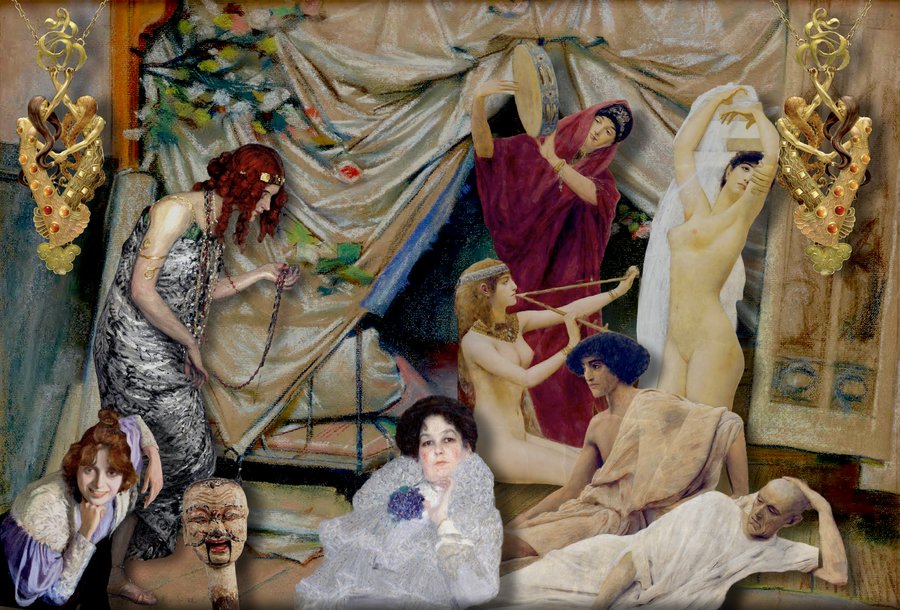
The young woman looking out at us from the bottom left was painted by the Spanish artist Santiago Rusiñol, co-owner of the famous art café ‘Els Quatre Gats’ (Four Cats), a meeting place for Barcelona's leading artists, architects, writers and musicians — encounters through which Modernisme and Symbolism took firm root in Spanish painting. Also on the left, the standing red-haired woman is Elli Forssell, wife of the painter Jānis Rozentāls, the first Latvian painter included in the UNESCO calendar honoring the birth anniversaries of major cultural figures.
The nudes at the center are the work of Gustav Klimt, the Viennese artist whose elegant, sensual, decorative style helped define Art Nouveau. The collage's title was suggested by an old article on the history of Swiss prostitution, from which we quote the passage that caught our attention: ‘In the territory of the old Swiss Confederacy, women offering their services worked from fixed locations: brothels, inns and public baths. Few know of the itinerant prostitutes who followed particular events, such as the Council of Basel (1431–49) or the Zurzach fairs.’ (Philipp Sarasin)
La giovane donna che ci guarda dall'angolo in basso a sinistra è stata dipinta dall'artista spagnolo Santiago Rusiñol, comproprietario del famoso caffè artistico ‘Els Quatre Gats’ (I Quattro Gatti), luogo d'incontro dei principali artisti, architetti, scrittori e musicisti di Barcellona — incontri grazie ai quali il Modernismo e il Simbolismo si radicarono saldamente nella pittura spagnola. Sempre a sinistra, la donna in piedi con i capelli rossi è Elli Forssell, moglie del pittore Jānis Rozentāls, primo pittore lettone inserito nel calendario UNESCO che celebra gli anniversari di nascita delle maggiori personalità della cultura.
I nudi al centro sono opera di Gustav Klimt, l'artista viennese il cui stile elegante, sensuale e decorativo contribuì a definire l'Art Nouveau. Il titolo del collage ci è stato suggerito da un vecchio articolo sulla storia della prostituzione svizzera, di cui riportiamo il passaggio che ci aveva incuriosito: ‘Nel territorio della vecchia Confederazione Elvetica, le donne che offrivano i loro servizi lavoravano in luoghi fissi: postriboli, osterie e bagni pubblici. Pochi sanno del fenomeno delle prostitute itineranti, che operavano al seguito di eventi particolari come il Concilio di Basilea (1431-49) o le fiere di Zurzach.’ (Philipp Sarasin)
Joy, Splendor and Prosperity
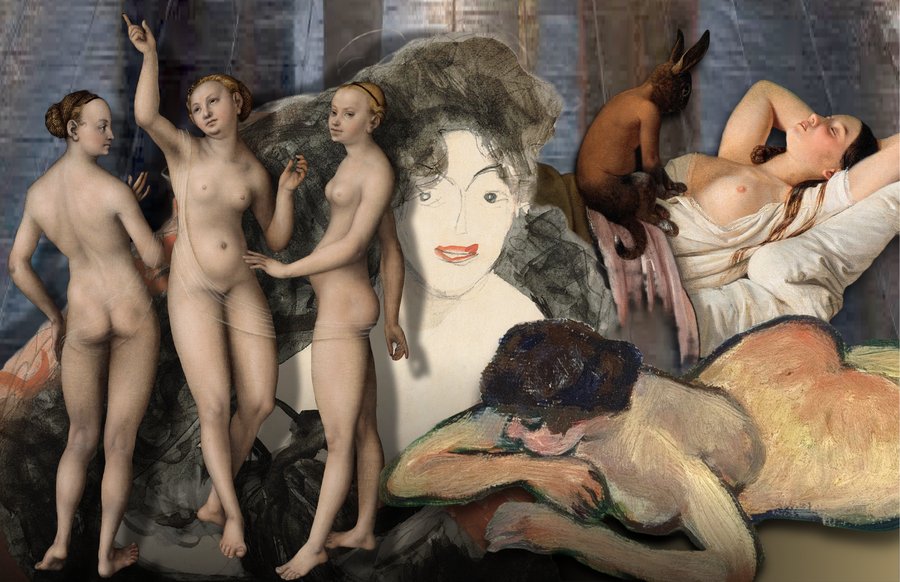
The subject of our collage is the Three Graces, painted by the German artist Lucas Cranach the Elder in 1535. Daughters of Zeus, the three maidens embody feminine beauty and grace; the Greek poet Hesiod handed down their names to us — Joy, Splendor and Prosperity. The Graces became popular during the Renaissance, amid a renewed fascination with antiquity, and Cranach captures that fascination in their entirely natural sensuality.
From the ancient Greeks and Romans through to modern art, the Three Graces have remained a recurring theme, always depicted in their nudity regardless of shifting styles — sensual or pure, graceful or imposing, they have crossed the centuries without losing their feminine charm. In the collage, three further beauties join them: the face in the foreground is a study by the Austrian Gustav Klimt for his 1908 portrait of the biblical heroine Judith; facing her, stretched out on the ground, a model painted by the Frenchwoman Suzanne Valadon in 1919; and in the background, a sleeping woman about to be woken by a nightmare embodied in a strange creature perched on her. That provocative image, painted in 1846 by the German Ditlev Blunck, aimed to unmask the bourgeois hypocrisy that professes scandal by day at the very nudity it craves by night.
Il soggetto del nostro collage sono le Tre Grazie, dipinte dal tedesco Lucas Cranach il Vecchio nel 1535. Figlie di Zeus, le tre fanciulle incarnano la bellezza e la grazia femminile; il poeta greco Esiodo ci ha tramandato i loro nomi: Gioia, Splendore e Prosperità. Le Grazie divennero popolari durante il Rinascimento, in un rinnovato interesse per il mondo antico, e Cranach ne coglie il fascino in una sensualità del tutto naturale.
Dagli antichi Greci e Romani fino all'arte moderna, le Tre Grazie sono state un tema ricorrente, sempre raffigurate nella loro nudità nonostante le variazioni negli stili — sensuali o pure, aggraziate o imponenti, hanno attraversato i secoli senza mai perdere il loro fascino femminile. Nel collage, altre tre bellezze si uniscono a loro: il volto in primo piano è uno studio dell'austriaco Gustav Klimt per il ritratto del 1908 dell'eroina biblica Giuditta; di fronte a lei, sdraiata a terra, una modella dipinta dalla francese Suzanne Valadon nel 1919; sullo sfondo, una donna dormiente sta per essere svegliata da un incubo incarnato da una strana creatura che le siede sopra. Quell'immagine provocatoria, dipinta nel 1846 dal tedesco Ditlev Blunck, intendeva smascherare l'ipocrisia borghese che di giorno finge di scandalizzarsi della nudità che brama di notte.
Klimt never seen
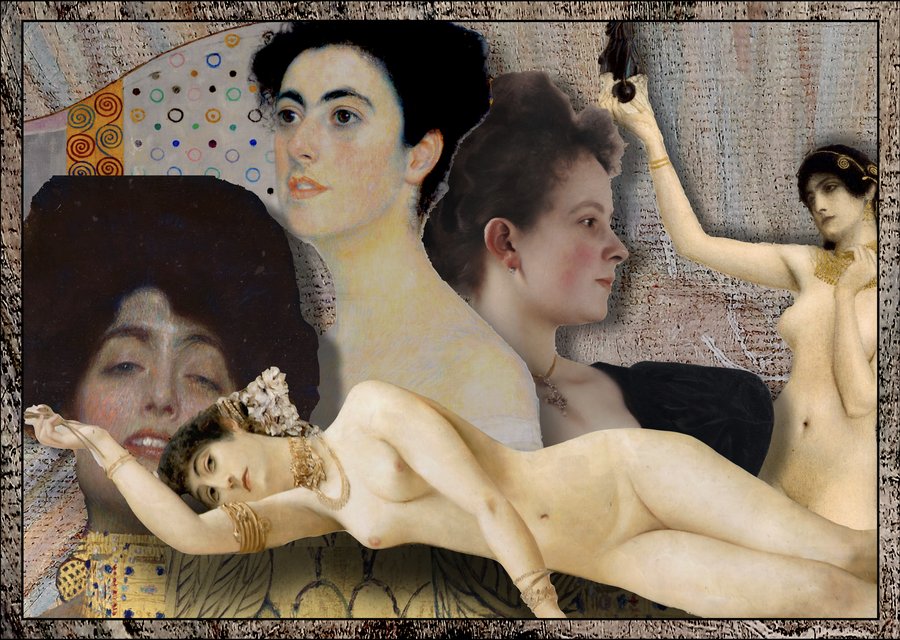
Gustav Klimt (1862–1918) is certainly one of the most iconic artists of all time. His work continues to fascinate generation after generation, above all for its depictions of sensual women wrapped in elaborate, gilded geometric decoration. Throughout his life Klimt was fascinated by women, painting them in every possible way; it's said he loved surrounding himself with nude models in his studio even when not painting, simply to study their movement, the sinuousness of their bodies, their gaze.
The erotic charge running through his entire output made him an easy target for critics such as the architect Adolf Loos, a forerunner of modernism, who accused him of an ‘erotic pollution’ that ruined his paintings. ‘Klimt's great merit was to represent women in a new and personal way, normalizing female nudity. Even in his most daring poses, he is never vulgar, keeping always a sense of intimacy, sensuality, naturalness and, at times, tenderness — taking his idea of eroticism from the Japanese, where erotic tension lives in the interplay between what is shown and what is hidden.’ (Monica Marcoleoni) Eroticism in art has taken countless other forms across cultures and eras, but for many, Klimt remains unsurpassed — fittingly so, for an artist who claimed that ‘all art is erotic.’
Gustav Klimt (1862–1918) è certamente uno degli artisti più iconici di tutti i tempi. La sua produzione continua ad affascinare intere generazioni, soprattutto per la rappresentazione di donne sensuali avvolte in elaborate decorazioni geometriche, spesso dorate. Per tutta la vita Klimt fu affascinato dalle donne, dipingendole in ogni modo possibile; si dice amasse circondarsi di modelle nude nel suo atelier anche quando non intendeva dipingere, ma solo studiarne i movimenti, la sinuosità dei corpi, lo sguardo.
La componente erotica che percorre tutta la sua produzione lo rese un facile bersaglio per critici come l'architetto Adolf Loos, precursore del modernismo, che lo accusò di un ‘inquinamento erotico’ che rovinava i suoi quadri. ‘Il grande merito di Klimt è stato quello di rappresentare le donne in modo nuovo e personale, normalizzando la nudità femminile. Anche nelle pose più audaci non è mai volgare, mantenendo sempre un sentimento di intimità, sensualità, naturalezza e, a tratti, tenerezza — prendendo l'idea di erotismo dai giapponesi, dove la tensione erotica vive nel gioco tra ciò che è visibile e ciò che è nascosto.’ (Monica Marcoleoni) L'erotismo nell'arte ha assunto molte altre forme in culture ed epoche diverse, ma per molti Klimt rimane insuperato — e non potrebbe essere altrimenti per un autore che sosteneva che ‘tutta l'arte è erotica’.
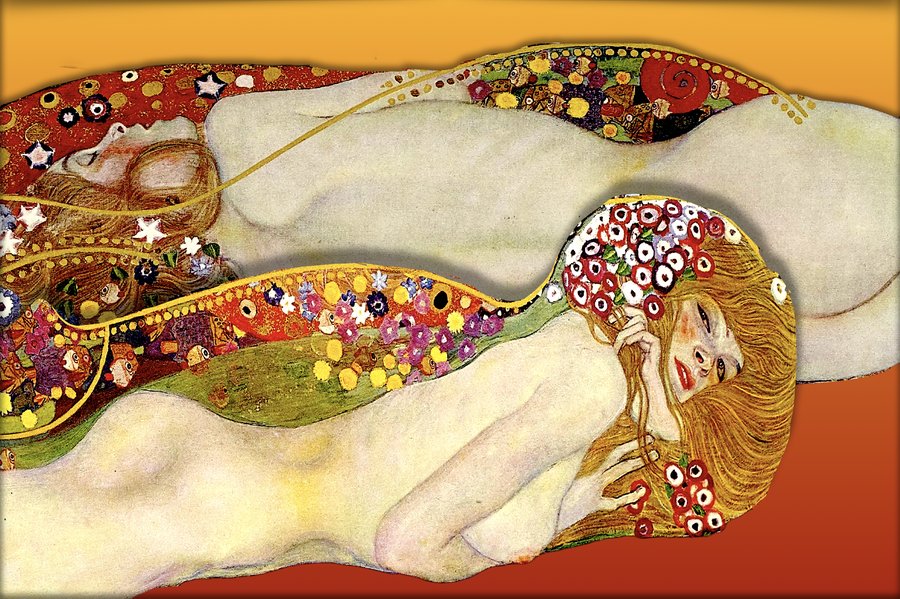
Klimt's Water Snakes
The central years of Klimt's output fall in the 1910s, in a Vienna alive with cultural ferment, shaken by Freud's discovery of the unconscious and unsettled by the centrality sexuality assumed in the theories of the father of psychoanalysis. These ideas deeply shaped the artist's own poetics, in which the female body asserts itself forcefully as protagonist, relegating men to a marginal role in his iconography.
His women appear at times proud and cruel, at times sensual and self-aware, but above all superior to men because — unlike them — capable of procreation, of surrendering fearlessly to love and to sexual passion; a thought echoing Lou von Salomé, ‘the Russian woman with revolution in her heart,’ as the psychoanalyst Cesare Musatti once called her. ‘Klimt's credit is certainly to have liberated female sexuality, making it one of his central themes, recounting it explicitly while veiling it in mystery and suffering — what place more fitting than art to express humanity's most hidden, unconscious drives, and to study that strange creature, woman, capable of atrocious cruelty yet also of loving and giving herself without restraint.’ (Valentina Grispo)
Gli anni centrali della produzione di Klimt sono gli anni Dieci del Novecento, in una Vienna in grande fervore culturale, scossa dalla scoperta freudiana dell'inconscio e turbata dalla centralità che la sessualità assume nelle teorie del padre della psicoanalisi. Queste teorie influenzano profondamente la poetica dell'artista, in cui il corpo femminile si impone prepotentemente come protagonista, relegando l'uomo a un ruolo marginale nel suo repertorio iconografico.
Le sue donne appaiono a tratti fiere e crudeli, a tratti sensuali e consapevoli, ma soprattutto superiori all'uomo perché, a differenza di lui, capaci di procreare, di abbandonarsi senza paura all'amore e alla passione del rapporto sessuale; un pensiero che richiama Lou von Salomé, ‘la donna russa con la rivoluzione nel cuore’, come la definì lo psicoanalista Cesare Musatti. ‘Il merito che va riconosciuto a Klimt è certamente quello di aver liberato la sessualità femminile, facendone uno dei suoi temi centrali, raccontandola esplicitamente e al tempo stesso velandola di mistero e sofferenza — quale luogo più appropriato dell'arte per esprimere le pulsioni più nascoste e inconsce dell'umanità, e per studiare quella strana creatura che è la donna, capace di crudeltà atroci ma al tempo stesso di amare e donarsi senza freni.’ (Valentina Grispo)
Artistic Nudes is part of Blu Artworks' wider body of work — 577 original SIAE-registered collages in total. Explore the Artistic Nudes fa parte del lavoro più ampio di Blu Artworks — 577 collage originali registrati SIAE in totale. Esplora la Full GalleryGalleria Completa.